National Cocoa Day
When the Spanish broke into the storerooms of Tenochtitlan in 1519, they found one chamber stacked with what they took for shrivelled almonds. There were, by some accounts, close to a billion of them, and they were not food in the ordinary sense — they were money. The ninth Aztec ruler, Montezuma, kept that hoard of cacao beans as a treasury, and reportedly drank a bitter, spiced chocolate from golden cups several times a day, believing it gave him strength. National Cocoa Day, observed on 13 December, lands in the cold heart of the northern winter and toasts the drink that descends, by a long and unlikely route, from that vault: a mug of hot cocoa, sweetened and smoothed and stripped of every menace the Aztecs would have recognised.
A bean worth more than gold
The cacao tree, Theobroma cacao, will not grow in the dry highland basin where the Aztecs built their capital, so every bean in Montezuma’s storeroom had been carried up from the humid lowlands of the south as tribute or trade. That scarcity made it precious. In the markets of Mesoamerica a single ripe bean had a fixed exchange value — period sources record prices such as a rabbit or a few tomatoes reckoned in beans — and the Aztecs paid taxes, tribute and wages in cacao. Because the currency was edible, it was also counterfeited: dishonest traders would hollow out a bean and pack the shell with mud, the original adulterated banknote.
The drink itself, xocolatl, bears almost no resemblance to the sweet beverage of 13 December. It was unsweetened, often laced with chilli, achiote and vanilla, and whisked or poured between vessels to raise a thick foam that was the most prized part. It was the preserve of priests, nobles and warriors, a ceremonial and even ritual substance rather than an everyday comfort. The botanist Linnaeus, naming the genus in 1753, reached for the Greek and called it Theobroma — “food of the gods” — which is one of the few cases where a scientific name agrees entirely with the people who got there first.
The long road to a soluble powder
Cacao crossed the Atlantic in the sixteenth century and the Spanish, predictably, added sugar. For two hundred years European chocolate was a luxury drink of the wealthy, served in dedicated chocolate houses that doubled as social clubs — London’s White’s, founded in 1693, began life as a chocolate house before it became the famous gambling establishment. Yet the drink remained a problem to make: the natural bean is roughly half cocoa butter, so the beverage was greasy, heavy and prone to separating into an oily scum that had to be skimmed or beaten back in. It was rich in every sense and difficult to love by the mugful, which is partly why it stayed a sipped indulgence rather than the everyday drink it would later become.
The decisive break came in the Netherlands. In 1828 the Amsterdam chemist Coenraad Johannes van Houten patented a hydraulic press that squeezed much of the fat out of roasted, ground beans, dropping the cocoa-butter content from around 53 per cent to about 27 and leaving a dry cake that could be milled into a fine, light powder. Van Houten also treated the powder with alkaline salts — the process still called “Dutching” — which cut the harsh acidity, darkened the colour and made it dissolve cleanly in hot liquid. For the first time, anyone could stir a spoonful into hot milk and have a smooth drink rather than a fatty sludge. The modern mug of cocoa is, quite literally, van Houten’s invention; the leftover cocoa butter, meanwhile, would soon be recombined with sugar and cocoa solids to make the first solid eating chocolate. The same restless nineteenth-century food science that gave us soluble cocoa also turned distant tropical crops into household staples, the kind of quiet revolution that sits behind days like Brazilian National Cocoa Day, which honours one of the great cacao-growing economies of the modern world.
Why a warm cup endures
There is a reason hot chocolate clusters in the calendar around the solstice rather than at any other time. The drink does something almost no other does at once: it is sweet, it is fatty, it is warm, and it carries a trace of theobromine and caffeine, a mild stimulant pairing peculiar to cacao. Put together, those qualities make it the archetypal cold-weather restorative, the thing handed to a child who has come in frozen from the snow. The pleasure is partly chemical and partly ceremonial, and the two are hard to separate.
It is worth keeping the supply chain in view as well. The cacao that ends up in a December mug is grown overwhelmingly by smallholder farmers in the tropics, with the Ivory Coast and Ghana between them producing well over half the world’s beans — a striking inversion of the geography that began with a tree native only to the Americas. The drink that warms a kitchen in the dark of winter is the end point of a journey that crosses the equator twice.
That same cocoa butter pressed out of the bean is what makes chocolate melt at body temperature, and it is the reason cocoa is the rare flavour equally at home hot and frozen — the warming December mug has a midsummer twin in the chocolate scoop honoured on National Ice Cream Day. One bean, two opposite seasons, held together by the peculiar physics of a fat that is solid in the hand and liquid in the mouth.
How the cup is taken
In Spain and across much of Latin America, the chocolate is so thick it is barely a drink at all: chocolate a la taza, almost a sauce, served for dunking churros at a café counter, often first thing in the morning. Italy’s cioccolata calda is similarly dense, thickened with cornflour until a spoon will nearly stand in it, while the French keep a more refined chocolat chaud made by melting good chocolate into hot milk. In Mexico, the old spiced tradition never died — chocolate is still flavoured with cinnamon and sometimes chilli, frothed with a carved wooden whisk called a molinillo spun between the palms. North America took the opposite tack, leaning into the powder-and-marshmallow version that van Houten’s invention made possible, the camping-trip and after-sledging cup; the small foil sachet of instant cocoa, just-add-water, is the furthest descendant of Montezuma’s golden goblet. The Dutch themselves, fittingly, keep cocoa close to their breakfast in the form of hagelslag, chocolate sprinkles strewn over buttered bread — a reminder that the country which industrialised the bean never stopped finding new ways to eat it.
What the mug stands for
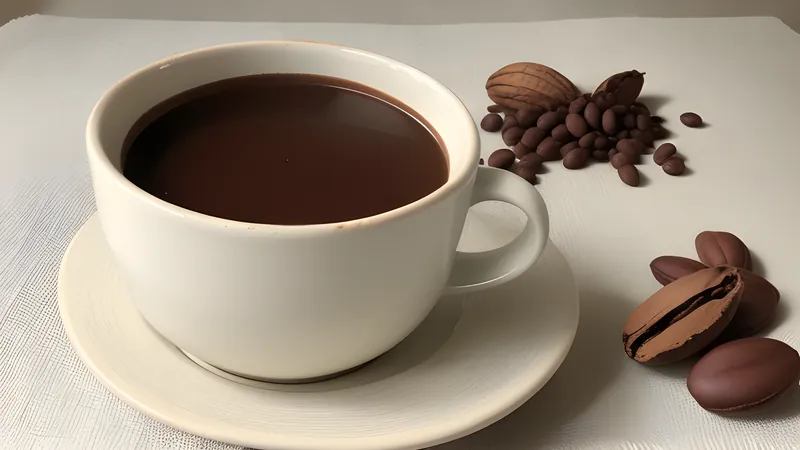
The image the day trades on is unmistakable: a steaming mug topped with marshmallows, perhaps a dusting of cinnamon or a candy cane hooked over the rim. It belongs to a whole grammar of winter comfort — log fires, frosted windows, the pause between coming in from the cold and warming up. The cocoa pod itself, a ridged ochre football split to reveal pale beans nested in white pulp, is the more exotic counter-image, a reminder that this most domestic of drinks begins in a rainforest. Cinnamon and nutmeg cling to it by association, the spices of the season folded into the cup.
Fun facts
- Montezuma is said to have kept a storehouse of close to a billion cacao beans and to have drunk xocolatl from golden goblets several times a day, treating the drink as a source of physical strength.
- Cacao beans were used as small change across the Aztec world, and the temptation was so great that forgers hollowed out beans and refilled the shells with mud — counterfeit currency you could, in theory, eat.
- The genus name Theobroma, coined by Linnaeus in 1753, means “food of the gods” in Greek, an unusually poetic choice for a botanical classification.
- Until Coenraad van Houten’s 1828 press removed half the fat, hot chocolate was an oily, heavy drink that tended to separate; his invention is the direct ancestor of every soluble cocoa powder sold today.
- A cacao tree native solely to the Americas now has its commercial centre in West Africa, where the Ivory Coast and Ghana together grow more than half the world’s beans.
A closing reflection
There is something quietly comic in the journey from Montezuma’s treasury to a packet of instant cocoa: a substance once reserved for emperors, priests and the dead, now stirred absent-mindedly into hot water and topped with miniature marshmallows. But the line is unbroken, and the appeal at each end of it is the same. The ingredient has been sacred, currency, medicine, aristocratic indulgence and finally a child’s after-school treat, shedding meanings at each stage and gaining new ones. To drink cocoa on 13 December is to take part in a habit that has survived empires, oceans and a Dutch chemist’s press without ever losing its essential point — that on a cold, dark day there are few better things to hold in two hands than a warm cup of something sweet, and that the simplest comforts often have the longest and strangest histories behind them.
Related Content