National Chopsticks Day
In the ruins of Yin, near Anyang in Henan province, archaeologists pulled six bronze sticks from the earth of a city that fell more than three thousand years ago. Each was about twenty-six centimetres long and barely a centimetre wide, and they are the oldest chopsticks anyone has yet found, dated to roughly 1200 BC and to the dying decades of the Shang dynasty. They are slightly bent, a little corroded, entirely unglamorous, and they belong to the same unbroken lineage as the pair you might pick up on 6 February. National Chopsticks Day, observed on that date, sets aside a moment for a tool so familiar across East Asia that its quiet genius usually passes unnoticed: two slender sticks that, in a trained hand, can pluck a single grain of rice, debone a fish or lift a slippery noodle without a knife in sight.
Where they began
The bronze pair from Yin are not the beginning of the story, only its earliest hard evidence at the table. Long before them, Neolithic sites in China yielded bundles of bone sticks that scholars read as the deep ancestors of the chopstick. From a layer dated to roughly the seventh and sixth millennia BC, excavators recovered dozens of polished bone rods, and the prevailing view among Chinese archaeologists is that these were used not for eating but for cooking: stirring grain, fishing morsels out of pots of boiling water or hot oil, turning food on the fire. The hand had not yet learned to bring them to the mouth.
That shift, from hearth to bowl, seems to have happened gradually and then become entrenched. Chinese cooking favoured food cut small before it reached the pot, partly to save fuel by cooking quickly, and a cuisine of bite-sized pieces has little use for a blade at the table. The philosopher’s gloss came later: the tradition that a cultivated person keeps knives in the kitchen and away from the dining mat is often attributed to Confucian distaste for anything resembling the slaughterhouse. Whatever the cause, the sticks won out, and by the time of the great dynasties they were simply how one ate.
A king, a text, and a name that changed at sea
One of the oldest written mentions of chopsticks is also one of the most damning. The Legalist text Han Feizi, compiled in the third century BC, recalls that King Zhou, the last and most notorious ruler of the Shang, commissioned a pair of chopsticks carved from ivory. The minister Jizi is said to have despaired at the sight, reasoning that ivory chopsticks would demand jade cups, that jade cups would demand rare delicacies, and that the whole apparatus of luxury would end in ruin. The kingdom did fall, and the story survives as a parable about how a small extravagance signals a larger rot.
The word itself has its own quiet drama. The old Chinese term for chopsticks was zhù, the standard word from at least the Han dynasty onward, and for a very long stretch that was simply that. But zhù sounded uncomfortably like a word meaning “to stop” or “to halt”, an ill omen for boatmen who depended on a swift, unobstructed voyage. Among the fishing and shipping communities of the lower Yangtze, sailors began avoiding the unlucky homophone and substituting a word of opposite meaning, kuài, “fast” or “quick”. The substitution spread inland until it displaced the original almost entirely, and the modern Mandarin word, kuàizi (筷子), still carries that nautical superstition in its bones. Words like this are exactly the sort of small inheritance that International Mother Language Day exists to protect, a reminder that a tongue carries history in places no dictionary thinks to record. The character was written with a bamboo radical over the sign for “quick”, so the everyday word literally reads as something like “the quick bamboo ones”.
The English name has a parallel, if tangled, history. “Chopstick” is usually traced to Chinese Pidgin English, where “chop chop” meant “quickly” — a neat echo of kuài — though the dates do not quite line up, since that pidgin took shape only in the eighteenth century while English sailors had encountered the sticks earlier. Either way, both the Chinese and the English names settled, independently, on the idea of speed.
Across the sea and the border
From China the implement travelled, and each place that adopted it reshaped it to suit its own kitchen. In Japan chopsticks (hashi) tend to be shorter and taper to a fine point, an adaptation well suited to lifting flakes from a whole grilled fish and to picking bones from delicate flesh; lacquered and individually owned pairs are common, and disposable wooden waribashi appear at countless meals. Korea took a notably different path, favouring chopsticks of metal — historically brass or silver, now usually flattened stainless steel — paired with a long-handled spoon, since rice in Korea is often eaten with the spoon and the sticks reserved for side dishes. The metal preference is sometimes linked to the royal court, where silver was believed to tarnish in the presence of poison, a precaution that may have filtered down into the country’s distinctive cutlery. Vietnam, with its rice-centred cuisine, developed its own conventions, including the long đũa cả used to serve from the communal pot.
The disposable billions
The single greatest change to the chopstick in three thousand years is not a change to the tool at all but to how it is owned. For most of their history chopsticks were personal, durable objects, washed and reused for years. The disposable wooden pair, snapped apart at the table, is a twentieth-century invention that has since multiplied to a scale that is hard to picture. China alone is estimated to consume around eighty billion pairs of single-use chopsticks a year, and Japan a further twenty-five billion or so of its waribashi. The arithmetic of the forest behind that figure is sobering: it takes a mature poplar to make roughly five thousand pairs, and Chinese production of throwaway chopsticks is reckoned to swallow scores of acres of timber every day.
The response has been both regulatory and cultural. In 2006 China imposed a tax on disposable chopsticks specifically to curb the waste, and in Japan a “my-hashi” movement encouraged diners to carry their own reusable pair, reviving exactly the personal-ownership habit the disposable version had displaced. It is a neat illustration of how an object can change character entirely while keeping its shape: the same two sticks that were once a treasured, lifelong possession became, for a few decades, the most disposable thing on the table, and are now being asked to become personal again.
The grammar of good manners
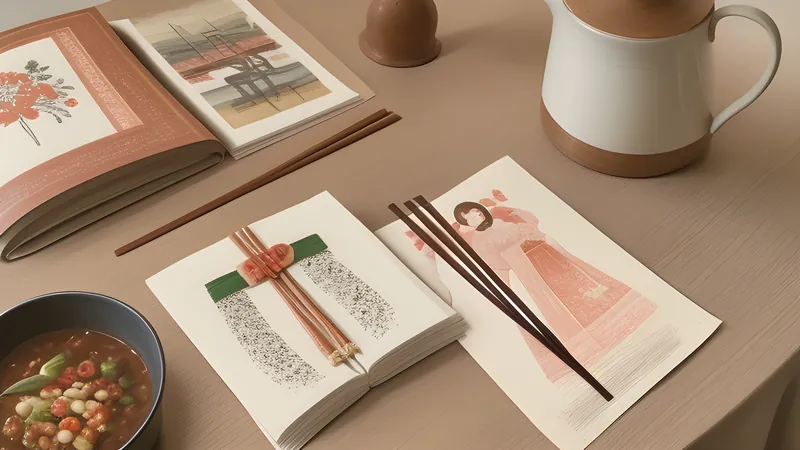
What makes chopsticks more than a tool is the dense etiquette that surrounds them, much of it shared across the region and much of it concerned with death. Standing a pair upright in a bowl of rice is a serious breach almost everywhere, because that is precisely how rice is offered to the dead at a funeral altar, the sticks planted like incense. Passing food directly from one person’s chopsticks to another’s is likewise avoided in Japan, where it recalls the ritual of transferring cremated bones between mourners with chopsticks. Pointing with them, drumming them on the bowl like a beggar, spearing food rather than gripping it, or rummaging through a shared dish all carry their own degrees of rudeness. The chopstick rest, the small ceramic or wooden support that keeps the tips off the table, is a refinement that grew directly out of this concern for propriety. Decorated pairs, meanwhile, make popular gifts: in Chinese custom a matched set can stand for a couple’s union, since two sticks must work together to be of any use at all. That a humble daily utensil should carry so much ritual weight is not unusual — the same is true of the ritual around hospitality marked by World Arabic Coffee Day, where the way a thing is served matters as much as the thing itself.
Fun facts
- The earliest chopsticks were cooking gear, not cutlery — Neolithic Chinese sites yielded polished bone rods thought to be used for stirring pots and fishing food out of boiling water thousands of years before anyone ate with them.
- The modern Mandarin word kuàizi exists because superstitious boatmen on the Yangtze refused to say the old word zhù, which sounded like “stop”; they swapped in kuài, “fast”, to wish their voyage a speedy passage.
- The Han Feizi records that King Zhou of Shang had chopsticks made of ivory, and a minister read this single luxury as an omen that the dynasty would collapse — which, in the telling, it duly did.
- Korean chopsticks are typically metal partly because of a court belief that silver would change colour on contact with poison, leaving a king’s table protected by its own cutlery.
- The world’s oldest surviving chopsticks are bronze, about twenty-six centimetres long, and were dug from the ruins of the Shang capital at Anyang, dated to around 1200 BC.
A closing reflection
There is a particular kind of intelligence in a tool that has barely changed in three thousand years. The bronze pair from Yin would feel entirely usable at a table tonight, which is more than can be said for almost any other object of comparable age. That continuity is the real marvel of 6 February: not that chopsticks are old, but that they were got right so early and so completely that improvement has had little to offer since. To eat with them is to repeat, almost exactly, a gesture made by people who watched the Shang dynasty rise and fall — a small, daily act of inheritance that asks nothing of us but a steady hand.
Related Content