National Cheesesteak Day
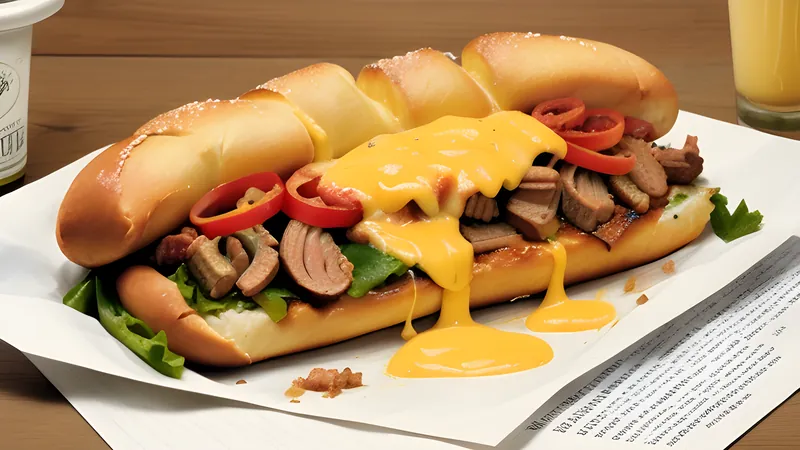
In 1930, at a hot-dog cart standing where 9th Street meets Wharton Street and Passyunk Avenue in South Philadelphia, two Italian-American brothers named Pat and Harry Olivieri changed their lunch and, by accident, their lives. Pat fancied something other than the frankfurters he sold all day, sent for some beef scraps from the butcher, griddled them with onions and folded the lot into a hot-dog roll. A passing cab driver smelled it, demanded one of his own, ate it, and told the brothers to stop selling hot dogs. National Cheesesteak Day, observed each year on 24 March, honours that improvised meal and the sandwich it became: thinly sliced beef, griddled tender, heaped into a long soft roll and finished with melted cheese.
The cheese came later
The detail that surprises people is that the original sandwich had no cheese at all. For its first decade the Olivieri creation was simply beefsteak on a roll, and a very good one. Cheese entered the story in the 1940s, when a manager at the Olivieris’ Ridge Avenue location reportedly laid provolone over the meat. The combination caught, the name followed the addition, and a steak sandwich became a cheesesteak.
The other defining ingredient arrived later still. Cheez Whiz, the bright, pourable processed cheese that now seems inseparable from the dish, did not exist until 1952 and only made its way onto the griddle through the 1950s. Frank Olivieri, Pat’s nephew, said plainly in a 1985 interview that the shop used Whiz because it was fast: it clung to the hot meat instantly, with no waiting for a slice to melt. The most “authentic” cheesesteak topping, in other words, is a mid-century industrial product younger than the sandwich it crowns.
A rivalry across one intersection
What turned a local favourite into a civic emblem was competition. Pat’s stand grew into Pat’s King of Steaks, anchored at the corner where the cab driver placed his order. Then, in 1966, Geno’s Steaks opened directly across the street, and the intersection of 9th and Passyunk became something close to a pilgrimage site, two neon-drenched institutions glaring at one another around the clock. The feud has always been more theatre than war, but it gave Philadelphia a stage on which to perform its devotion, and it gave visitors a clear instruction: pick a side, then defend it.
Through the twentieth century the sandwich spread outward as Philadelphians carried their cravings across the country, and the cheesesteak hardened into shorthand for the city itself, photographed by tourists and demanded by visiting dignitaries who quickly learned that ordering one badly could become a small public humiliation.
The roll that holds it together
Philadelphians will tell you, with some justification, that the bread is half the sandwich. The city’s cheesesteaks are built on long Italian-style hoagie rolls, and the most revered of them come from a handful of local bakeries, with Amoroso’s the name invoked most often. The ideal roll has a thin, faintly crisp crust giving way to a soft, airy interior, sturdy enough to soak up the meat juices and cheese without turning to paste or splitting at the seam. It is no accident that the sandwich arose in a city with a deep Italian-American baking tradition; the same neighbourhoods that produced the Olivieris produced the bread their invention required. Exported cheesesteaks frequently fail not on the beef but on the roll, because a baguette is too crusty and a soft burger bun too flimsy to do the job. Get the bread wrong and even perfect meat collapses into a soggy disappointment.
The order, and the cheese question
Part of the cheesesteak’s charm is its compressed ordering language, developed to keep the line moving at a busy window. “Whiz wit” means Cheez Whiz with onions; “provolone witout” means provolone and hold the onions. Fumble the rhythm and you mark yourself as an outsider. The choice of cheese is a genuine and unending point of contention. Cheez Whiz is prized for the way it coats the meat and seeps into every crevice; provolone offers a sharper, more grown-up note; American cheese sits in the mild, melting middle. There is no settled verdict, only loyalties, and two locals can sustain a long and cheerful argument over which is correct without ever convincing each other.
How the day is marked
On 24 March, sandwich shops and delicatessens across the United States run specials and trade good-natured boasts about who makes the definitive version. In Philadelphia the day verges on a civic holiday, with queues forming early and feeds filling with photographs of dripping rolls. Elsewhere, home cooks take up the challenge: hunting down ribeye to shave thin, sourcing a roll that will hold the filling, debating whether their effort could survive a head-to-head with the originals. For a good few the date is simply the nudge they needed to seek out a cheesesteak they had been meaning to try.
Making a good one
The craft is more exacting than it looks. The beef is traditionally ribeye, partly frozen so it shaves into thin sheets, then thrown onto a screaming-hot griddle and chopped with the spatula’s edge as it browns. The roll matters enormously; Philadelphians prize the airy, faintly chewy hoagie rolls of local bakeries, sturdy enough to carry the filling without dissolving. Onions are cooked low and slow until sweet, and the cheese goes on at the last moment so it melts into the meat rather than perching on top. Restraint is the secret weapon. Pile on too much and the balance that makes the sandwich sing is buried under its own toppings. The onions deserve a note of their own, because they divide cooks as sharply as the cheese does. Some griddle them until barely translucent so they keep a faint crunch; others cook them down for the best part of an hour until they collapse into sweet, jammy strands that almost melt into the meat. Mushrooms and sweet peppers are common additions in shops outside the two famous corners, though purists regard anything beyond beef, cheese and onion with suspicion. The order in which the elements hit the griddle matters too, since the meat must be chopped and folded around the cheese while everything is still hot enough to bind into a single mass rather than a loose pile. The same discipline of doing a few cheap ingredients perfectly governs other griddle-and-fryer classics, from a well-built basket of loaded cheddar fries to the broader argument about what counts as proper comfort food.
Beyond Philadelphia, and the political peril
Though unmistakably American, the cheesesteak has travelled, turning up on menus far from Pennsylvania and inspiring endless regional riffs adapted to local cheeses and breads, with chicken versions common for those wanting something lighter. Purists wince, but the spread only confirms the appeal of a warm, savoury, hand-held thing that crosses borders without fuss, in the same spirit of portable, fiercely defended national pride that surrounds dishes like carbonara in their home cities.
Closer to home, the sandwich has acquired a peculiar role in American politics. Candidates campaigning in Philadelphia are expected to eat one, and to eat it correctly, and several have been mocked for years over a wrong cheese or an over-fussy order. The cheesesteak has, improbably, become a small test of authenticity in a city that takes the question seriously.
The economics of an icon
There is a quiet lesson in the cheesesteak’s origins that the neon and the queues tend to obscure. It was, from the first, a way of turning the cheapest cut into something people would line up for. Pat Olivieri did not send for prime steak; he sent for scraps, and the genius lay in shaving and griddling them so fast that toughness never had a chance to assert itself. The thin slicing is not a flourish but a solution, exposing maximum surface to the hot iron so the beef browns and tenderises in seconds. That frugal cleverness is why the sandwich could be sold for pocket change to dock workers and cab drivers in Depression-era Philadelphia, and why it spread first through working neighbourhoods rather than down from fashionable restaurants. The dish that visiting senators now eat for the cameras began as a way to feed people who could not afford anything grander, which is perhaps the most Philadelphian thing about it.
Fun facts
- The original 1930 cheesesteak had no cheese; it was plain griddled beef on a roll for roughly a decade before provolone was added in the 1940s.
- Cheez Whiz, now treated as the classic topping, was not invented until 1952, making it younger than the sandwich it tops.
- Pat’s and Geno’s stand on opposite corners of the same South Philadelphia intersection, their neon signs visible from one another since 1966.
- The clipped ordering shorthand (“whiz wit”, “provolone witout”) is partly a crowd-control device, designed to keep a fast-moving line from stalling.
- A botched cheesesteak order has genuinely become campaign-trail news in Philadelphia, where the sandwich doubles as a loyalty test for visiting politicians.
A closing reflection
The cheesesteak began as one man’s restlessness with his own lunch menu, and it ended as a symbol a whole city polices. There is something instructive in that arc: the most cherished traditions are rarely the products of planning, and the things people defend most fiercely often started as the cheapest thing on the cart. A sandwich built from beef scraps and a hot-dog roll became a test of belonging, which says less about the meat than about how readily we attach ourselves to the food of a place we love.
Related Content