National Carbonara Day
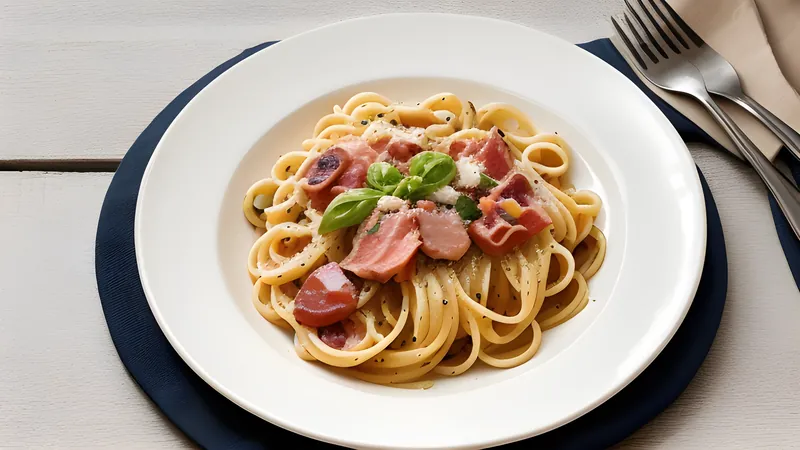
On 22 September 1944, in the newly liberated seaside town of Riccione, a young Italian cook named Renato Gualandi was asked to feed the officers of the British Eighth Army and the American Fifth Army, who had just met to mark the end of the fighting along that stretch of coast. He had little to work with except what the Allies carried: superb bacon, tinned cream, some cheese and powdered egg yolk. He combined them with pasta, and the result was so well received that he kept cooking for Allied troops in Rome until April 1945. The dish he improvised that autumn is, by the most credible account we have, the ancestor of carbonara. National Carbonara Day, observed each year on 6 April, celebrates this glossy, peppery Roman pasta and the unlikely story of how a handful of military rations became one of Italy’s most fiercely defended recipes.
Where the dish actually comes from
Carbonara is, by the standards of Italian cooking, astonishingly young. There is no mention of it in the great regional cookbooks of the nineteenth century, and even Ada Boni’s celebrated 1930 guide to Roman cuisine does not include it. Its absence from the record before the Second World War is itself a kind of evidence: a dish this beloved would have left earlier fingerprints had it existed.
The wartime theory built on Gualandi’s improvisation is the one most food historians now take seriously, precisely because it explains the ingredients. Cured pork, eggs and hard cheese were exactly what American supply lines delivered in 1944 and 1945, and Rome at that moment was a city of shortages where such bounty would have been transformative. The popular folk explanation, that the dish was named for the carbonari, the charcoal-burners of the Apennines, who supposedly cooked it over open fires, is charming but unsupported by any document. The cracked black pepper that flecks the finished plate is sometimes offered as a poetic stand-in for charcoal dust, which tells you how much the story relies on imagination rather than archive.
How the recipe settled
The first carbonara recipe printed in Italy appeared in 1954, in the magazine La Cucina Italiana, and it would horrify a modern Roman purist: it called for pancetta, garlic and Gruyère. The dish was clearly still finding itself. Over the following decades it hardened into the canon now defended so vigorously, anchored on five ingredients and nothing else: pasta, egg, Pecorino Romano, guanciale and black pepper.
That codification matters because carbonara became, in the postwar decades, a point of culinary identity for Rome, set alongside the city’s other great pasta dishes. It belongs to a closely related family: cacio e pepe (cheese and pepper), gricia (guanciale and Pecorino) and amatriciana (gricia plus tomato). Seen this way, carbonara is essentially gricia with egg folded through, a small genealogy that any cook curious about the dish’s logic can taste their way around in an afternoon.
The no-cream argument
No subject divides carbonara cooks more sharply than cream, and the surprising truth is that the authentic Roman version contains none. The silkiness comes entirely from an emulsion: warm egg yolk loosened with a little starchy pasta water, the cheese melting into it, the residual heat of the pasta thickening the lot into a sauce that coats each strand without setting into scrambled curds. Cream is a foreign insurance policy, added abroad to make the result more forgiving, and the moment you understand the emulsion you no longer need it.
This is why carbonara is best understood as a technique rather than a list. The window between glossy sauce and ruined egg is narrow and unforgiving. Romans cook the pasta off the direct heat, tossing the drained spaghetti with the egg-and-cheese mixture in a pan warm enough to thicken but never hot enough to cook the egg solid. Get it right and the sauce clings like a second skin; rush it and you have an omelette draped over noodles.
Why it matters
Carbonara rewards a particular philosophy that runs through much of Italian home cooking: that excellence is a matter of restraint and good raw materials rather than elaboration. There is nowhere to hide in a dish of five ingredients. The guanciale must be properly rendered, its fat the carrier of flavour; the Pecorino must be sharp and freshly grated; the eggs must be handled with respect for their fragility. A cook who can make carbonara well can be trusted with almost anything, because the dish exposes timing, heat control and judgement all at once.
There is also something democratic about it. Carbonara needs no long braise, no obscure ingredient, no special equipment. It is the food of a tired evening that nonetheless tastes like an occasion, which is a large part of why it has travelled so far from the Lazio kitchens that perfected it.
How the day is marked
On 6 April, Roman trattorias and home cooks alike treat the date as a small festival of technique. Restaurants run carbonara specials, food writers publish their definitive methods, and social feeds fill with photographs of forks lifting pale-gold strands. A good number of people use the day to attempt the strict Roman version for the first time, deliberately leaving out the cream they have always reached for. Others stage friendly taste tests between guanciale and pancetta, or between Pecorino alone and a blend with Parmigiano.
The mood is argumentative in the warmest sense. Carbonara is the rare dish where getting the details wrong in public invites correction from strangers, and the day gives everyone licence to weigh in. Much like the convivial bickering that surrounds Extra Virgin Olive Oil Day and the question of which pressing and which region make the finest oil, the carbonara debate is really an expression of affection dressed up as dispute.
Variations and their critics
Beyond Italy, carbonara has been pulled in every direction. Cream is the most common addition, but peas, mushrooms, garlic and smoked bacon all appear in versions that Romans regard with weary patience. The so-called “carbonara crisis” of 2016, when a French cooking video showed eggs being poured raw over barely cooked pasta, briefly united Italian social media in horror and showed just how protective people have become.
The variations are not without value: they are the natural fate of any dish good enough to be adopted by people who lack the original ingredients. Where guanciale is impossible to find, pancetta or even good streaky bacon stands in; where Pecorino Romano is scarce, a Parmigiano blend softens the edge. Treated honestly, as substitutions rather than improvements, these adaptations are how carbonara conquered kitchens far from Rome. A plate of well-made carbonara is, in its own way, as bound up with national pride as the pasta-and-cheese rituals that other cultures elevate into everyday comfort.
The geography of those adaptations is telling. In the United States, where Italian-American cooking matured separately from the home country, the cream-laden version became so standard that many diners have never tasted the egg-only original. In Japan, carbonara is a beloved fixture of yōshoku, the genre of Western dishes reinterpreted to local taste, frequently appearing with a glossy cream sauce and sometimes a raw yolk perched on top. Britain absorbed it through the trattoria boom of the 1960s and 1970s, when bacon and double cream were the obvious local stand-ins for guanciale and starchy water. Each country reached for what its larders held, which is precisely why no two national carbonaras taste quite alike, and why the Roman insistence on five ingredients reads, from a distance, as much like cultural self-defence as like a recipe. The same protective instinct surrounds Italy’s other exported staples, including the olive-pressing pride celebrated on Extra Virgin Olive Oil Day.
Fun facts
- The earliest credible carbonara contained no Italian ingredients at all beyond the pasta: American powdered egg, tinned cream, GI bacon and military cheese, assembled by an Italian cook in 1944.
- The first carbonara recipe published in Italy, in 1954, used Gruyère and garlic, both of which would now get a cook thrown out of any serious Roman kitchen.
- Carbonara is structurally just gricia (guanciale and Pecorino) with beaten egg added, which makes it a direct cousin of cacio e pepe and amatriciana.
- The “charcoal-burner” origin story is so unsupported that its strongest evidence is the colour of cracked black pepper against pale sauce, a coincidence elevated to legend.
- A 2016 French video showing raw egg poured over pasta provoked enough Italian outrage to be reported as a minor diplomatic incident in the food press.
A closing reflection
What lingers about carbonara is not the recipe but the smallness of the margin it asks you to manage. A few seconds of inattention turn a sauce into a scramble; a few seconds of patience turn the same ingredients into something glossy and alive. There is a quiet lesson in that, about how the most modest materials can demand the most precise attention, and how a dish born from borrowed rations in a ruined country became a thing people will argue about with strangers. To make it well is to accept that simplicity is not the same as ease.
Related Content