National Bloody Mary Day
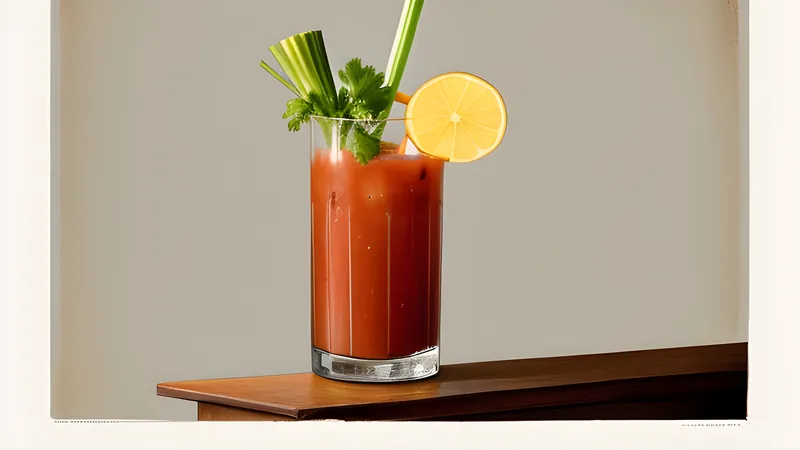
In 1934, a young French bartender named Fernand Petiot stepped behind the bar of the King Cole Room at the St. Regis Hotel in New York and began seasoning a drink that, until then, had been little more than vodka and tinned tomato juice. He added salt, black pepper, lemon, a few drops of Tabasco and a generous lash of Worcestershire sauce, partly to satisfy American customers who found the original flat. That spicier version is more or less the drink we now raise on the first morning of every year. National Bloody Mary Day falls on 1 January, and the timing is no accident of the calendar: this is the savoury cocktail with a reputation, deserved or not, as the kindest companion to a fragile head.
The Bloody Mary sits in an unusual category. It is barely a cocktail and almost a light meal, a tall glass thick with tomato, brine and heat, often crowned with a wedge of lemon, a spear of celery and, in its more theatrical forms, an entire snack bar of olives, pickles and bacon. It rewards a slow start to the year, the kind of late, unhurried brunch that 1 January was practically designed for.
Where the drink may have begun
The exact birth of the Bloody Mary is genuinely contested, and anyone claiming certainty is overstating the record. The most durable account credits Fernand Petiot, who as a teenager worked his way up from kitchen boy to bartender at the New York Bar in Paris, the establishment that later became Harry’s New York Bar under Harry MacElhone. By the early 1920s, Petiot is said to have been mixing vodka with the tinned tomato juice then newly arriving from America, serving it to an expatriate crowd. The bar’s own tradition holds that the first version was thrown together on the spur of the moment and consisted of nothing more than equal measures of the two.
A rival claim points across the Atlantic. In 1939 the columnist Lucius Beebe printed one of the earliest American references to the drink and attributed it to the actor and entertainer George Jessel, a regular at the 21 Club. Whether Petiot invented the thing outright, refined a Jessel original, or independently arrived at the same obvious pairing is impossible to settle now. What is clear is that when Petiot crossed to New York and took up his post at the St. Regis, he turned a plain mixture into a seasoned one, and that the seasoned version is the one the world adopted.
Why vodka, and why 1934
There is a reason the seasoned Bloody Mary belongs to the 1930s and not earlier. Vodka was barely available in America before then. Prohibition ended in December 1933, and in 1934 a Russian émigré named Rudolph Kunett bought the American rights to the Smirnoff name from the exiled Smirnov family and set up a small distillery in Bethel, Connecticut. For the first time, an American bartender could reach for vodka as readily as gin or whiskey. Petiot’s reworking of the drink at the St. Regis in 1934 lined up almost exactly with that moment; the cocktail was, in a sense, a solution looking for the spirit that had just arrived.
The room where he refined it has its own quiet fame. The King Cole Bar takes its name from a vast Maxfield Parrish mural, painted in 1906, depicting Old King Cole on his throne flanked by courtiers who appear to be suppressing a smile. It had originally hung in the Knickerbocker Hotel before moving to the St. Regis, and generations of New Yorkers have sipped Red Snappers beneath it while speculating about what, exactly, the king finds so amusing.
From Red Snapper to celery stalk
For years the St. Regis did not call its creation a Bloody Mary at all. The name was thought too vulgar for the hotel’s clientele, so the drink was offered as a “Red Snapper”, a genteel label that lingered for decades and survives today as the term for a Bloody Mary made with gin rather than vodka. The macabre name itself has been linked variously to Mary Tudor, the sixteenth-century English queen, and to a waitress or a Hollywood star, but none of these threads holds up under scrutiny.
The single most recognisable feature of the modern drink arrived later still, and by accident. The celery stalk is widely traced to 1960 and the Pump Room of the Ambassador East Hotel in Chicago, where a guest handed a poorly stirred Bloody Mary reportedly reached across to a relish tray, grabbed a stick of celery, and used it as a stirrer for want of a spoon. The improvisation stuck. Within a generation, a drink served without celery looked half-dressed. As vodka surged through mid-century American drinking, the Bloody Mary rose with it, settling permanently into the rituals of the hotel bar and the weekend brunch.
Why a cocktail earns its own day
A national day for a single drink might look like marketing dressed as tradition, yet the Bloody Mary occupies a more interesting corner of the culture than most. It is the rare cocktail built around customisation: no two bartenders season it the same way, and the garnish has become a kind of competitive sport. Marking the day is really a nod to craft and conviviality, to the small pleasure of a drink fussed over rather than poured.
Its New Year’s Day placement gives it a second meaning too. The first of January is the morning after the loudest night of the year, and the Bloody Mary has long worn the costume of a restorative. The medical truth is more modest, but the combination of fluids, salt and a leisurely table does a battered morning no harm at all.
How the day is kept
Celebration tends to be cheerful and informal. Bars and brunch spots build dedicated Bloody Mary menus and set up build-your-own stations where guests pick their spirit, spice level and garnish. At home, enthusiasts mix a jug to share and argue happily over the details: how much horseradish, the right ratio of citrus to brine, whether a pickled green bean outranks a celery spear. For many it marks the unofficial close of the festive season, one last indulgent brunch before ordinary life resumes on the second.
If you enjoy a day that hands a single ingredient or drink the spotlight, the calendar is generous with them. The same impulse drives US National Vodka Day, which honours the spirit at the Bloody Mary’s base, and US National Beer Lover’s Day, a reminder that the Bloody Mary’s spicier cousin, the Mexican michelada, is built on beer rather than vodka.
Variations and cousins
The non-alcoholic version, the Virgin Mary or “Bloody Shame”, lets the curious enjoy the savoury profile without the spirit. Swap the vodka and the drink changes name and character: gin makes a Red Snapper, tequila a Bloody Maria, and aquavit a Danish Mary with a caraway lilt. The michelada, seasoned with lime, chilli and savoury sauces over beer, belongs to the same family of salt-acid-heat refreshers. In Britain the Bloody Mary is a pub and brunch fixture, usually made with a confident hand on the Worcestershire; in Canada the related Caesar swaps tomato juice for clam-spiked Clamato, a substitution that baffles visitors and delights locals.
The brunch it belongs to
The Bloody Mary did not become a fixture by accident; it slotted neatly into the rise of brunch as an institution. A drink that is salty, savoury and substantial behaves quite differently from the sugary or sparkling cocktails of the evening. It pairs with eggs rather than fighting them, it forgives a late and lazy start, and its reputation as a restorative gave morning drinking a respectable cover story. By the mid-twentieth century the hotel brunch and the Bloody Mary had become so entwined that one rarely appeared without the other, and the association has only deepened in the era of the bottomless brunch and the build-your-own garnish bar. The drink’s savoury weight is also why it travels into territory no other cocktail dares: it is genuinely treated, by some, as a small meal, a glass you could in principle eat with a fork.
That same versatility explains the parade of variations. The drink tolerates, even invites, tinkering in a way a Martini never would. Adjust the heat, the brine, the spirit or the garnish and you have a different drink with a different name, yet the family resemblance, salt, acid, heat and umami in a single tall glass, holds across every one of them.
Fun facts
- The drink spent decades trading under the prim alias “Red Snapper” because the St. Regis thought “Bloody Mary” too coarse for its guests; the gin version still carries that name today.
- The now-iconic celery stalk was a piece of improvisation by a thirsty guest at Chicago’s Pump Room around 1960, not a deliberate invention by any bartender.
- The garnish arms race has produced genuinely absurd creations, with glasses topped by sliders, fried chicken, whole grilled-cheese sandwiches and skewers of prawns balanced over the rim.
- Fernand Petiot started at the Paris bar as a sixteen-year-old kitchen boy, long before he seasoned the version that made his name in New York.
- Its standing as a hangover cure is folklore rather than pharmacology, though Petiot himself reportedly thought the spices were the point of the whole thing.
A closing reflection
There is a quiet wisdom in handing the first day of the year to a drink you cannot rush. The Bloody Mary refuses to be knocked back; it asks to be sipped, adjusted, debated and lingered over. Beginnings, it seems to suggest, are best met gently, at a shared table, with a glass that doubles as breakfast and a morning that no one is in any hurry to end.
Related Content