National Best Friends Day
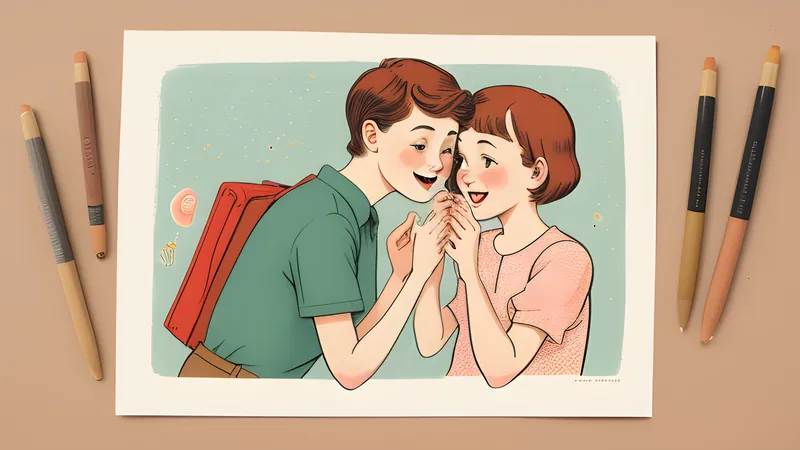
Think of the person you would call first with good news, before family, before a partner, before anyone official is told. Think, too, of the one who turns up uninvited when something has gone badly wrong, and whose company feels effortless even after months of silence. That particular bond, deeper than acquaintance and stranger than family, is what National Best Friends Day sets out to honour each 8 June. Friends rarely need a date in the calendar to matter, but the day offers a gentle nudge to pause and say so out loud, much as an anniversary marks a romantic milestone that everyone involved already knows is there.
It is deliberately narrow in focus. The day is not about the wide web of contacts and colleagues but about the small handful of people who have earned the word “best”, the ones defined not by how the friendship began but by the trust and ease that have grown inside it.
The tangled origins of celebrating friendship
The history here is messier than the tidy single-founder story these days usually carry, and worth untangling honestly. The broader idea of a friendship holiday is often traced to Joyce Hall, the founder of Hallmark Cards, who proposed a Friendship Day in 1930, originally pinned to 2 August because it fell in the longest gap between other holidays. Greeting-card firms pushed the idea through the 1920s and 1930s, but American consumers largely rejected it as a transparent commercial invention, and by the 1940s the supply of Friendship Day cards had dwindled and the observance faded at home.
A separate and more idealistic strand grew abroad. On 20 July 1958, a Paraguayan named Artemio Bracho proposed a World Friendship Day during a dinner with friends in Puerto Pinasco. His idea became the World Friendship Crusade, a civil-society movement that spent decades lobbying governments and, eventually, the United Nations to recognise friendship as a value worth marking; in Paraguay, 30 July remains a day for giving gifts to close friends.
National Best Friends Day, fixed on 8 June, is the intimate American cousin of all this. Its exact founding is not firmly documented, and much of its modern reach owes to social media, which gave people an easy, visible way to celebrate their closest companions in public. Whatever its precise beginnings, it has settled comfortably onto 8 June and is now widely kept, especially by younger generations who adopted it online.
Why close friendship is worth a day
Psychologists have spent decades establishing what most people feel instinctively: that close friendships are among the strongest predictors of wellbeing. Long-running studies of adult development have found that the quality of a person’s relationships in midlife is a better predictor of later health and contentment than wealth or fame. Friends act as sounding boards when a decision feels overwhelming, as ballast when confidence dips, and as the people with whom both burdens and good news are genuinely shared rather than merely reported.
A day set aside for this makes a quiet but real point: that these bonds, like any relationship, benefit from attention. The friendship that survives on assumption alone tends to thin over time, while the one that gets the occasional deliberate gesture endures. The same logic underpins other celebrations of human connection; the warmth of a shared pint on National Beer Day is, at its best, friendship doing exactly what it does best.
There is a harder-edged case to be made too. Researchers studying loneliness have come to treat chronic social isolation as a genuine health risk, with effects on mortality that some have compared to smoking or obesity, while strong friendships appear to buffer against stress, depression and cognitive decline in later life. Sociologists have also noted a long-term thinning of close friendships in many developed countries: surveys repeatedly find that the number of people who say they have a close confidant has fallen over recent decades, even as the number of casual online connections has soared. Against that backdrop, a day that asks people to single out and contact their closest friends is doing something more useful than it first appears. It nudges against a measurable drift towards isolation.
Friendship through the stages of life
One of the quieter truths the day highlights is that friendships change shape as life moves on. The inseparable companions of school or university often become people we see only occasionally yet still trust completely, while new friendships form through work, parenthood, shared hobbies or simple proximity, and these too can grow into the closest of bonds. Some endure unbroken for a lifetime; others fade, are rekindled, or settle into a comfortable rhythm of irregular but heartfelt contact. The value of a friendship is not measured by how often the two meet or how long they have known one another, but by the depth of understanding between them. Recognising that can ease the guilt many feel about friendships that have grown quieter with age, and encourage them to cherish such bonds for what they remain rather than mourning what has changed. The day’s greatest practical use, for a great many who keep it, is exactly this: an unforced prompt to pick the thread back up with someone who has drifted out of regular contact, no apology required, just a message asking how they are.
How people mark it
Celebrations tend to be informal and personal. Many simply send a heartfelt message, an old photograph, or a half-forgotten memory dredged up to make someone laugh. Others arrange to meet for coffee, a meal or a walk, choosing time together over any ceremony. Small gifts are common, often a favourite treat or a token referencing a private joke. On social media the day prompts a reliable wave of tributes, with people posting pictures and naming the friends they are grateful for. The spirit is warmth rather than expense, and a thoughtful word almost always outweighs anything bought. It pairs naturally with other gently humorous observances, sitting comfortably alongside the playful tone of something like International Talk Like a Pirate Day, where the whole point is shared silliness with people who get the joke.
The many forms a best friend takes
Part of the day’s charm is how loosely the title fits. For some, a best friend is a sibling or a partner; for others it is someone met at six years old whose history now stretches back decades, or a colleague who quietly became a confidant. Friendships also form late, between neighbours, fellow hobbyists, or people thrown together by chance, and these can grow into the closest bonds of all. The day makes room for every version, insisting that what matters is the depth of understanding, not the route by which it arrived.
Anthropologists who study how friendships form note that two ingredients recur almost universally: repeated, unforced time spent together, and a willingness to be vulnerable in front of one another. It is why so many lifelong friendships date to school, university or early jobs, the settings that throw people together day after day at an age when they are still figuring themselves out. As adult life grows busier and more scheduled, those conditions become harder to recreate, which is part of why making genuinely new close friends in middle age is notoriously difficult, and why holding on to the ones already made matters all the more. The friend who knew you before you had your defences fully assembled occupies a place a later acquaintance, however warm, rarely can.
How people mark the reconnection
Many treat the day primarily as a prompt to reach across a lapse in contact, and the methods are unfussy. A phone or video call tends to feel more personal than a text, while floating a future visit gives the renewed connection something concrete to build towards. The trick, most people find, is to skip the apology for lost time entirely; dwelling on the silence only makes it heavier, whereas simply picking the thread back up, with a question, a memory, an invitation, lets the friendship resume as if it had merely paused. Most friends, far from holding the gap against you, are quietly delighted to hear from someone they once spent so much of their life beside.
Not the same as International Friendship Day
It is easy to confuse this with International Friendship Day, but they are genuinely distinct. The international observance, recognised by the United Nations on 30 July, takes the broad view, promoting friendship between peoples, cultures and nations as a path to peace, the descendant of Bracho’s Paraguayan crusade. National Best Friends Day is the intimate counterpart, concerned with individual close friendships rather than friendship as a global ideal. Both encourage connection on very different scales, and nothing stops anyone marking both.
Fun facts
- The idea of a friendship holiday is often credited to Hallmark founder Joyce Hall, who proposed one in 1930, only for American consumers to reject it as too obviously a way to sell cards.
- The global strand of friendship day traces to a 1958 dinner in Puerto Pinasco, Paraguay, where Artemio Bracho proposed what became the decades-long World Friendship Crusade.
- The United Nations did not formally recognise an International Day of Friendship until 2011, more than fifty years after Bracho first floated the idea.
- One of the longest-running studies in psychology, tracking the same people for over eighty years, found that the strength of close relationships predicts late-life health better than cholesterol levels do.
A closing reflection
There is a faint irony in needing a date to remind us of the people we would, in theory, never forget, and yet the reminder works precisely because daily routine is so good at burying what matters most beneath what merely seems urgent. The friendships that grow quieter with time are not lesser for it; a message sent on 8 June is less an apology for lost contact than a small proof that the thread was never really cut.
Related Content