National Beer Day
At one minute past midnight on 7 April 1933, the doors of American breweries opened for the first time in over thirteen years, and the crowds that had queued through the night surged forward. The night before had a name, New Beer’s Eve, and the day that followed has carried weight ever since. On 7 April that year, the Cullen-Harrison Act took effect, legalising beer of modest strength after the long drought of Prohibition. National Beer Day, marked each 7 April, commemorates that precise moment of relief, when a country that had banned alcohol in 1920 could once again, legally, raise a glass.
The drink it celebrates is far older than the law that brought it back. Beer has kept human company since the first farming societies, valued as nourishment, as a safer companion to untreated water, and as the natural lubricant of gatherings. The day honours both: a turning point in American social history, and one of the oldest and most companionable things people make.
Where the day comes from
The legal story is exact. The Cullen-Harrison Act, named for its sponsors, Senator Pat Harrison and Representative Thomas H. Cullen, was passed by Congress on 21 March 1933 and signed the next day by President Franklin D. Roosevelt. It legalised beer and wine of up to 3.2 per cent alcohol by weight, a level the lawmakers judged too low to intoxicate, and it came into force on 7 April. The relief was immediate and enormous: contemporary accounts describe vast quantities consumed in the first hours, the front edge of the full repeal of Prohibition that would follow in December.
The holiday itself is far younger than the event it marks. National Beer Day was proposed in 2009 by Justin Smith, a beer enthusiast from Richmond, Virginia, who, with his friend Mike Connolly of Liverpool, promoted the date through a Facebook page that grew quickly. What began as an online idea spread into bars, breweries and eventually official proclamations, an unusually well-traced example of a modern observance with a named founder and a fixed year. Virginia’s General Assembly formally recognised the day in 2017, and Smith has since been dubbed, half in jest, the “godfather of National Beer Day”, a title that captures how an offhand internet idea can harden into something approaching tradition within a decade.
The choice of the 3.2 per cent threshold is itself a small piece of history worth pausing on. The figure was a political compromise: it let Roosevelt’s new administration deliver an immediate, popular loosening of Prohibition and a much-needed tax revenue stream while the slower constitutional process of full repeal, the Twenty-first Amendment, ground forward. Beer at that strength was declared, somewhat arbitrarily, non-intoxicating, which allowed it through the door months ahead of spirits. The queues of 6 April were, in effect, queuing for a legal fiction that happened to taste like the real thing.
A history far older than the law
Beer’s real history stretches back into the ancient world. Fermented grain drinks were brewed in Mesopotamia and Egypt thousands of years ago, recorded in some of the earliest written documents that survive: a Sumerian hymn to the brewing goddess Ninkasi, dating to around 1800 BC, doubles as a recipe, and Egyptian labourers building the pyramids were partly paid in rations of beer and bread. Some archaeologists have gone so far as to argue that the desire to brew, as much as the desire to bake, may have helped push early peoples towards settled grain agriculture in the first place. Beer has accompanied nearly every age since. Medieval monasteries refined the craft, brewing for their communities and for travellers and giving us some of the styles still made today; the Trappist breweries of Belgium continue that lineage directly. The great regional traditions of Europe, the ales of Britain, the lagers of central Europe, the stouts of Ireland, took shape over centuries of local water, grain and habit. Germany’s Reinheitsgebot of 1516, the famous “purity law” restricting beer to water, barley and hops, is among the oldest food regulations still partly in force.
The craft
At heart, beer is four ingredients: water, malted grain, hops and yeast. The grain provides the sugars the yeast ferments into alcohol; the hops lend bitterness and aroma to balance the malt’s sweetness; the yeast and the brewing method shape the final character. The single biggest divide runs through that last element. Ales are made with top-fermenting yeasts working warm and fast, producing fruity, rounded flavours; lagers use bottom-fermenting yeasts and a long cold conditioning that yields the clean, crisp character that came to dominate the twentieth-century market. From that simplicity comes enormous range, the fruity warmth of an ale, the roast of a stout, the bracing bitterness of an India pale ale, a style whose heavy hopping was once said, probably more myth than fact, to help it survive the long sea voyage to colonial India. The modern craft movement has pushed the range further still, reviving sour and barrel-aged styles and prizing experimentation and local character over uniformity.
How it is celebrated
On 7 April, drinkers gather with friends, visit breweries and pubs, and sample new and familiar brews. Breweries host releases and tastings, and the day has the relaxed, sociable feel of the drink itself. Many use it to explore styles they have not tried or to learn how beer is actually made. The boisterous brewery crawl sits at one end of the spectrum; the quiet pint shared with a best friend sits at the other, and the day makes room for both. As with the unembarrassed indulgence of National Bacon Day, the point is good company and a little pleasure, taken in good measure.
Around the world
While the date is rooted in American history, beer belongs to everyone, and nearly every nation has its own brewing traditions and signature styles. Germany’s beer halls and the great Munich Oktoberfest, which serves millions of litres over a fortnight each autumn, sit at one extreme of scale; Belgium’s monastic and sour traditions, with their bottle-conditioned complexity, sit at another. The Czech Republic drinks more beer per head than any other country, the pilsner having been born in the city of Plzeň in 1842, and the lively craft scenes that have sprung up from Australia to Japan to the United States itself reflect local taste and local ingredients. The revival of small, independent breweries over recent decades has renewed an appreciation for variety and provenance, nudging drinkers beyond the familiar national lagers and reviving styles that had nearly vanished.
Drinking it well
The day’s relaxed character carries an unwritten rule that the better breweries and bars take seriously: the point is appreciation, not excess. Beer rewards attention. Served at the right temperature, often warmer than the near-freezing custom of mass-market lager, and in the right glass, a good beer reveals aromas and flavours that a cold can flattens entirely. Tasting across styles, an evening that moves from a crisp pilsner through a hoppy pale ale to a dark, roasty stout, teaches the palate more than a dozen pints of the same thing ever could. That is rather the spirit National Beer Day invites: curiosity and good company over quantity, a single well-chosen pint savoured slowly being far more in keeping with the occasion than a forgettable session.
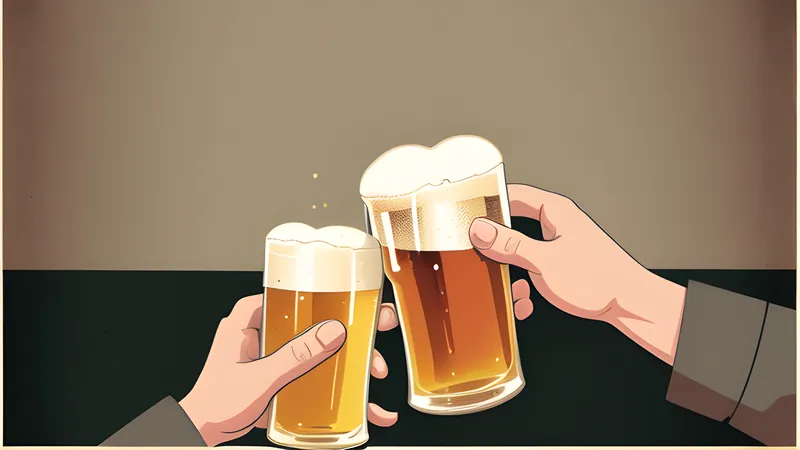
The shared round, in which each member of a group buys a turn, is a piece of unwritten social contract in much of Britain and Ireland, a ritual of reciprocity that has little to do with the drink and everything to do with belonging. The toast, the clink of glasses, the easy conversation over a pint are the textures of friendship made visible, which is why the day sits so comfortably alongside an occasion like catching up with an old best friend. Different cultures layer their own customs on top: the Bavarian Prost demands eye contact held throughout, Belgian tradition insists each beer arrives in its own correct glass, and the American craft brewery offers its tasting flight of small measures so a drinker can compare without committing. The same unembarrassed, sociable appetite runs through other food celebrations too, the weekend fry-up at the heart of National Bacon Day among them, all of them really about the pleasure of consuming something good in company rather than alone.
Fun facts
- National Beer Day commemorates 7 April 1933, when the Cullen-Harrison Act legalised 3.2 per cent beer after over thirteen years of Prohibition; the night before is still called New Beer’s Eve.
- The holiday itself dates only to 2009, founded by Justin Smith of Richmond, Virginia, with Mike Connolly of Liverpool, and spread largely through a Facebook page.
- The Cullen-Harrison Act was signed by Franklin D. Roosevelt, who is reported to have remarked that it was a good time for a beer.
- Beer is among the oldest prepared drinks known, recorded in Mesopotamia and Egypt thousands of years ago, well before much of what we think of as written history.
A closing reflection
There is a neat symmetry in a holiday that began with a law and a queue, and was revived by a Facebook page nearly eighty years later. Both moments were really about the same thing: the desire to share a drink openly and in company. A glass of beer carries a surprising amount, craft, history, and the simple human wish to mark the end of a long day with something good and someone to drink it with.
Related Content