National Barbershop Quartet Day
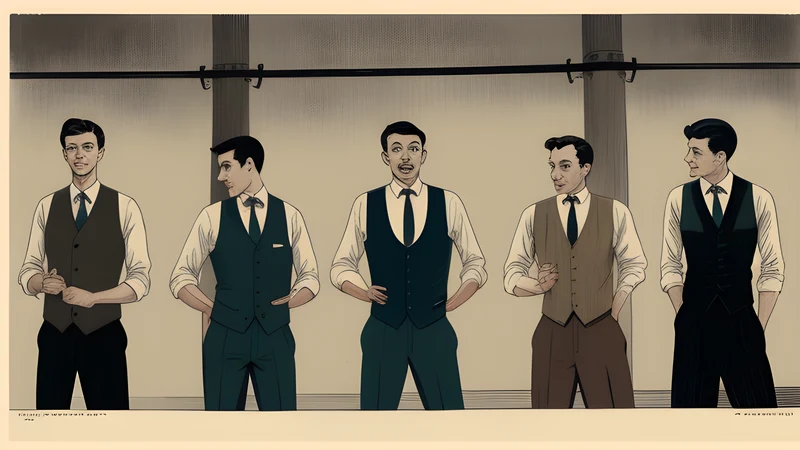
On the evening of 11 April 1938, twenty-six men crowded onto the roof garden of the Tulsa Club in Oklahoma, invited by a tax attorney named Owen Clifton Cash and an investment banker named Rupert Hall. The two had met by chance on a business trip, discovered a shared fondness for the unaccompanied four-part singing of their youth, and worried aloud that it was dying out. Their invitation, written in Cash’s mock-bureaucratic prose, announced the founding of a society with a name so long it was plainly a joke: the Society for the Preservation and Encouragement of Barber Shop Quartet Singing in America. The men sang on that roof until the police, responding to noise complaints, arrived — and then stayed to listen. National Barbershop Quartet Day marks that gathering every 11 April.
What barbershop harmony actually is
Barbershop names a specific musical craft with precise rules, and the word is often misused for any group of men singing together. Four voices — tenor, lead, baritone and bass — sing largely homophonic chords, meaning they move together on the same words rather than weaving independent lines. The melody sits in the lead voice, unusually placed below the tenor, who harmonises above it. The baritone fills whatever note the chord needs, often the least intuitive one, while the bass anchors the root.
The style prizes a particular sound: dominant seventh chords tuned in just intonation rather than the equal temperament of a piano. When four singers lock those overtones precisely, listeners hear phantom higher notes that nobody is actually singing, a ringing overtone the singers call “expanded sound” or the “fifth voice”. Chasing that ring is the whole point, and it is why barbershop groups tune by ear and often refuse a starting pitch from any instrument once they are underway. A well-arranged barbershop song spends a startling proportion of its bars sitting on some flavour of seventh chord, because that is the harmony that rings most richly when tuned true.
The history: from street corner to organised movement
The roots reach back to informal African American vocal harmony of the late nineteenth century, sung on street corners and, yes, in the waiting chairs of barbershops, where men killing time would improvise harmonies over a familiar tune. That practice fed into the popular close-harmony singing of the 1890s and 1900s, the era of songs like “Sweet Adeline” (1903), which became so bound up with the style that a rival women’s organisation later took the name Sweet Adelines. Vaudeville stages and early phonograph records carried the sound to a mass audience, and quartets like the Haydn and the Peerless became recording stars of their day.
By the 1930s the sound had been pushed aside by radio dance bands and the smoother crooners. Cash’s 1938 gathering was an act of deliberate revival. The society, mercifully abbreviated to SPEBSQSA, grew with startling speed: within two years it had thousands of members and chapters spreading across the United States, held its first national contest in 1939, and by the 1940s was a genuine national movement with a magazine, a codified contest system, and a network of arrangers producing new charts in the old idiom.
The long joke-name stuck for decades before the organisation rebranded itself as the Barbershop Harmony Society in 2004, though the old acronym is still worn with pride on badges and banners. The society moved its headquarters to Nashville in 2007, planting the hobby squarely in the American music capital.
Women were singing barbershop in parallel and were, for many years, kept out of the men’s society. Sweet Adelines International was founded in 1945 in Tulsa, and Harmony Inc. followed in 1959; both built their own contest structures and international memberships. The men’s society only formally admitted women as singing members in 2018, eighty years after that rooftop meeting, opening its contests and choruses to everyone.
Why the day matters
The day protects a genuinely fragile art. Just intonation sung a cappella cannot be faked with technology or padded with instruments; it demands ear training, discipline and hundreds of hours of rehearsal for four people to lock a single chord. Amateur societies are the main reservoir keeping that skill alive, since barbershop is rarely taught in conservatoires and almost never appears on a formal syllabus. Marking 11 April is a way of pointing at that reservoir and reminding people it needs new singers to keep from draining.
There is a civic dimension too. Barbershop chapters have long functioned as community institutions, meeting weekly in church halls and school rooms, welcoming men who cannot read a note and teaching them by rote until they can hold a part. The tradition of the “afterglow”, informal singing once the formal rehearsal ends, turns the hobby into a social anchor for people who might otherwise sing nowhere at all. For older members in particular, the weekly chapter meeting is a defence against isolation as much as a musical pursuit.
How it is celebrated
Chapters mark the day with public sings, and the society encourages a custom that captures the spirit of the whole enterprise: the singing valentine. Around Valentine’s Day each year, quartets are hired to arrive unannounced, sing two love songs, present a rose and a card, and leave — a small piece of theatre that raises funds and recruits curious listeners. On 11 April itself, groups perform “tags”, the ringing final chords of songs sung in isolation for the pure pleasure of the overtone, and share them online among the wider harmony community. The tag has become a genre of its own: a self-contained ten-second morsel of harmony that four strangers can pick up and sing together within minutes.
Competition is the other great engine of the day and the year. The society runs district contests feeding into an international quartet and chorus championship, judged in categories of music, performance and singing. Winning quartets — names like the Buffalo Bills, who appeared in the stage and film versions of The Music Man, or later champions who tour schools and festivals — become travelling ambassadors for the craft, and their contest recordings serve as models for the next generation of arrangers.
Variations around the world
Barbershop long ago left America. Britain has the British Association of Barbershop Singers and the Ladies Association of British Barbershop Singers; the Netherlands, Germany, Sweden, Australia and New Zealand all support thriving contest circuits. Swedish and Dutch quartets have placed highly in the international championships, and the arranging tradition has absorbed pop, jazz standards and folk material without abandoning the seventh-chord core. The Dutch scene in particular is known for its precision and has produced international medallists, proof that an idiom born on American street corners now belongs to the world.
The style also feeds naturally into other unaccompanied singing worlds. Its emphasis on communal, ear-based harmony connects it to the wider culture of the voice celebrated on World Voice Day and to the massed singing traditions behind World Choral Day. Where barbershop insists on four soloists tuning to one another, choral singing scales the same instinct to hundreds, and both share the conviction that harmony is something people make together rather than consume.
Traditions and symbols
The visual shorthand is instantly recognisable: matching striped waistcoats, straw boaters and handlebar moustaches, an affectionate nod to the 1890s the revivalists were reaching back toward. The barber’s pole, with its spiralling red and white stripe, doubles as an emblem of the movement. None of it is compulsory — plenty of modern choruses wear ordinary concert dress and sing contemporary arrangements — but the imagery endures because it tells newcomers, at a glance, what kind of sound they are about to hear.
Fun facts
The society’s original name was so deliberately absurd that Cash, who had a taste for satire, was partly mocking the alphabet-soup agencies of the New Deal era. The abbreviation SPEBSQSA was reportedly designed to poke fun at Franklin Roosevelt’s WPA, TVA and NRA.
The “fifth voice” is not a metaphor. When a barbershop seventh chord is tuned in just intonation, the reinforced overtones can be measured on a spectrum analyser, and skilled quartets learn to make it audible enough to fill a room without any singer straining.
“Sweet Adeline”, the unofficial anthem of the style, gave its name both to the women’s organisation and, in early twentieth-century American slang, to a whole category of sentimental old parlour songs.
The singing valentine has become a serious fundraiser. Some chapters dispatch dozens of quartets across a single city on 14 February, coordinating routes like a courier service so that each surprise serenade lands on schedule.
The first SPEBSQSA meeting drew twenty-six men, but the invitation had gone out to only a handful; word spread through Tulsa’s business community so fast that the roof garden was full by the time Cash began, a small measure of how many people had been quietly missing the sound.
A closing reflection
There is something quietly radical about an art form whose entire value lies in four ordinary people listening to one another closely enough to summon a note none of them is singing. Barbershop rewards attention over ego, blend over brilliance, the patient tuning of a chord until it rings. On 11 April, when someone somewhere sings a tag on a rooftop or in a car park and hears that overtone bloom, the rooftop in Tulsa is, for a moment, occupied again.
Related Content