National Banana Split Day
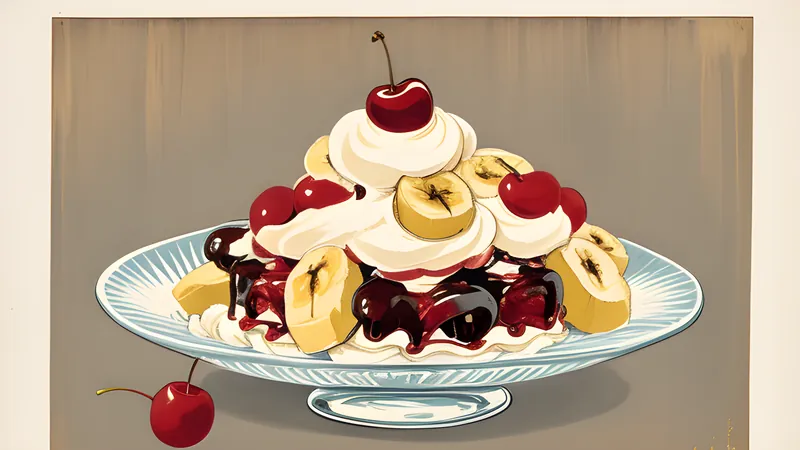
During the Christmas break of 1904, a group of students from Saint Vincent College wandered into Tassell Pharmacy at 805 Ligonier Street in Latrobe, Pennsylvania, and told the soda jerk behind the fountain to make them something exciting. He was David Strickler, twenty-three years old and studying pharmacy at the University of Pittsburgh, and what he improvised that day has been served, more or less unchanged, ever since. He sliced a banana lengthwise, wedged three scoops of vanilla, chocolate and strawberry ice cream between the halves, ran chocolate, strawberry and pineapple sauces over the top, scattered peanuts, piped whipped cream and finished with a maraschino cherry. National Banana Split Day, kept each year on 25 August, honours that piece of improvisation at the tail end of summer, when ice cream still feels seasonal and excess needs no defending.
The dish is a small monument to abundance, and that is precisely its appeal: a banana cleaved in two, cradling three scoops, draped in three sauces and crowned with cream, nuts and fruit. It has delighted diners for well over a century, and for once the inventor and the place are not a matter of vague legend.
Where the day comes from
The banana split has an unusually well-documented birth for a sundae. Strickler’s creation was an immediate hit with the Saint Vincent students, who carried word of it well beyond Latrobe, and parlours elsewhere began copying it within a few years. Strickler himself stayed at Tassell Pharmacy, eventually bought it, and renamed it Strickler’s Pharmacy. He even commissioned the long, boat-shaped dish that still defines the dessert, ordering the elongated glass boats from the nearby Jeannette Glass works so the towering thing would have somewhere to sit.
The town’s claim is not merely local pride. In 2004, the National Ice Cream Retailers Association formally certified Latrobe as the birthplace of the banana split, and in 2013 the Pennsylvania Historical and Museum Commission approved a state historical marker, installed at the site of the former pharmacy. Latrobe still throws an annual Great American Banana Split Celebration in his honour. Other towns have floated rival stories over the years, the most persistent from Wilmington, Ohio, where a restaurant owner named Ernest Hazard is said to have devised a split around 1907 to draw in college students through a slow winter. The Ohio version postdates Strickler’s by three years, and lacks the corroborating detail of the glass order and the contemporary student accounts, which is why Latrobe carries the weight of official recognition while Wilmington keeps the friendly rivalry alive with a festival of its own.
What makes Strickler’s claim unusually durable is the sheer specificity of the evidence: a named inventor, a dated season, an address, the colleges whose students spread the word, and a paper trail leading to the glassworks that made the dish. Most food origin stories dissolve into legend the moment you press on them. This one holds.
A dessert built on cheap fruit
The split could not have spread without a quiet revolution in shipping. Around the turn of the twentieth century, refrigerated steamers and aggressive plantation trade turned the banana from an expensive curiosity into one of the cheapest fruits in American and European groceries. Strickler’s flourish depended on that abundance: a dessert built on a banana would have been an extravagance a generation earlier, and a near-luxury before that.
The dish rode the golden age of the soda fountain, the now-vanished institution, usually attached to a pharmacy, where towns gathered for a respectable treat. There is a particular reason the soda fountain flourished where it did: through the years of American Prohibition, the fountain offered a wholesome, alcohol-free alternative to the saloon, and pharmacists, already licensed and respectable, were well placed to run them. The elaborate sundae was partly a way of making non-alcoholic indulgence feel like an occasion, and the banana split, theatrical and generous, was the form that did it best. Through the mid-twentieth century the split became a fixture of parlours, diners and seaside cafés on both sides of the Atlantic, an emblem of the special occasion. Its scale made it a natural for sharing and for celebration, which is part of why it survived the decline of the fountains that birthed it.
Why honour something so excessive
The banana split is frankly over the top, and a day in its honour is a cheerful argument for occasional, wholehearted indulgence over perpetual restraint. It also preserves a thread of social history: the lost world of the soda fountain, and the manual craft of the people who built these things by hand to look like an event. The same unembarrassed spirit animates National Bacon Day, another food celebration that puts pleasure ahead of moderation without apology.
How it is made
The classic construction follows a loose but recognisable formula. A ripe banana is peeled and split lengthwise, then laid in a long dish. Three scoops, traditionally vanilla, chocolate and strawberry, sit between the halves, each dressed differently: chocolate sauce over one, strawberry over another, crushed pineapple over the third. Whipped cream, chopped nuts and one or more maraschino cherries finish it. The pleasure lies in the contrasts, cold against the slight warmth of the sauces, smooth scoops against crunchy nuts, sweet ice cream against tart fruit.
Building one well, neat, balanced and generous, was long a point of pride for the people behind the counter, and the long glass boat Strickler commissioned remains its defining vessel.
The banana itself is doing more work than it might seem. A ripe banana is soft, sweet and aromatic enough to hold its own against three ice creams and three sauces without being lost, and its shape, halved lengthwise, makes a natural cradle for the scoops. Substitute almost any other fruit and the architecture collapses. That the dish depends so completely on a fruit that was, within living memory of its invention, an expensive rarity is part of what makes it a small monument to a particular moment in food history, the brief window when the banana had become cheap but still felt faintly exotic.
Why honour something so excessive, continued
The split also quietly preserves a craft that has all but disappeared: the manual assembly of a dessert by a skilled person working at speed in front of the customer. The soda jerk, a profession with its own slang and its own showmanship, was a genuine trade, and the banana split was its showpiece, the order that demanded the most flourish. Honouring the dish is, in a small way, honouring that vanished kind of work, the kind that turned cheap ingredients into theatre for the price of a few coins. In an age when most desserts arrive pre-portioned and machine-made, the hand-built split is a deliberate throwback, and 25 August is as good a day as any to insist that some pleasures are worth the extra effort.
Around the world
Though born in Latrobe, the split travelled with ice cream culture and now appears on dessert menus far beyond the United States, adapted to local taste. Some versions add caramel or fudge sauces; others swap in regional fruits or ice cream flavours. In Britain it became a familiar treat in seaside parlours and holiday resorts, sitting alongside other warm-weather indulgences much as National Ice Cream Day celebrates the broader pleasure it belongs to. Japanese parfait culture took the towering-sundae idea and ran with it into elaborate, beautifully layered creations; Latin American versions lean on local fruits and dulce de leche. The day itself is observed most consciously where the dessert is already a nostalgic favourite, but it needs little explaining anywhere bananas and ice cream are sold.
Records keepers, inevitably, have got involved too. Towns and ice cream makers periodically build enormous splits, stretching hundreds or even thousands of feet down a street with the help of dozens of volunteers and industrial quantities of ice cream, sauce and bananas. The results are uneatable in any practical sense and entirely beside the point, which is to turn a private indulgence into a communal spectacle, a fitting tribute to a dessert that was theatrical from its first afternoon.
Fun facts
- The banana split was invented in 1904 by David Strickler, a 23-year-old pharmacy student moonlighting as a soda jerk, on a Christmas break dare from college students.
- Strickler commissioned the long glass “banana boat” dish from the nearby Jeannette Glass works, designing the now-standard serving vessel along with the dessert.
- Latrobe, Pennsylvania, was officially certified the birthplace of the banana split by the National Ice Cream Retailers Association in 2004, and got a state historical marker in 2013.
- Strickler eventually bought the pharmacy where he invented it and renamed it after himself, spending much of his life at the very counter where the dessert began.
A closing reflection
It is worth dwelling on how accidental the whole thing was: a bored student behind a fountain, a casual dare, a banana and whatever sauces were to hand. The most enduring inventions are often like this, improvised rather than designed, and remembered precisely because nobody set out to be remembered. More than a century later, ordering a split is a small act of contact with a December afternoon in 1904 that its creator can have had no idea would outlast him.
Related Content