Lunar New Year
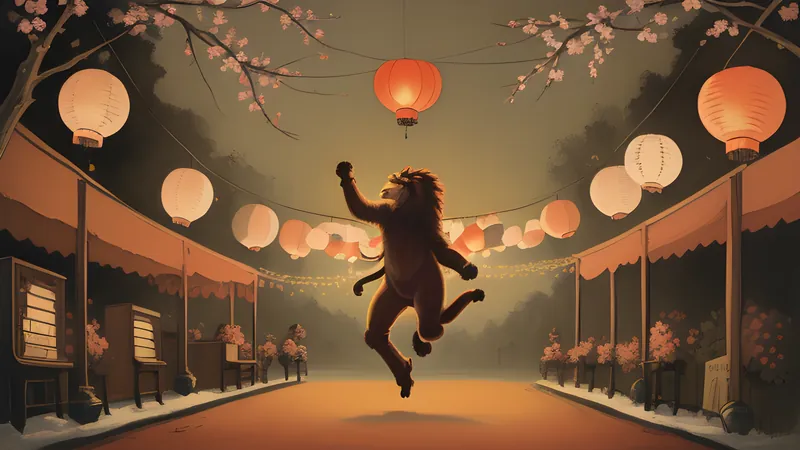
In the weeks around the second new moon after the winter solstice, somewhere close to three billion trips are taken across China as workers stream from the coastal cities back to the towns and villages where their parents wait. The migration has a name — chunyun, the Spring Festival travel rush — and it is reckoned the largest annual movement of people anywhere on the planet, a mass of trains, coaches, planes and motorbike convoys all pointed homeward for a single dinner. That dinner is the reunion meal on New Year’s Eve, and the festival it opens is Lunar New Year, kept across China and in Korea, Vietnam, Mongolia and the vast Chinese, Korean and Vietnamese diasporas from San Francisco to Singapore. The date shifts each year because it follows the moon, falling somewhere between 21 January and 20 February.
Why the Date Moves
The Chinese calendar is lunisolar, meaning it tracks both the phases of the moon and the length of the solar year, and this is what sends the festival wandering across late January and February. Each month begins on a new moon, so a lunar month runs about 29.5 days and twelve of them fall short of the solar year by roughly eleven days. Left uncorrected, the new year would drift backwards through the seasons the way the purely lunar Islamic calendar does. To stop that drift, the Chinese system inserts a leap month seven times in every nineteen years, keeping the new year anchored to late winter.
The governing rule is astronomical. The winter solstice must always fall in the eleventh month, and Lunar New Year begins on the second new moon after that solstice — in most years the new moon nearest the midpoint between the solstice and the spring equinox. Because the calculation has been based since 1928 on the meridian of the observatory near Beijing, countries slightly to the east can occasionally reckon the date a day differently. The animal of the year rotates through the familiar twelve-year zodiac cycle: Rat, Ox, Tiger, Rabbit, Dragon, Snake, Horse, Goat, Monkey, Rooster, Dog and Pig.
The Deep History
The festival’s roots run back to agrarian rituals of the Shang dynasty in the second millennium BCE, when sacrifices were offered to gods and ancestors at the turn of the year to secure a good harvest. The observance took clearer shape under later dynasties. It was the Han emperor Wu, reigning from 141 to 87 BCE, who reformed the calendar in 104 BCE and fixed the new year firmly at the first new moon of the first lunar month, a placement that has held ever since. Many of the customs recognisable today — staying up through New Year’s Eve, exchanging good wishes, lighting lamps — were well established by the Tang dynasty of the seventh to tenth centuries, when the celebration grew into a public carnival with a lighter, more sociable mood.
Gunpowder gave the festival one of its defining sounds. Firecrackers began as bamboo stalks thrown on fires to burst with a crack — the original Chinese word for firecracker, baozhu, means “exploding bamboo” — but once gunpowder was packed into paper tubes during the Song dynasty, the explosive strings of red firecrackers that scatter the streets with paper became standard. The most disruptive chapter came in the twentieth century. After the fall of the Qing dynasty in 1912 the new Republic adopted the Gregorian calendar for official business, and in 1928 the Nationalist government actually tried to abolish the traditional new year altogether, ordering celebrations moved to 1 January. Popular resistance was so complete that the attempt collapsed. The People’s Republic later renamed it the Spring Festival, and though the Cultural Revolution suppressed many of its “feudal” customs, they returned in force after 1980.
What It Means
At its heart the festival is about family reunion and the renewal of the year, a chance to sweep away the old and welcome fortune for the new. The days before are given over to cleaning the house from top to bottom, a symbolic clearing-out of the past year’s bad luck, and to settling debts so as to start the year unencumbered. Underlying much of the ritual is an old story about a beast called Nian, a monster said to emerge at year’s end to devour livestock and children, driven off by the colour red, by loud noise and by bright light — which is why red decorations, firecrackers and lanterns are everywhere. The Chinese word for the festival’s turning, guonian, literally means “to pass over the Nian”.
There is also a heavenly bureaucracy at work in the folk tradition. The Kitchen God, who watches each household through the year, is said to ascend to heaven a week before the new year to report on the family’s conduct, and households smear his paper image with sticky sweets so that he will speak only sweetly, or say nothing at all.
How It Is Celebrated
The reunion dinner on New Year’s Eve is the emotional centre, a meal at which absent family members are conspicuous by their absence and every effort is made to be present. Dishes are chosen for the puns and blessings hidden in their names. Fish, yu, sounds like the word for surplus, so a whole fish is served and pointedly not finished, expressing the wish for abundance to carry over into the coming year. Dumplings shaped like old silver ingots promise wealth in the north; sticky rice cake, niangao, sounds like “higher year” and promises advancement in the south; long uncut noodles stand for long life.
The following morning children offer new-year greetings to their elders and receive hongbao, red envelopes of money, the sum kept to even numbers and never containing the unlucky four. Homes are hung with couplets of poetry on red paper flanking the doorways, and the character fu, fortune, is pasted up deliberately upside down, because the phrase for “upside-down fortune” sounds like “fortune has arrived”. Over the fifteen days that follow, families visit relatives and friends in a set order, temples fill with worshippers, and the festival ends with the Lantern Festival on the fifteenth night, when the first full moon of the year is greeted with glowing lanterns, riddles written on their sides, and sweet glutinous rice balls called tangyuan.
Each of the fifteen days carries its own small rules. The first days are for the closest family and are hedged with taboos: no sweeping, in case one sweeps away the year’s good luck, no washing of hair on the first day, lest fortune be rinsed out, and no breaking of crockery or speaking of death, illness or debt. The second day is often when married daughters return to visit their own parents, having spent the eve with their husbands’ families. The seventh day, renri, is reckoned everyone’s shared birthday, the day humanity itself was created in one old myth, and the fifteenth brings the lanterns and the end of the season, after which normal life resumes and the decorations come down.
Beyond China
The festival is far from Chinese alone. In Korea it is Seollal, a quieter, more solemn family observance centred on ancestral rites called charye and a bow of respect, sebae, to elders; the traditional dish is tteokguk, a rice-cake soup, and eating a bowl is said to add a year to one’s age. In Vietnam it is Tết Nguyên Đán, usually just Tết, the most important holiday of the year, marked by kumquat trees, peach and apricot blossom, and square sticky-rice cakes called bánh chưng wrapped in green leaves. Mongolia keeps Tsagaan Sar, the White Moon festival, with mountains of steamed dumplings and stacked pastries. The Vietnamese and Korean dates can differ from the Chinese by a day when the new moon falls awkwardly across time zones.
Fun Facts
The dragon dance and lion dance are often confused: a lion is worked by two performers and moves like an animal, while a dragon is carried aloft on poles by a whole team and can stretch to enormous lengths — one made in Hong Kong ran over three thousand metres. Chinese New Year is a public holiday across East Asia and in places with large Chinese communities, including Malaysia, Singapore, Indonesia, the Philippines, Mauritius and Suriname. The colour and number superstitions are taken seriously enough that flat prices, phone numbers and wedding dates are chosen around the lucky eight and away from the unlucky four. And the reason the whole festival is sometimes called “Spring Festival” despite falling in the depth of winter is the old Chinese reckoning of the seasons, in which spring begins around early February, at the solar term called lichun.
A Closing Reflection
For a festival built around a monster and a heavenly kitchen inspector, Lunar New Year rests on a very human foundation: the pull of home. The chunyun migration is not really a logistical marvel to be admired from outside; it is what it looks like when an entire civilisation decides, all at once, that being at one table with one’s parents for one meal is worth a two-day journey. The lanterns and the firecrackers and the red envelopes are the decoration around that decision. Other movable feasts turn on the same instinct to gather at a fixed moment — Easter Sunday and Diwali both send families home against the calendar of the moon — and the strength of Lunar New Year is that it has kept several billion people making that journey year after year, through empire, republic and revolution, and shows no sign of stopping.
Related Content


