Japanese Shichi-Go-San
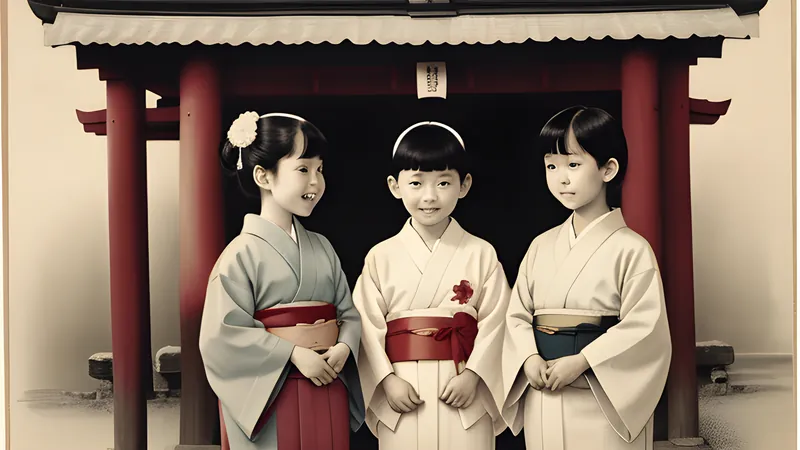
On 15 November 1681, the shogun Tokugawa Tsunayoshi is said to have taken his ailing young son Tokumatsu to a shrine to pray for the boy’s health and growth. The date he chose, the fifteenth of the eleventh month, was already regarded as auspicious, and his very public act helped fix it as the day on which Japanese families would celebrate their children. That tradition survives as Shichi-Go-San, whose name means simply “seven-five-three”. Each year on 15 November the stone paths of Shinto shrines fill with the bright rustle of children in their finest: toddlers tottering under the weight of formal kimono, seven-year-olds walking with careful pride, and parents and grandparents following behind with cameras and a quiet catch in the throat. It is among the gentlest occasions in the Japanese calendar, not a public holiday or a loud carnival but a family pilgrimage of thanks for a child’s growth and a prayer for the years ahead.
Where the day comes from
The festival’s roots reach back to the Heian period, from the late eighth to the late twelfth century, when court families marked the passage of childhood with a sequence of small ceremonies. The numbers three, five and seven were considered fortunate in older Japanese counting, odd numbers being thought lucky, and each carried its own ritual moment. Over the centuries these separate aristocratic observances drifted together into a single seasonal celebration centred on the middle of November.
Tsunayoshi’s 1681 prayer for his son is the most-cited origin for the specific date, and the choice of 15 November is also linked to the old lunar calendar, on which that day fell under the constellation Kishuku, regarded as an especially favourable time to honour the deities and give thanks. Whatever the exact mechanism, by the Edo period the day had crystallised into a recognisable festival.
Three customs, one festival
Beneath Shichi-Go-San sit three older coming-of-age rites, one for each age. The first, kamioki, “leaving the hair”, marked the point around the age of three when a child was finally allowed to grow their hair out, after the infant custom of keeping young heads shaved in the belief it encouraged healthier hair later. The second, hakamagi, “putting on the hakama”, celebrated a boy of about five wearing the formal pleated hakama trousers for the first time, a visible step towards the adult male world. The third, obitoki, “untying the cord”, honoured a girl of around seven who set aside the simple cords of a child’s kimono for the proper obi sash of a grown woman’s dress.
These began as customs of the aristocracy. They spread to samurai households, and during the prosperous Edo period they reached merchants and townsfolk, until what had been an elite rite belonged to families of every station. The modern grouping, boys at five, girls at three and seven, settles the three old ceremonies onto the two sexes, though regional and family practice has always varied.
The ages were traditionally reckoned in kazoedoshi, the old East Asian system in which a child is counted as one year old at birth and gains a year at each New Year rather than on their birthday. Under that scheme a “seven-year-old” girl might be only five or six by Western reckoning. Since the mid-twentieth century, when Japan moved officially to counting age from zero at birth, families have increasingly used the modern manzai system instead, and many now simply pick whichever count means their child is dressed up sooner. This quiet shift in arithmetic is why two children at the same Shichi-Go-San shrine visit, both nominally “seven”, can be a clear year apart in age.
Why the day mattered, and still does
The festival carried real weight in an age of high child mortality. When illness routinely claimed children before they reached school age, surviving to three, five or seven was a genuine achievement, and Shichi-Go-San was a public acknowledgement that a child had come through the most dangerous years. Tsunayoshi’s own prayer for a sickly son captures the feeling exactly: this was a day born of relief as much as celebration.
That undertone of thanksgiving persists even now that such dangers have largely receded. The day gives a family a fixed occasion to pause, recognise how far a child has come, and ask the kami, the shrine deities, to watch over the road ahead. In binding the generations through a familiar ritual, it does quietly for the very young what the autumn holiday of Respect for the Aged Day does for the old, marking the two ends of a life within the same season.
How families observe it
Families visit a local shrine, where a priest may perform a short blessing, an omiyamairi, for the child. Many children wear traditional dress: girls in vivid kimono with elaborate sashes and hair ornaments, boys in haori jackets over hakama. Because formal kimono are costly and awkward to wear correctly, rental shops do brisk business in the surrounding weeks, and professional photographers, who increasingly handle the whole occasion in studios, are booked well in advance. The shrine visit is usually the centrepiece of a larger day out, ending in a celebratory meal shared among parents, grandparents and the child of honour.
The festival shares its November shrine grounds and much of its mood with Culture Day, which falls twelve days earlier, so that the first half of the month becomes a season of formal kimono and crisp autumn ceremony. It also pairs in spirit with the spring Doll Festival, the two together expressing a parent’s hopes for a child through ritual and finery.
The thousand-year candy
The most beloved emblem of the day is chitose-ame, “thousand-year candy”, a long, thin stick of red-and-white sweet sold in decorated paper bags. Its great length is the point: it stands for a wish that the child’s life will stretch out long and healthy, and tradition holds the candy should be stretched rather than snapped, never broken. Red and white are Japan’s colours of celebration, and the bags are commonly printed with cranes and tortoises, both ancient symbols of longevity. The sweet is so tied to the festival that its appearance in shop windows signals the season as surely as the turning of the maples.
The candy itself has a traceable history. It is generally credited to an Edo-period confectioner, a sweet-seller named Shichibei who is said to have sold long sticks of pulled, hardened sugar candy under the name sennen-ame, “thousand-year candy”, near the Sensō-ji temple in the Asakusa district of Edo. The name and the format caught on precisely because they suited a festival about wishing children long life, and the sweet has kept its essential form, a pliable stick of red and white amezaiku sugar candy, for some three centuries. Modern bags often add a length limit set by custom, traditionally no longer than a metre, so that even a wish for a thousand years comes in a child-sized portion.
Beyond Japan
Shichi-Go-San is observed wherever Japanese communities have settled, from Hawaii to the large Japanese-descended population of Brazil to the cities of North America and Europe, often at shrines or cultural centres that recreate the ceremony far from home. For diaspora families the day can take on an added charge, becoming a way to keep a thread of heritage alive and hand it to children growing up inside another culture. The essentials travel well: a blessing, fine clothes, a stick of long candy and a photograph to keep.
Fun facts
- The date is traditionally traced to 15 November 1681, when Shogun Tokugawa Tsunayoshi prayed for the health of his young son Tokumatsu at a shrine.
- The festival absorbs three distinct older rites: kamioki, when a child stopped having their head shaved; hakamagi, a boy’s first formal trousers; and obitoki, a girl’s first adult sash.
- Chitose-ame, the “thousand-year candy”, is meant to be pulled and stretched rather than snapped, its unbroken length symbolising a long unbroken life.
- Shichi-Go-San is not a public holiday, so most families now hold their shrine visits on a convenient weekend, spreading the celebration across much of November.
- The young heads of infants were once deliberately kept shaved on the folk belief that it would produce thicker, healthier hair later, which is why the age-three rite is literally “leaving the hair”.
A closing reflection
It is worth remembering that this most charming of festivals began with a worried father and a sick child. The grandeur of the kimono and the cheer of the candy sit on top of something far older and more fragile: the simple terror of losing a child, and the relief of watching one grow. Tsunayoshi’s prayer has outlasted his dynasty by centuries, which suggests the festival endures less because of who started it than because of what it answers. A small child in a grand kimono, clutching a sweet meant to last a thousand years, is walking a path that countless anxious parents have walked before.
Related Content