Japanese Setsubun
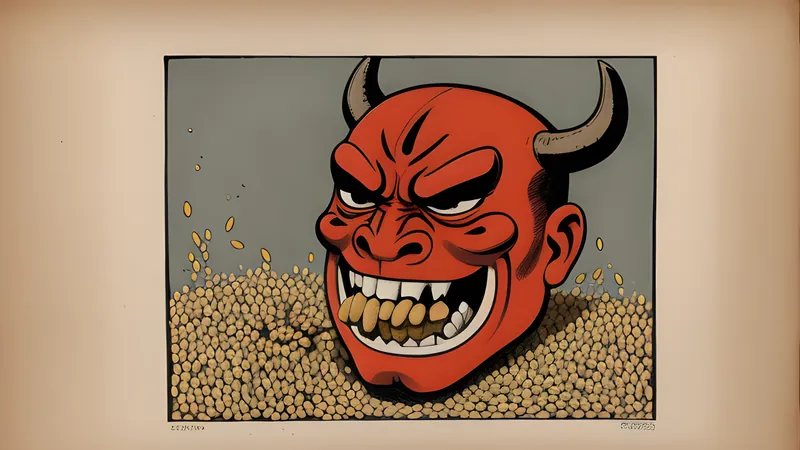
The Japanese chronicle Shoku Nihongi records that in the year 706, a plague having swept the country, the imperial court held a ceremony to drive out the spirits of pestilence. Officials decorated the palace gates with clay figures of oxen and children and brandished peach-wood staves to chase off the malign forces that brought disease. That rite, called tsuina, is the distant ancestor of Setsubun, the festival held each 3 February when Japanese families scatter roasted soybeans to expel bad luck and welcome the good. Today it is mostly a scene of laughter, children pelting a parent in a fearsome red demon mask and shouting for misfortune to leave, but beneath the play lies that same old idea: that the seam between two seasons is a vulnerable moment when ill fortune must be deliberately swept away.
What the name means
Setsubun translates roughly as “seasonal division”, and originally it referred to the eve of any of the four turning points of the old lunisolar calendar, the days before the calendrical start of spring, summer, autumn and winter. Of these, the start of spring, risshun, was the most important, marking what amounted to a new year in the agricultural reckoning. In the traditional calendar it fell close to the beginning of February, and over time the word Setsubun attached itself almost exclusively to this single eve, the one that ushered in the most significant transition of the year.
The festival’s underlying logic came partly from China, on the belief that the boundaries between seasons were precisely when evil spirits, oni, could slip through and needed to be repelled. A new beginning was also a moment of exposure, and the rituals of Setsubun were designed to seal it.
From court ceremony to bean-throwing
The tsuina rite of 706 was a solemn court affair, conducted on the last day of the year in the lunar calendar, and it became established as a regular palace ceremony during the Heian period. What gradually transformed it into the festival recognised today was the rise of mamemaki, the scattering of beans, which appeared in the Muromachi period, roughly the fourteenth to sixteenth centuries. The roasted soybean took over from the peach-wood staves of the old rite as the weapon of choice against demons.
There is wordplay buried in the custom. The Japanese for bean, mame, can be read with characters meaning “to destroy demons” (ma-me), which helped fix the soybean at the centre of the ritual. By tradition the beans are thrown by the toshiotoko, the man of the household born under the corresponding zodiac sign for the coming year, or else by the head of the family. As the rite spread from the imperial court to temples and ordinary households, it shed its solemnity and gathered the noisy, domestic warmth it has now.
A folk story attached to a shrine near Kyoto helps explain why beans in particular came to be seen as a weapon. In the tale, a demon menacing the Kurama district was driven off when someone flung roasted soybeans into its eyes, blinding it long enough to be banished. The legend is impossible to date and was very likely fitted to the custom after the fact, but it captures the underlying logic neatly: the bean is not merely a token but a missile, something thrown with force at a personified evil. Other regional charms accompany the throwing, including hanging a holly branch strung with the head of a dried sardine at the door, the prickly leaves and pungent smell together meant to keep demons from crossing the threshold at all.
Why the festival lasts
Setsubun survives because it gives a concrete, satisfying action to an abstract wish. The instinct to mark a threshold and to take an active step towards good fortune is widespread, but Setsubun makes it physical: you can hear misfortune being driven out in the rattle of beans across the floor. That tangibility has carried it intact through successive calendar reforms, including Japan’s switch to the Western calendar, which left the date fixed at 3 February rather than drifting with the moon.
It is also, unusually, a festival built around children. Where many Japanese observances place adults or ancestors at the centre, Setsubun hands the leading role to the young, who get to throw things at their parents with full sanction. That turns an ancient idea about cosmic order into a family game, and a game is a more reliable vehicle for tradition than a ceremony, because it is fun enough to be passed on without being enforced.
How the day is celebrated
The core ritual is mamemaki. A family member, often the father, dons an oni mask, and the others fling roasted soybeans at him crying “Oni wa soto! Fuku wa uchi!”, “Demons out! Fortune in!” Afterwards it is customary to eat a number of beans equal to one’s age, plus sometimes one more for the year ahead, to secure health. Temples and shrines stage far larger versions, where priests, sumo wrestlers and invited celebrities hurl beans, and increasingly small wrapped sweets and envelopes, into eager crowds; the events at major temples in Kyoto and Tokyo draw thousands.
A second custom, eating an ehōmaki, has spread dramatically in living memory. The ehōmaki is a thick, uncut sushi roll eaten whole and in silence while facing the year’s lucky compass direction, the ehō, which shifts annually according to the zodiac and takes only one of four possible bearings in any given year. Long a regional practice in the Kansai area around Osaka, it went national after a major convenience-store chain began selling rolls under the name ehōmaki in 1989, and aggressive promotion by shops through the 1990s turned it into a nationwide February ritual. The commercial success has had an awkward side effect: the surge in demand produces large quantities of unsold rolls, and the resulting food waste each Setsubun has become a recurring subject of public criticism, prompting some retailers to switch to pre-order systems to curb the surplus.
Variations across Japan and beyond
The festival flexes by region. In snowier northern districts such as Hokkaido and parts of the Tōhoku region, families traditionally throw roasted peanuts in their shells rather than loose soybeans, since they are easier to spot and gather up in the snow, and more hygienic to eat afterwards. Some shrines associated with deities thought to command demons reverse the famous chant, omitting “demons out” or even welcoming the oni in.
The festival sits within Japan’s wider rhythm of seasonal markers. It is the demon-banishing prelude to the spring that the Doll Festival celebrates only a month later, and its preoccupation with luck and the turning year rhymes with the civic stocktaking of Culture Day at the opposite end of the calendar. Wherever the Japanese diaspora has settled, families and Buddhist temples abroad keep the bean-throwing alive, offering newcomers a vivid window onto how Japan marks the passage of its seasons.
Symbols and their meanings
The roasted soybean is the central emblem, valued both as a missile against misfortune and, when eaten, as a token of health. Crucially the beans must be roasted: a raw bean that sprouted after being thrown was thought to bring bad luck, so cooking them first sterilised the symbolism as well as the bean. The red-faced oni mask embodies the disease and ill fortune to be repelled, a direct descendant of the spirits the 706 court tried to chase from the palace gates. The ehōmaki, eaten unbroken, stands for unbroken good fortune, and the silence in which it is consumed is meant to keep that luck from escaping the eater’s mouth.
Fun facts
- The earliest recorded ancestor of Setsubun is the tsuina rite held at the Japanese court in 706, staged to drive out a plague.
- The choice of beans rests on a pun: mame, “bean”, can be written to mean “destroy demons”, which made the soybean the natural weapon of the festival.
- You eat your age in beans, plus sometimes one extra for the coming year, so the ritual doubles as a small annual reckoning of how old you are.
- The now-ubiquitous ehōmaki sushi roll went nationwide only after a convenience-store chain marketed it under that name in 1989; it had been a regional Osaka custom before.
- In snowy parts of northern Japan, families throw shell-on roasted peanuts instead of soybeans, because they are easier to find and pick up out of the snow.
A closing reflection
What is striking about Setsubun is how a court ceremony born of real terror, a plague serious enough to be written into the national chronicle, mellowed over thirteen centuries into a game children look forward to. The fear did not vanish so much as get domesticated, folded into a parent’s mask and a handful of beans. There is a quiet wisdom in that. A culture that can turn its oldest dread of disease and disorder into a shared laugh on a February evening has found a durable way to keep the dread, and the hope that answers it, alive.
Related Content