International Red Panda Day
In 2010 the Red Panda Network, a conservation group with roots in the eastern Himalayas of Nepal, declared the third Saturday of September International Red Panda Day, and gave a small, russet, tree-dwelling animal a fixed place in the calendar. The choice of a floating date rather than a fixed one was practical: it guarantees a weekend, when zoos and schools can most easily gather a crowd. The cause was urgent. The red panda had spent nearly two centuries being misunderstood, mislabelled and quietly hunted, and its forests were vanishing faster than most people realised. A day of its own was a way to make the world look at an animal it had always found charming yet rarely taken seriously.
The animal that named the panda
The red panda holds a curious historical distinction: it was the original panda. When the French zoologist Frédéric Cuvier formally described the species in 1825, giving it the scientific name Ailurus fulgens, meaning roughly shining cat, the word panda already attached to it, most likely derived from a Himalayan name such as the Nepali nigalya ponya. The giant panda, the black-and-white bear now synonymous with the word, would not be described by Western science until decades later, in 1869, and it borrowed the name from its smaller, unrelated namesake. For a long time the red panda was left without a clear place in the tree of life, shuffled between the raccoon family and the bears as naturalists struggled with an animal that resembled both and belonged to neither.
Modern genetics settled the question by giving the red panda a family entirely to itself. It is the sole living member of the family Ailuridae, a lineage that split from the other carnivorans millions of years ago and whose relatives are known only from fossils. In 2020 a further study, led by Yibo Hu and colleagues, confirmed that the red panda is in fact two species: the Himalayan red panda, Ailurus fulgens, found in Nepal, north-east India, Bhutan and southern Tibet, and the Chinese red panda, Ailurus styani, of northern Myanmar and southern China, which is generally redder and larger with a more distinctly ringed tail. The two were found to have diverged hundreds of thousands of years ago, a discovery with real consequences for how each population must be protected.
History of the day
The Red Panda Network was founded to work in the Nepalese districts where the animal survives, training local people as forest guardians who monitor the pandas and discourage poaching. Establishing an international day in 2010 was a way to connect that fieldwork to a global audience of zoos, and the timing proved shrewd. Red pandas are among the most popular animals in captivity, and the network could offer keepers a ready-made annual event to which they could attach their own celebrations. Within a few years the day was being marked at institutions across dozens of countries, each drawing on the same pool of facts and imagery supplied by the founders.
The animal’s appeal had already been amplified by an unlikely source. When the Mozilla Foundation renamed its web browser in 2004, it chose Firefox, and the name was understood to refer to the red panda, for which firefox is an old alternative name; the browser’s logo shows a fiery creature curled around a globe. Millions of people who had never heard of Ailurus fulgens encountered its nickname daily, and conservationists were happy to borrow the association. The day gave them a way to convert that flicker of recognition into something more durable.
Why the day matters
The red panda is classified as endangered by the International Union for Conservation of Nature, with a wild population estimated at fewer than ten thousand mature individuals and falling. The threats are interlocking. The temperate mountain forests it depends on, dense with rhododendron and bamboo between roughly 2,200 and 4,800 metres, are being cleared for farmland, timber and grazing, fragmenting the animal’s range into ever-smaller islands. Poaching for the striking russet pelt persists, and there is a grim trade in live cubs for the exotic-pet market. Free-roaming dogs, which follow herders into the forest, spread canine distemper and sometimes kill pandas outright.
Because the red panda breeds slowly, usually producing one or two cubs a year after a gestation that can stretch to several months owing to delayed implantation, populations recover poorly from losses. Its plight overlaps with that of many Himalayan species squeezed by the same pressures, which is why the day sits comfortably alongside broader observances such as World Wildlife Conservation Day and the plight of high-altitude specialists marked on International Cheetah Day. Protecting the forest that shelters the red panda protects a whole community of creatures that share its slopes.
The biology of a bamboo specialist
The red panda is a carnivore that has, over evolutionary time, become almost entirely vegetarian, and its body carries the marks of that awkward compromise. Its digestive system is that of a meat-eater, short and simple, yet its diet is dominated by bamboo, which it cannot digest efficiently, so it must eat prodigious quantities of leaves and shoots to survive, supplementing them with fruit, berries, eggs and the occasional insect. To grip the bamboo it has evolved a false thumb, an enlarged wrist bone that works as an opposable digit, the very same adaptation that the giant panda evolved independently, a celebrated case of two unrelated animals arriving at the same solution.
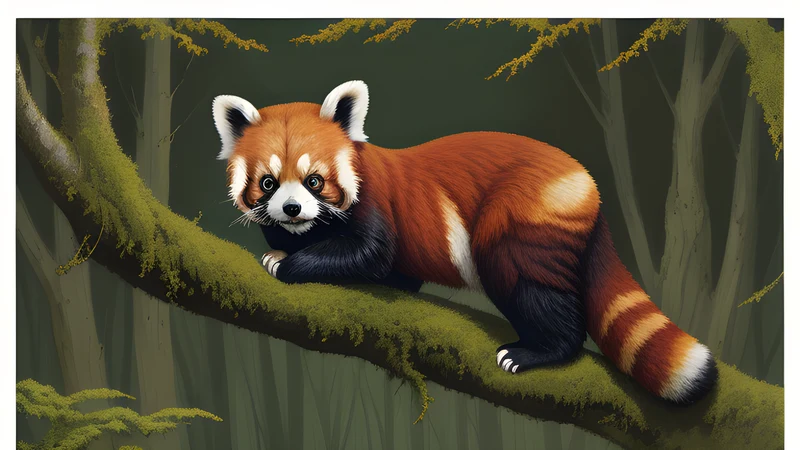
Everything about the red panda suits a life in cold, wet mountain forest. Its dense fur covers even the soles of its feet for warmth and grip on mossy branches, its long bushy tail, ringed in cream and rust, serves as both a balance aid in the canopy and a blanket wrapped around the body in sleep, and its reddish coat blends with the rust-coloured moss and the reddish-brown lichen that drape the trees of its home. It is largely solitary and most active at dawn and dusk, spending the day dozing high in the branches.
How it is celebrated
Zoos anchor the day with keeper talks, special feeds and fundraising for the Red Panda Network’s forest-guardian programme. Many hold naming events for new cubs, adoption drives and craft activities for children, all trading on an animal that needs no exaggeration to charm a crowd. In Nepal and India, community groups mark the day in the villages nearest the pandas’ habitat, folding it into wider efforts to make conservation pay for the people who live alongside the animal. Online, the day fills with footage of red pandas standing on their hind legs in a defensive posture that looks endearingly like a raised-arms surrender, and with the endless supply of cub photographs the internet never tires of.
Culture and local names
In the villages of eastern Nepal the red panda is known as the habre, and in the Sherpa-speaking highlands as the wah, a name said to echo the animal’s soft call. For generations it lived at the edge of local knowledge, glimpsed in the rhododendron forest and occasionally trapped for its fur, which was used to trim hats and make ceremonial items in parts of Yunnan and Bhutan. It never carried the heavy symbolic weight of the tiger or the snow leopard, and that relative obscurity is part of why its decline went unremarked for so long. The founders of the day set out to change the animal’s standing among the people who share its mountains, arguing that a creature valued alive, as a source of eco-tourism income and local pride, has a better chance than one valued only as a pelt. Renaming the animal a source of livelihood rather than a nuisance has become central to the conservation strategy in Nepal, where former poachers have in some districts become the pandas’ most reliable guardians.
Fun facts
The red panda’s standing threat display, in which it rears up and raises its forelimbs to look larger, has become one of the most shared animal images on the internet, though to the animal it is a genuine warning rather than a greeting. Red pandas communicate partly through a sound often described as huff-quacks or a bird-like twitter, and cubs squeak to their mothers from the nest. The animal has a sweet tooth of an unusual kind: studies have shown red pandas can taste aspartame, an artificial sweetener that most non-primate mammals cannot detect. And the giant panda and the red panda, despite sharing a name, a homeland, a bamboo diet and even a false thumb, are not close relatives at all, a coincidence so complete that it reads like a joke evolution decided to tell twice.
The effort behind the celebration
Behind the cub photographs sits a year of methodical work. The Red Panda Network trains and pays local forest guardians who walk fixed transects through the habitat, recording sightings, droppings and signs of poaching, and their data feeds the population estimates that conservation bodies rely on. Reforestation projects replant the bamboo understorey and the tree canopy that logging strips away, and community nurseries grow seedlings for slopes that grazing has laid bare. Anti-poaching patrols and dog-vaccination drives tackle two of the most direct threats, disease and the snare. International Red Panda Day is the shop window for all of it, the single date on which the network asks the animal’s many admirers to fund the quiet, unphotogenic labour that keeps the forest standing, from tree nurseries to the salaries of the guardians who have made the pandas their responsibility.
A closing reflection
There is a lesson folded into the red panda’s long confusion of names and classifications: an animal can be beloved and still be overlooked, familiar as a logo yet unknown as a creature with a shrinking home. International Red Panda Day works against that gap, asking the people who coo over the cub videos to learn where the cubs actually live and what is happening to their forests. Like the wider constituency of quiet, threatened species celebrated on days such as World Frog Day, the red panda’s survival depends on being taken as seriously as it is adored, and the third Saturday of September is the moment set aside to close the distance.
Related Content