International Polar Bear Day
International Polar Bear Day falls on 27 February, a date chosen by the conservation group Polar Bears International to coincide with the time of year when polar bear mothers are denned deep in the snow with their newborn cubs. In late February across the Arctic, females that gave birth in midwinter are nursing tiny, blind cubs inside snow dens, waiting for spring before they emerge onto the sea ice. The day places its spotlight on that vulnerable moment, and on the shrinking, warming Arctic that increasingly threatens the largest land carnivore on Earth.
The great bear of the sea ice
The polar bear, Ursus maritimus, is the biggest of all bears and the largest terrestrial carnivore alive, with adult males weighing up to around six hundred kilograms. Its scientific name means “sea bear”, and the name is precise: the polar bear is classified as a marine mammal because it spends much of its life on the frozen ocean rather than on land. Everything about it is engineered for extreme cold, from a thick layer of blubber to a dense coat that traps warmth so effectively that adults can overheat when they run.
Its most important adaptation is behavioural. Polar bears hunt seals, chiefly ringed and bearded seals, by waiting at breathing holes in the sea ice or stalking them across the frozen surface. The sea ice is the very platform on which the animal feeds. Without sea ice, a polar bear cannot reach the fatty seals it needs to survive, and this single dependence is what makes the species a living barometer of the changing Arctic.
The history: from hunted animal to climate emblem
Polar bears have loomed large in the cultures of the Arctic for thousands of years. Inuit and other northern peoples hunted them for food and hides, wove them into mythology, and regarded them with a respect bordering on reverence. European explorers and, later, commercial and trophy hunters killed polar bears in large numbers through the nineteenth and twentieth centuries, and by the mid-1900s unregulated hunting had reduced some populations sharply.
The turning point came in 1973, when the five nations with polar bear populations — Canada, the United States, the Soviet Union, Norway and Denmark, for Greenland — signed the International Agreement on the Conservation of Polar Bears. The treaty restricted hunting and committed the Arctic states to protecting the species and its habitat, and populations recovered from the worst of the hunting era. In 2008 the United States listed the polar bear as threatened under its Endangered Species Act, the first species to be listed primarily because of the projected impact of climate change, cementing the animal’s new role as the emblem of a warming planet.
Why it matters
The polar bear’s fate is bound tightly to the extent and timing of Arctic sea ice, and the Arctic is warming several times faster than the global average. As the ice forms later in autumn and breaks up earlier in spring, the window in which bears can hunt seals from the ice shortens, forcing them to fast for longer on their fat reserves. Thinner, hungrier bears produce fewer surviving cubs, and in some regions scientists have already documented declining body condition and falling numbers linked to the lengthening ice-free season.
This makes the polar bear one of the clearest large-scale indicators of climate change, a species whose difficulties translate an abstract global trend into a visible, individual struggle. The day uses that visibility deliberately, arguing that saving polar bears ultimately means addressing the greenhouse-gas emissions warming their world. The message links the species to the wider environmental calendar and to conservation campaigns such as World Wildlife Conservation Day and the effort behind World Otter Day, each of which ties a single animal’s survival to broad human choices.
How it is celebrated
The day is coordinated largely by Polar Bears International, which uses it to run public campaigns, live broadcasts and educational events. A recurring feature is the Thermostat Challenge, which asks people and organisations to turn down their heating for the day as a small, concrete gesture toward reducing the energy use that drives climate change. The idea is to connect the fate of a distant Arctic animal to an ordinary domestic action that anyone can take.
Zoos with polar bears mark the day with talks, special feeds and fundraising, and schools use it to teach children about the Arctic, sea ice and climate. Online, the day generates a wave of striking polar bear imagery and scientific explanation, along with livestreams from Arctic field sites and question-and-answer sessions with researchers. Conservation groups pair the celebration with calls to support climate policy and habitat protection, keeping the underlying message tethered to action rather than admiration alone.
World variations and the Arctic nations
The polar bear ranges across the territory of five Arctic nations, and the day is observed most strongly in those countries and among the wider international audience that follows Arctic science. In Canada, home to the largest share of the world’s polar bears, the town of Churchill in Manitoba has become a global centre for polar bear tourism, where visitors watch bears gather each autumn to wait for the sea ice to reform on Hudson Bay. That gathering has itself become a barometer of change, as the bears wait longer each year for ice that arrives later than it once did.
Elsewhere, in the Russian Arctic, Norway’s Svalbard, Greenland and Alaska, the day supports research and community programmes that address the growing problem of hungry bears coming into contact with people as their hunting season contracts. Managing that conflict safely, for both bears and residents, has become an urgent local dimension of a global problem, and the day highlights the work of the communities living closest to the animal.
Traditions and symbols
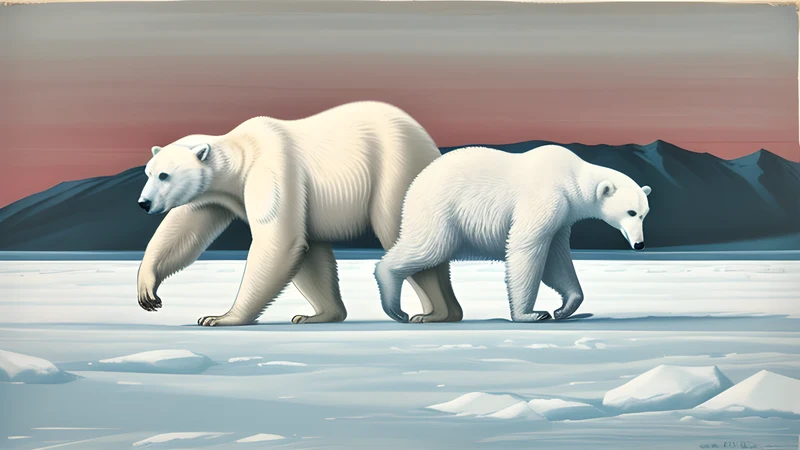
The polar bear needs little visual introduction: the white bear against blue-white ice is one of the most recognisable images in the natural world, and it has become shorthand for the Arctic and for climate change itself. Campaigns often show a lone bear on a shrinking ice floe, an image so widely used it has become an icon, sometimes criticised for oversimplifying a complex science but undeniably powerful. The mother bear emerging from her den with cubs, the scene the February date honours, is the day’s gentler and more hopeful symbol.
Fun facts
A polar bear’s fur is not actually white; each hair is transparent and hollow, scattering light so that the coat appears white, while the skin beneath is black to absorb the sun’s warmth.
Polar bears have an extraordinary sense of smell and can detect a seal nearly a kilometre away, or beneath almost a metre of compacted snow and ice, guiding them to breathing holes they cannot see.
Newborn polar bear cubs are astonishingly small, weighing little more than half a kilogram at birth, blind and almost hairless, and they spend their first months in the den growing rapidly on their mother’s rich milk.
Polar bears are strong swimmers and have been tracked swimming continuously for many days across open water, an ability that becomes more important, and more dangerous, as the gaps between ice floes widen.
Because the polar bear and the brown bear diverged relatively recently in evolutionary terms, the two can interbreed, and rare wild hybrids sometimes called “pizzly” or “grolar” bears have been documented where their ranges now overlap.
The state of the nineteen populations
Scientists divide the world’s polar bears into nineteen subpopulations spread around the Arctic, and their fortunes vary sharply. The global total is estimated at somewhere between twenty-two and thirty-one thousand animals, a figure surrounded by genuine uncertainty because counting bears across millions of square kilometres of remote ice is extraordinarily difficult. Some populations, particularly in the southern parts of the range such as the western Hudson Bay and the southern Beaufort Sea, have shown clear declines and falling body condition as the ice-free season lengthens. Others, in the colder high Arctic, remain stable for now, buffered by ice that still forms reliably each winter. This unevenness matters, because it means the species will retreat northward rather than vanish all at once, contracting toward the last dependable ice as the southern edges of its range become unlivable. The International Union for Conservation of Nature classifies the polar bear as vulnerable, and projections suggest that continued warming could cut the global population substantially within a few decades. The day exists partly to keep that gradual, uneven retreat in public view, so that a slow loss does not pass unnoticed simply for lacking a single dramatic moment.
A closing reflection
There is a particular poignancy in a day timed to the weeks when polar bear mothers lie hidden under the snow with cubs that have never seen the ice their lives will depend on. Whether that ice is still there when those cubs grow is a question no single den, and no single Thermostat Challenge, can answer alone. International Polar Bear Day asks the world to look at the great white bear and understand it as a messenger, carrying news from the top of the planet about a change that will not stay in the Arctic.
Related Content