International Podcast Day
In the summer of 2013, a podcaster from Tehachapi, California named Steve Lee heard a radio spot announcing National Senior Citizens Day and was struck by an obvious gap: there was a day for almost everything, but none for the medium he loved. His response, by his own account, was simply, “Let’s create a Podcast Day.” The following year he and his collaborators staged the first National Podcast Day in the United States, and in 2015 they broadened it to International Podcast Day, fixing the date at 30 September. That is the occasion now observed each year, a celebration of the creators, the technology and the listeners who turned a niche hobby of audio tinkerers into a medium reaching hundreds of millions of ears.
Where the day comes from
The choice of late September was not arbitrary. Podcasting as a distributable, subscribable format is usually dated to 2004, so by 2014 the medium was approaching its tenth anniversary, and Lee’s celebration doubled as a birthday party for the form itself. The Modern Life Network, the small media outfit Lee was involved with, drove the early years, organising a marathon of online sessions in which podcasters interviewed one another about gear, technique and the strange business of talking into a microphone for strangers. When the rebrand to “international” came in 2015, it was a recognition of something the founders had heard directly from their audience: the listeners and the makers were never confined to one country, so the celebration should not be either.
A short history of the medium
The technical pieces fell into place in the early 2000s. Adam Curry, the former MTV presenter, and the software developer Dave Winer are usually credited with the breakthrough that made audio subscription practical: Winer’s work extending RSS to carry enclosures, and Curry’s iPodder script, which could pull those audio files down automatically and drop them onto a portable player. The name arrived in February 2004, coined by the British journalist Ben Hammersley in an article for The Guardian, who tossed off “podcasting” as a portmanteau of Apple’s iPod and “broadcasting” almost as an aside while casting about for a label for the new phenomenon.
For a few years the format grew quietly. Apple folded podcast support into iTunes in 2005, which gave the medium a directory and a distribution channel overnight, but the cultural breakthrough came later. The 2014 release of Serial, a spin-off of the public-radio programme This American Life hosted by Sarah Koenig, became the first podcast to be downloaded tens of millions of times and proved to sceptics that long-form audio storytelling could command mass attention. The arrival of deep-pocketed streaming platforms followed: Spotify spent heavily acquiring shows and studios from 2019 onward, and what had been a cottage industry of enthusiasts with USB microphones became a battleground for exclusive talent and advertising revenue.
It is easy to forget how contested the medium’s survival once looked. In its first decade podcasting depended almost entirely on a single point of access, Apple’s directory, and on RSS, an open standard that nobody owned and few companies had any incentive to promote. Predictions that the format would wither for lack of a business model recurred throughout the late 2000s, when advertising on a downloadable file was hard to measure and harder to sell. The thing that saved it was precisely that openness: because no single company controlled the pipe, no single company could kill it, and the medium quietly compounded its audience year after year until the money finally noticed. By the time Spotify, Amazon and others arrived to build walled gardens, the open format was too entrenched to displace, which is why most podcasts can still be heard in any app a listener cares to choose.
Why it matters
The deeper significance of podcasting is that it collapsed the cost of broadcasting to almost nothing. Traditional radio required a licence, a transmitter and a slot in a schedule controlled by someone else; a podcast requires a microphone, a laptop and a hosting account. That shift handed a megaphone to people the old gatekeepers had no room for, and the results were not just amateur diaries but genuinely specialist work that found its audience precisely because the audience no longer had to be enormous to be viable. A show about medieval history, semiconductor manufacturing or a single long-running television series can sustain itself on a few thousand devoted listeners, an economics that broadcast radio could never accommodate.
There is also the matter of intimacy. Because podcasts are typically heard through headphones, often during solitary stretches of a day such as a commute or a run, the host’s voice lands closer than almost any other medium manages. Regular listeners frequently describe their favourite presenters as companions rather than broadcasters, a parasocial closeness that helps explain both the loyalty podcasts inspire and the trust advertisers are willing to pay for. That closeness has a practical edge, too: the host-read advertisement, in which a presenter personally vouches for a mattress or a meal-kit in their own voice, became one of the medium’s defining commercial forms precisely because the listener’s relationship with the voice does some of the selling. It is the same intimacy that makes the betrayal of a bad sponsorship feel, to listeners, genuinely personal.
How it is celebrated
The day belongs to the community that makes it. Podcasters release special episodes, swap guest spots, and reflect publicly on how their shows began and where they have stumbled. A strong thread runs through it of helping newcomers across the technical threshold, with established hosts publishing guides on recording, editing and getting a feed accepted into the major directories. The format suits its own celebration neatly: many of the marquee events of International Podcast Day are, fittingly, podcasts about podcasting, recorded live and released the same day. For listeners, the occasion functions as an invitation to wander outside their usual subscriptions and sample the sheer breadth of what exists.
That breadth connects podcasting to a wider family of spoken-word and listening cultures. The medium owes an obvious debt to radio, the heritage celebrated on World Radio Day, and it shares the conviction, central to World Read Aloud Day, that the human voice carries stories in a way text alone cannot.
Variations across languages
Podcasting long ago outgrew its English-speaking origins. Latin America developed a vast and noisy scene, with Spanish-language shows in Mexico, Argentina and Colombia drawing audiences that rival their North American counterparts. In much of sub-Saharan Africa and South Asia, where a first encounter with the internet typically came through a smartphone rather than a desktop computer, audio leapfrogged older formats entirely, well suited to data-light listening and shared handsets. China developed its own enormous parallel ecosystem of paid audio courses and shows on apps largely unknown in the West. Each of these scenes has grown its own stars and conventions rather than simply importing American ones, which is precisely why the day carries the word “international” rather than describing a single industry.
Symbols of the form
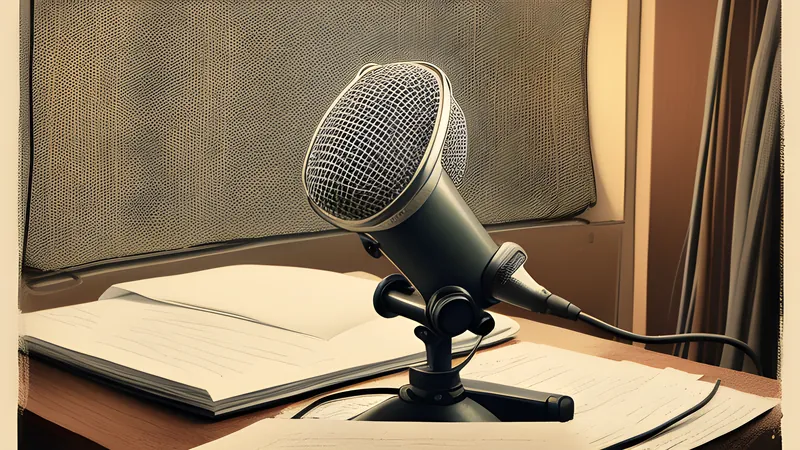
The visual shorthand for podcasting is almost always a large studio condenser microphone, often the distinctive cylindrical shape of a particular popular model, even though most podcasts are recorded on far humbler equipment. Headphones, audio waveforms and the universal triangular play button complete the iconography. The culture around the medium leans hard into mutual promotion, with the feed swap and the guest appearance functioning as a kind of gift economy in which hosts cheerfully send their listeners off to discover one another, treating attention as something to be shared rather than hoarded.
Fun facts
- The word “podcast” was named Word of the Year by the New Oxford American Dictionary in 2005, barely a year after Ben Hammersley coined it in print.
- Despite the name’s nod to Apple’s iPod, you have never needed an iPod, or any single device, to listen to one; the term outlived the gadget that inspired it.
- Serial drew more than 5 million downloads on iTunes faster than any podcast before it, a milestone widely credited with dragging the whole medium into the mainstream in 2014.
- President Obama recorded an episode of the comedian Marc Maron’s WTF podcast in 2015 in Maron’s garage in Los Angeles, one of the clearest signs the format had arrived as a serious cultural venue.
- Spotify reportedly paid in the region of 100 million US dollars for exclusive rights to The Joe Rogan Experience in 2020, a sum that would have been unthinkable for a downloadable audio file a few years earlier.
A closing reflection
What strikes me about podcasting is how thoroughly it revived a very old pleasure inside a very new technology. Before print was cheap, knowledge and story travelled by voice, and the listener sat in the presence of the teller. The podcast smuggles that ancient arrangement back into a world of screens and notifications, except that the teller is now a stranger who may be on the other side of the planet, speaking into an ear that chose, deliberately, to listen. A day set aside for it is really a day for the act of listening itself, which remains one of the more generous things a person can do.
Related Content