International Joke Day
Around 1900 BC, a Sumerian scribe pressed into clay what is now reckoned to be the oldest recorded joke in the world. It is a piece of toilet humour about a young wife, too coarse to reproduce here in full, and the striking thing about it is not how funny it is but how recognisable. Four thousand years before anyone thought to invent a calendar of observances, someone wanted to make a stranger laugh. International Joke Day, marked each year on 1 July, is the modern descendant of that impulse: an informal, ungoverned, faintly ridiculous date set aside for the small art of making one another laugh.
Where the day comes from
It would be dishonest to dress up the origins of International Joke Day in grandeur. There is no founding charter, no proclaiming body, no documented first celebration. It belongs to that sprawling category of unofficial “days” that circulate through online calendars and listicles, accumulating a following without ever acquiring an institution. What can be said with confidence is that 1 July has settled into place as its accepted date, and that its very lack of authority is the point. No committee needs satisfying; only a smile.
The day reflects a broader modern appetite for designating playful occasions, and it shares that spirit with other light-hearted entries in the calendar, from International Talk Like a Pirate Day, which began as a private joke between two friends in Oregon, to workplace observances such as Fun at Work Day. What unites them is a refusal to take themselves too seriously, which is more or less the only qualification a joke requires.
A long and disreputable history
If the day is recent, the practice it honours is ancient and surprisingly continuous. The Sumerian gag is the earliest written example, but the Philogelos (“Laughter-Lover”), a Greek joke book compiled around the fourth or fifth century AD, contains more than 250 jokes, many built on character types, the absent-minded scholar above all, that survive almost intact in modern stand-up. The “man walks into a bar” structure would not have baffled a Roman.
Jokes also leave a long paper trail. In England, the first printed jest-books appeared in the early sixteenth century, with collections such as A Hundred Merry Tales (around 1526) gathering bawdy and clever stories for a literate audience; Shakespeare has a character in Much Ado About Nothing mock another by accusing her of getting her wit from that very book. By the eighteenth and nineteenth centuries, almanacs and newspapers ran joke columns as a matter of course, and the riddle and the conundrum became parlour entertainments. The mass-market joke, in other words, is older than the light bulb, and the appetite the modern day serves was being commercially fed centuries ago.
Through the medieval and Renaissance courts of Europe, the professional fool occupied a peculiar and privileged position. A jester such as Will Sommers, attached to the court of Henry VIII, could mock the powerful and voice unwelcome truths precisely because his jokes carried a licence no courtier enjoyed. The court jester was an early demonstration of a principle comedians still rely on: humour can smuggle in what plain speech cannot. From the jester runs an unbroken line through the music-hall comic and the satirical pamphlet to the stand-up performer working a club at midnight. International Joke Day sits, modestly, at the end of that line.
Why it matters
Beneath the silliness, the day brushes against something substantial. Laughter is genuinely good for people: it lowers tension, signals safety, and forges quick rapport between strangers in a way that few other behaviours can. Sharing a joke is an act of trust, an offer that can be accepted or refused, and the accepting binds two people for a moment in a shared way of seeing.
Humour also rewards a particular kind of intelligence, the knack of holding two incompatible ideas together until they collapse into surprise. The best jokes work by misdirection, leading the listener confidently down one path before pulling the rug. A day that encourages people to practise that, even badly, is a day in praise of mental flexibility and of connection, which tend to arrive together.
How it is celebrated
There is no prescribed ritual, which is rather the charm of it. People swap jokes in person and online, post puns and riddles, and tag friends with their worst groan-inducing one-liners. Some offices hold informal joke exchanges or comedy quizzes; teachers and parents trade riddles with children, who embrace the day with an unselfconscious glee adults tend to have mislaid. Comedy clubs and broadcasters occasionally use the date as a hook for themed programming. The cost of entry could hardly be lower: one joke and one willing listener.
Variations from country to country
Humour is universal, but its dialects are local. British comedy leans on irony, understatement and a fondness for the absurd, the deadpan tradition that runs from the music hall through the Goons and Monty Python to the cringe comedy of The Office. American humour more often favours the bold, the observational and the confessional, the stand-up monologue raised to an art form by figures from Lenny Bruce to Richard Pryor. Jewish humour built a whole tradition on wry self-deprecation and the perfectly timed question answered with another question. Japanese manzai pairs a boke (the fool) and a tsukkomi (the straight man) in rapid back-and-forth, a double act with rules as formal as any sonnet.
Wordplay, being bound to a particular language, travels worst of all, so that a pun untranslatable in one tongue finds an entirely different counterpart in another; this is why translating comedy is widely held to be harder than translating poetry. Some forms barely cross borders at all. The British pantomime, with its scripted call-and-response of “He’s behind you!”, baffles most outsiders, while the French and Belgian tradition of the blague Belge or the regional rivalry joke has close cousins everywhere, only with the butt of the joke swapped for the neighbouring town. The day quietly celebrates that variety, while acknowledging that the laugh itself needs no translation.
The shape of a joke
It is worth pausing on what a joke actually does, because the mechanism is more elegant than it looks. Most jokes set up an expectation and then violate it with a second meaning that was hiding in plain sight; the laugh is the sound of the mind catching up. The philosopher Henri Bergson argued in 1900 that we laugh at “the mechanical encrusted upon the living”, the human being behaving like a malfunctioning machine. Freud, a few years later, treated jokes as a socially acceptable release valve for impulses we would otherwise have to suppress. Neither theory explains every joke, which is rather the point: humour is one of the few human universals that has stubbornly resisted being fully explained, even as every culture produces it effortlessly. A day devoted to telling jokes is, in a small way, a celebration of that happy mystery.
Symbols and traditions
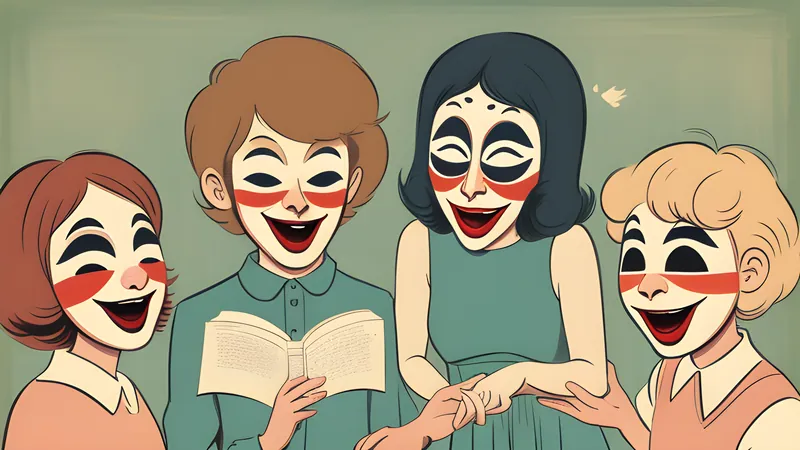
The day has no official emblem, but it borrows the familiar furniture of comedy: the paired theatrical masks of comedy and tragedy, descended from ancient Greek drama, and the cheerful clutter of clown noses, whoopee cushions and rubber chickens. Pride of place goes to the pun, the most maligned and most beloved form of wordplay, which provokes the groan that is, in its own way, a compliment. If the day has a tradition at all, it is the willingness to tell a joke knowing it is terrible, because the groan and the laugh are closer cousins than they look.
Fun facts
- The oldest known joke, that Sumerian quip from around 1900 BC, is a fart joke, which suggests that comic taste has evolved rather less than four millennia might lead one to hope.
- The scholarly study of laughter has a real name, gelotology, from the Greek gelos meaning laughter, and researchers genuinely investigate why and how humans laugh.
- The Philogelos, the surviving ancient Greek joke book, includes a gag about a man who, told that a bald barber had cut him badly, replies that he cannot expect much from a man who cannot even keep hair on his own head, a roast that would land today.
- Young children laugh strikingly more often than adults, and laughter is contagious enough that “canned” studio laughter measurably raises how funny audiences rate the same joke.
A closing reflection
A joke is the rare gift that costs the giver nothing and yet cannot be given alone; it only completes itself in someone else’s laughter. That may be why a day with no founder, no ceremony and no purpose beyond delight has quietly persisted. It asks for the one thing institutions cannot manufacture, a moment of shared, unguarded surprise, and trusts ordinary people to supply it. The worthiest way to mark 1 July, then, is also the easiest: find someone, tell the joke, and let the groan do its work.
Related Content