International Firefighters' Day
International Firefighters’ Day is held every 4 May, and it exists because of five men who died in a single afternoon. In December 1998, a wildfire near the small town of Linton in Victoria, Australia, turned suddenly, and five volunteer firefighters from the Geelong West brigade were killed when the wind shifted and trapped their tanker. In the grief that followed, an Australian firefighter named JJ Edmondson wrote a proposal for an international day of recognition and circulated it by email around the world in 1999. The idea travelled fast through the tight global fraternity of the fire service, and the day was set.
What the day marks
International Firefighters’ Day honours firefighters everywhere, the professional and the volunteer alike, both those who have died in the line of duty and those still serving. It is a day of remembrance and of thanks, an acknowledgement that a firefighter is someone who runs towards the danger that everyone else is fleeing. The observance covers the full breadth of the work, from urban structure fires and road rescues to the vast wildfires that have grown fiercer with a changing climate, and the water rescues, chemical spills and medical emergencies that fill the modern firefighter’s days between the flames.
The date carries its own meaning. The fourth of May is the feast day of Saint Florian, the patron saint of firefighters, which made it the natural anchor for a day about the fire service. Edmondson’s choice tied a brand-new observance to a figure who had symbolised the trade for many centuries, giving the modern day a deep historical root.
Saint Florian and the roots of the trade
Saint Florian was a real man, an officer in the Roman army in the province of Noricum, in what is now Austria, around the year 300. According to the traditional account, he had organised and trained a brigade of soldiers specifically to fight fires, one of the earliest recorded firefighting units. When the emperor Diocletian’s persecution of Christians reached the province, Florian declared his faith and was condemned. The story holds that he was sentenced to be burned, told his executioners that if they did so he would climb to heaven on the flames, and was instead drowned in the River Enns with a millstone tied around his neck, around the year 304.
That a man associated with fighting fire should be martyred by water gives the legend a certain grim symmetry, and it is why images of Saint Florian traditionally show him pouring water from a jug onto a burning building. He became the patron of firefighters, chimney sweeps, brewers and others whose work involved fire and water, and his image still hangs in fire stations across the Catholic world. The colours of the day’s ribbon, red and blue, echo the same pairing, red for the fire and blue for the water that fights it.
History of the modern fire service
Organised firefighting is ancient. Imperial Rome had the Vigiles, a corps of thousands who patrolled the city at night, watching for fires and armed with buckets, hooks and hand-pumped siphons. After Rome fell, formal firefighting largely lapsed in Europe for centuries, and cities burned with terrible regularity. London’s Great Fire of 1666, which destroyed much of the medieval city, prompted the first fire insurance companies, which ran their own private brigades to protect the buildings they had insured, marked with a metal badge or “fire mark” on the wall. Only later did municipal fire brigades, paid for by cities and open to all, replace the patchwork of private and insurance-company crews.
The nineteenth and twentieth centuries brought the steam pump, the motorised engine, breathing apparatus and professional training, transforming firefighting from a desperate bucket chain into a technical profession. The volunteer tradition, meanwhile, never disappeared; across rural Australia, much of Europe and small-town America, the fire service still depends heavily on volunteers who leave their jobs and beds to answer the siren, exactly as the Linton crews did.
Why the day matters
The blunt reason the day matters is that firefighting kills people who choose to do it. Every year firefighters die in structure collapses, in wildfires that turn, in road accidents responding to calls, and slowly, from the cancers and lung disease that decades of smoke and toxic combustion products leave behind. The day insists that this risk be seen and remembered, and that the volunteers who carry so much of the load, unpaid, be thanked. It also serves a practical purpose, raising money for firefighter charities and for the families of the fallen, and drawing attention to fire safety in the wider public.
How the day is observed
The central ritual of International Firefighters’ Day is the sounding of sirens. At a set moment, fire services around the world sound their sirens for around thirty seconds followed by a minute of silence, a collective salute across time zones. People are encouraged to wear or display red and blue ribbons, and communities hold memorial services, open days at fire stations, and fundraising events. Social media fills with tributes to local brigades and to firefighters lost. In many places the day doubles as an opportunity for the public to meet their local crews, tour the appliances, and learn how to prevent the fires that firefighters would otherwise have to fight.
Symbols of the fire service
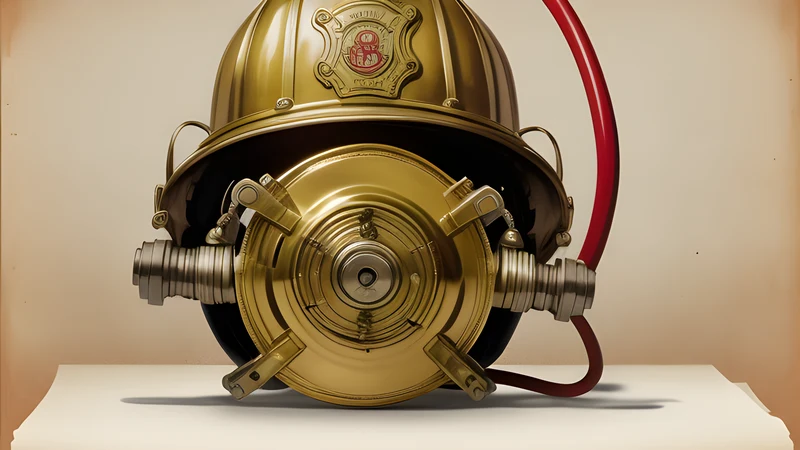
Beyond the red-and-blue ribbon, the fire service carries a rich set of emblems. The Maltese cross, the eight-pointed cross of the medieval Knights Hospitaller of Saint John, was adopted as a firefighting symbol because those knights fought fires among other duties and because the cross came to stand for the protection of others at cost to oneself. The brass helmet, the coiled hose, the axe and the red engine are all instantly legible worldwide. Each is a piece of shorthand for a profession built on courage and equipment in equal measure, and the day leans on all of them.
A day among the essential trades
International Firefighters’ Day belongs to a small cluster of observances devoted to the people who hold public safety together, often at real personal cost and frequently without much public notice. It sits naturally alongside World Plumbing Day, which honours the sanitation workers whose pipes prevent the epidemics that once emptied cities, and International Day of the Midwife, which marks the practitioners who guide new life into the world. Each of these days makes the same quiet argument: that the trades a society depends on most are often the ones it thinks about least, and that setting a date to notice them is a modest act of gratitude worth repeating.
The comparison is not idle. Firefighters, like midwives and sanitation engineers, work in a domain where success is invisible and failure is catastrophic. A fire prevented, a rescue that goes smoothly, a station that answers a call at three in the morning and is home by dawn, these leave no headline. The public tends to see firefighters only in disaster, which is precisely why a day of deliberate recognition matters; it corrects for the fact that competent, everyday service is, by design, unremarkable.
The modern hazards of the job
The dangers firefighters face have shifted over the past century in ways the public rarely appreciates. Modern homes are filled with synthetic materials, plastics and foams that burn hotter, faster and far more toxically than the timber and cotton of a century ago, so a modern room fire reaches lethal “flashover” temperatures in a fraction of the time it once did. The smoke itself is a chemical soup, and long-term exposure has made occupational cancer one of the leading causes of death among career firefighters, a slow toll that outlasts the dramatic ones. Wildfires, meanwhile, have grown larger and more erratic as the climate warms, putting the volunteer bushfire brigades of Australia, the western United States and southern Europe under pressures their founders never imagined. International Firefighters’ Day, in remembering the Linton five and all who followed, keeps these evolving dangers in public view.
Fun facts
The day was created in 1999 by an Australian firefighter, JJ Edmondson, in direct response to the deaths of five volunteers in the Linton bushfire the previous December, and it spread around the world by email at a time when that was still a novel way to launch a movement.
Saint Florian, the patron saint whose feast day gives the observance its date, is said to have been drowned rather than burned, giving the patron of firefighters a martyrdom by the very element used to fight fire.
The Maltese cross worn by so many fire services traces to the Knights of Saint John, whose members were burned fighting fires set by enemy forces during the Crusades, and the cross became a badge of that sacrifice.
Ancient Rome’s fire brigade, the Vigiles, numbered in the thousands and also functioned as a night police force, making the world’s first large organised firefighters double as its first beat officers.
A closing reflection
International Firefighters’ Day sits on the feast of a Roman officer martyred seventeen centuries ago and was set in motion by the deaths of five volunteers on an Australian afternoon, and the span between those two facts is the whole point. The danger has not changed, only the tools. Someone still has to walk into the smoke, and someone always has. When the sirens sound together on 4 May, they are answering a call that has never stopped, and thanking the people who keep choosing to run the wrong way down the street.
Related Content