International Day of Girls in ICT
In 2010, the member states of the International Telecommunication Union — the United Nations agency that has coordinated the world’s telegraphs, telephones and radio spectrum since 1865 — passed a resolution creating a day to draw girls and young women into technology careers. The first International Girls in ICT Day was held in 2011, and it falls each year on the fourth Thursday of April. ICT stands for information and communication technology, the sprawling field of computing, networks, software and telecommunications, and the day exists to confront a stubborn fact: women are badly under-represented in the industry that increasingly runs the world.
The problem the day was built to address
The numbers are stark and have proved slow to move. Across most of the world, women hold a minority of jobs in the technology sector, and the proportion shrinks further in technical and leadership roles. In many countries the share of women among computer-science graduates actually fell between the 1980s and the 2010s, even as computing itself exploded in size and importance. The pipeline narrows early: girls often disengage from computing in their early teens, well before university choices are made, discouraged by a mix of cultural signals, a shortage of visible role models, and the persistent stereotype that coding is a boy’s pursuit.
The International Telecommunication Union, known as the ITU, framed this as both a fairness problem and an economic one. A technology industry drawing on half the available talent designs products for half the population. Closing the gap widens the workforce at a moment when the world faces a chronic shortage of skilled technologists, and it means the tools shaping daily life are built by teams that resemble the people who use them.
The history: from resolution to global movement
The day’s origin lies in the ITU’s Plenipotentiary Conference of 2010 in Guadalajara, Mexico, where member states adopted the resolution establishing it. The choice of host agency was fitting. The ITU is one of the oldest international organisations in existence, founded in 1865 to standardise the telegraph, and it has spent a century and a half at the centre of every communications revolution since. Charging it with the gender gap in technology placed the campaign on a global, intergovernmental footing from the start.
What began as a single awareness day grew into a sustained programme. The ITU built a “Girls in ICT” portal to coordinate events, published toolkits for organisers, and encouraged governments, universities and companies to host their own activities. By the late 2010s the day was being marked in well over a hundred countries, with hundreds of thousands of girls and young women taking part in workshops, mentoring sessions and site visits each year. The observance also acquired annual themes, steering attention toward specific issues such as access to digital skills, safety online, and the role of technology in achieving development goals.
Why it matters
Beyond the workforce statistics, the day matters because technology is no longer a specialist niche; it is the substrate of modern economies, government services, healthcare and communication. Decisions about how software is built, what data it collects, and whom it serves have consequences for everyone. When those decisions are made by a narrow slice of the population, the results can encode blind spots — from voice-recognition systems that struggle with women’s voices to medical algorithms trained mostly on male data.
The day also matters for the girls themselves. Technology careers are among the better-paid and more flexible in the modern economy, and shutting girls out of them early narrows their futures for reasons that have nothing to do with aptitude. Study after study finds no meaningful gap in mathematical or computational ability between girls and boys; the gap is one of encouragement, expectation and belonging. The campaign shares its logic with the broader push behind World Engineering Day, which confronts the same imbalance in the engineering professions.
How it is celebrated
The signature activity is the immersive day-out. Technology companies, universities and government agencies open their doors to school-age girls, who spend the day coding simple games, building websites, meeting women engineers, touring data centres and trying their hands at robotics or app design. The aim is to replace an abstract, often intimidating idea of “working in tech” with something concrete and welcoming: a real workplace, a real mentor, a project the girl herself built before lunch.
Mentorship runs through the whole enterprise. Established women in technology speak at events, share their career paths, and often stay in touch with participants afterward. Coding clubs, hackathons and scholarship announcements cluster around the date, and social-media campaigns under hashtags like #GirlsinICT circulate the stories of women working in the field. In many countries the day is backed by national ministries and major employers, giving it reach into schools that a purely grassroots effort could not manage.
Variations and global context
The day’s flexibility is one of its strengths, because the barriers it addresses differ sharply by region. In parts of sub-Saharan Africa and South Asia, the more immediate obstacle is basic access — to electricity, to devices, to the internet at all — and events there often combine digital-skills training with the message that girls belong in these spaces. In wealthier countries with near-universal connectivity, the focus tilts toward retention: keeping girls engaged with computing through their teens and countering the cultural coding of tech as male territory.
Some regions have built their own strong traditions around the observance. The Arab states, Latin America and parts of Asia run large coordinated programmes, and the European Union has folded the day into wider digital-skills initiatives. The campaign connects, too, with the broader constellation of technology observances that includes Programmers’ Day, which celebrates the coders many of these girls may one day become.
Traditions and symbols
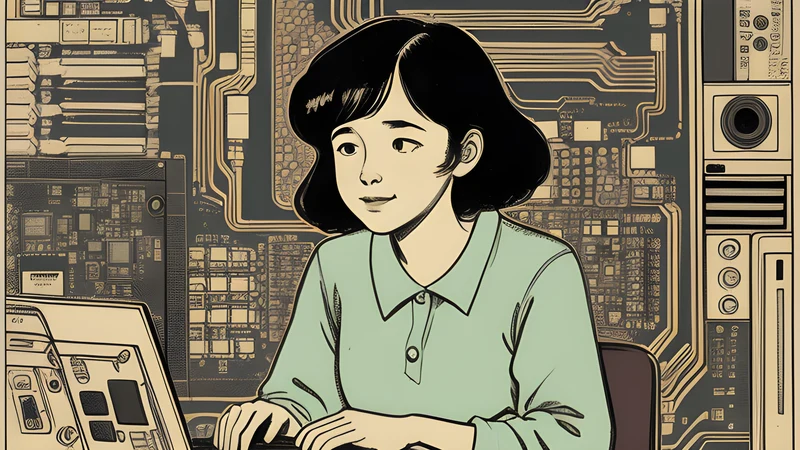
The day has no single fixed emblem, but its imagery is consistent: girls at keyboards, circuit-board motifs, lines of code, robots and the recurring visual of a young woman looking directly and confidently at a screen. The ITU’s branding leans on bright, optimistic design meant to strip away the grey, masculine cliché of the computer lab. The recurring message, repeated across languages and posters, is simply that this world has room for her.
Fun facts
The agency behind this thoroughly modern day, the ITU, is older than the telephone, the light bulb and the motor car — founded in 1865 to manage the international telegraph network.
The history of computing is full of women whose pioneering work the day seeks to reclaim: Ada Lovelace, who wrote what is often called the first algorithm in the 1840s; Grace Hopper, who developed early compilers and popularised the term “debugging”; and the largely female teams who programmed the earliest electronic computers in the 1940s, when programming was considered clerical work.
The day is deliberately floating rather than fixed, always landing on the fourth Thursday of April, so that it can slot into the school term across the northern hemisphere and reach girls while they are actually in class.
In several countries, the proportion of women earning computer-science degrees was higher in the mid-1980s than it is today — a reversal that helped convince the ITU the gap would not close on its own.
The barriers that keep the gap open
Researchers who study the leak in the pipeline tend to converge on a handful of causes, and the day’s programmes are designed against each. The first is visibility: children form ideas about who “does” computing remarkably early, and a girl who never sees a woman writing code absorbs the quiet assumption that the work is meant for someone else. The second is confidence rather than competence; studies repeatedly find girls rating their own technical ability below boys of identical measured skill, and abandoning computing subjects they could comfortably pass. The third is culture — the coding-club atmosphere, the gaming in-jokes, the informal pecking orders that can leave a lone girl feeling like an intruder in her own classroom.
Structural obstacles compound the social ones. In many school systems computing is optional and taught late, so the decision to pursue it collides with every discouraging signal a teenager has already absorbed. Access widens the gap where devices and connectivity are scarce, and in many households girls get less unsupervised screen time than their brothers, less licence to tinker and break things and learn by trial. The ITU’s insistence on hands-on, often girl-only events is a direct answer to all of this: a space where a beginner can fail at a task without an audience of more experienced boys, and where the person demonstrating the robot arm looks like her. No single intervention claims to close the gap on its own. The wager behind the day is cumulative — that enough small, well-timed encounters, repeated across enough girls and enough years, will shift the unspoken default about who belongs in the room.
A closing reflection
The talent to build software is distributed evenly across humanity; the encouragement to develop it is not. That single mismatch is what the fourth Thursday of April exists to correct. Every girl who spends the day writing her first working line of code carries away something an argument cannot give her — the plain evidence that she can do it. The world she will help design is better for having her hand on it.
Related Content