International Chess Day
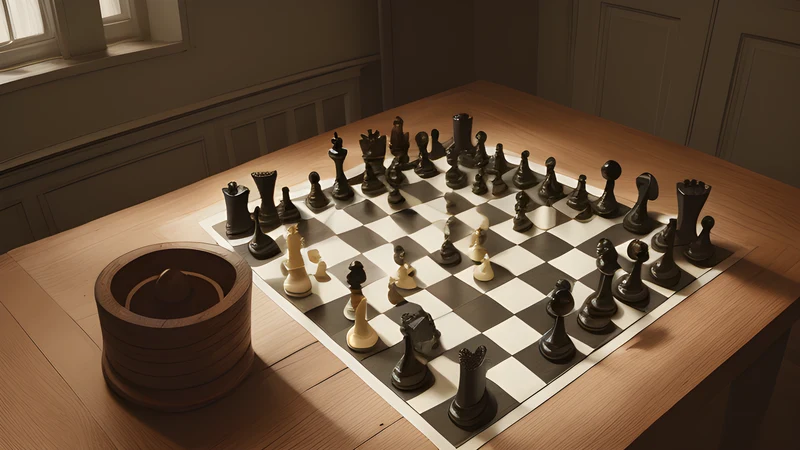
On 20 July 1924, delegates from fifteen countries gathered in Paris during the summer Olympic Games and founded the Fédération Internationale des Échecs, the world governing body still known by its French initials FIDE. They adopted a motto that has aged remarkably well, “Gens una sumus”, Latin for “we are one people”. Four decades later FIDE turned the anniversary of its own birth into International Chess Day, and in 2019 the United Nations gave the date its blessing, so that every 20 July the oldest board game still in serious competitive play gets a global holiday.
From a Paris congress to a UN resolution
FIDE proposed International Chess Day in 1966, choosing 20 July because it was the federation’s founding date. For half a century it remained a celebration observed mainly within the chess world, marked by tournaments and club events. That changed on 12 December 2019, when the United Nations General Assembly adopted resolution 74/22, proclaiming 20 July as World Chess Day and praising the game as an affordable, inclusive activity that crosses language and social barriers. India, the country where the game began, was among the resolution’s sponsors, a neat closing of a very long circle.
History on sixty-four squares
Chess descends from a game called chaturanga, played in northern India during the Gupta period around the sixth century. Its name refers to the four divisions of an ancient army, infantry, cavalry, elephants and chariots, which survive on the modern board as pawns, knights, bishops and rooks. From India the game travelled to Persia, where it became shatranj. The Persian phrase spoken when a king was trapped, “shah mat”, meaning “the king is helpless”, gives English the word checkmate.
When Arab armies absorbed Persia in the seventh century they carried the game westward across North Africa and into Moorish Spain, where Europeans encountered it around the tenth century. For centuries the medieval game moved slowly; the queen and bishop were feeble pieces that shuffled one square at a time. Then, in fifteenth-century Spain and Italy, players granted the queen her sweeping modern range and the bishop its long diagonals. Contemporaries called the faster version “mad queen chess”, and it is essentially the game played today.
The modern competitive era began in London in 1851 with the first international tournament, won by the German Adolf Anderssen. In 1886 Wilhelm Steinitz beat Johannes Zukertort in a match recognised as the first official contest for the world championship, a title Steinitz then held while formalising the positional principles that turned chess from romantic attacking flair into disciplined strategy.
The Cold War on a board
Nothing raised chess to global spectacle like the rivalry between the Soviet Union and the West. The Soviet state treated the game as proof of intellectual superiority, pouring resources into training and dominating the world championship for decades. That machine met its most famous challenger in 1972, when the volatile American Bobby Fischer travelled to Reykjavik to face the Soviet champion Boris Spassky. The “Match of the Century” was front-page news around the world; Fischer’s victory ended a quarter-century of Soviet monopoly and, for a while, made a chessboard the most watched object on Earth.
The next revolution came from silicon. In 1997 the IBM supercomputer Deep Blue defeated the reigning world champion Garry Kasparov in a six-game match, the first time a machine had beaten a sitting champion under standard tournament conditions. Two decades on, the program AlphaZero taught itself chess in a matter of hours in 2017 by playing against itself, then dismantled the strongest conventional engines with a style commentators described as unnervingly human. Far from killing the game, the machines have become its most demanding teachers.
The champions who defined the title
The unbroken line of world champions reads like a history of the modern mind under pressure. Emanuel Lasker, a mathematician and friend of Albert Einstein, held the crown for twenty-seven years from 1894, the longest reign in the game’s history. The Cuban José Raúl Capablanca, who succeeded him, played with such fluent simplicity that opponents spoke of him as a natural force rather than a student of theory. Alexander Alekhine, who took the title from Capablanca in 1927, brought a ferocious attacking imagination and died in 1946 still holding the championship, the only champion never to lose it in a match.
The women’s game produced its own dynasty. Vera Menchik dominated the first women’s world championship from 1927 until her death in a London air raid in 1944, and later the Georgian and Soviet schools produced a run of formidable champions. In the 1980s and 1990s the Hungarian sisters Susan, Sofia and Judit Polgar, raised by their father in a deliberate experiment to prove that genius is made rather than born, upended assumptions about the game; Judit became the strongest female player in history and beat several reigning world champions in open competition rather than segregated events.
Why the day matters
Chess is one of the very few pursuits that a child in a village square and a grandmaster in a championship hall play by identical rules. It needs no common language, little money and no physical advantage, which is exactly why the United Nations singled it out as a tool for education and inclusion. Studies have linked regular play to gains in concentration, planning and pattern recognition, and schools on every continent use it to teach patience and consequence to children who would never sit still for a lecture. The day exists to celebrate a rare thing: a game that is simultaneously ancient, universal and genuinely difficult.
How it is celebrated
Chess clubs and national federations use 20 July for open tournaments, simultaneous exhibitions in which a master plays dozens of opponents at once, and outdoor events that set giant boards up in city squares. Online platforms, which now host millions of games a day, run themed events and puzzles. Schools and libraries organise beginners’ sessions, and charities use the date to distribute sets in places where they are scarce. Since the pandemic drove much of the game online, the celebrations have become a hybrid of the physical and the digital, with grandmasters streaming to audiences far larger than any tournament hall could hold.
A game reborn on screen
Chess has enjoyed an unlikely popular revival. The 2020 television series The Queen’s Gambit, following a fictional orphan’s rise through the male-dominated tournament world of the 1960s, sent sales of chess sets soaring and drew millions of new players to online sites. It was an old lesson relearned: the game photographs beautifully, carries obvious drama in its clash of two minds, and rewards a storyteller willing to trust an audience with its silences.
The game had long haunted the arts before television found it. Marcel Duchamp abandoned painting at the height of his fame to play competitive chess and represented France in international team events, insisting that a well-played game was itself a work of art. Vladimir Nabokov built his novel The Defence around a grandmaster undone by the game, Stefan Zweig his final novella around a match on an ocean liner, and Ingmar Bergman staged the most famous chess scene in cinema when a knight plays the game against Death himself in The Seventh Seal. The board has always offered writers a ready-made image of fate, choice and the cost of thinking too far ahead.
Fun facts
The number of possible distinct chess games is so vast that the physicist Claude Shannon estimated it in 1950 at around ten to the power of one hundred and twenty, a figure now called the Shannon number and larger than the estimated count of atoms in the observable universe.
The longest tournament game on record, played between Ivan Nikolic and Goran Arsovic in Belgrade in 1989, lasted 269 moves over more than twenty hours and ended in a draw.
The folding chessboard was reputedly invented by a priest who was forbidden to play the game and disguised his board as two books that closed together on a shelf.
The word “checkmate” and the word “rook” both entered English from Persian and Arabic, while “gambit”, an opening in which a player sacrifices a pawn for position, comes from the Italian “gambetto”, a wrestler’s trip of the leg.
The shortest possible checkmate, known as Fool’s Mate, takes just two moves, and requires one player to make two spectacularly bad choices in a row.
The most expensive chess set ever made, the Jewel Royale, was valued at close to ten million pounds, its pieces cast in gold and platinum and studded with diamonds, rubies and sapphires.
The largest chess tournament in history, held in Ahmedabad in India in 2010, gathered more than twenty thousand players in a single hall, a fitting record for the country where the game was born.
The eighteenth-century sensation known as the Turk, a mechanical figure that toured Europe apparently playing and beating human opponents, was an elaborate hoax; a strong human player sat hidden inside the cabinet, working the machine’s arm.
A closing reflection
A chessboard holds no hidden information; both players see everything, and every defeat is entirely one’s own. That transparency is the quiet cruelty of the game and also its enduring appeal, because it rewards nothing but clear thinking under pressure. Fifteen centuries after Indian courtiers first arranged their little army of infantry and elephants, the same thirty-two pieces still teach the same difficult lesson about foresight and consequence to anyone willing to lose a few hundred games learning it. Those drawn to that particular pleasure might also spend an afternoon with World Sudoku Day, or trace the deeper logic beneath the board on the International Day of Mathematics.
Related Content