International Cheetah Day
In 2010, the conservationist Dr Laurie Marker chose 4 December for International Cheetah Day, a date she picked in memory of Khayam, a cheetah she had raised by hand in the late 1970s. Marker had brought Khayam from a wildlife park in Oregon to Namibia to test whether a captive-born cheetah could learn to hunt, and the experience convinced her that the species faced extinction unless someone devoted a life to saving it. She founded the Cheetah Conservation Fund in Namibia in 1990 and, twenty years later, established the day to focus the world’s attention on an animal that has been vanishing quietly for decades.
The fastest land animal on Earth
The cheetah, Acinonyx jubatus, is built entirely for speed. It can accelerate from standstill to around a hundred kilometres per hour in roughly three seconds, faster than most sports cars, and reach top speeds of between ninety-three and a hundred and twenty kilometres per hour in a sprint that rarely lasts more than half a minute. Every part of its body serves that specialism: an oversized heart and lungs, wide nostrils for gulping air, a long flexible spine that acts like a spring, and a heavy tail that works as a rudder to steer through the tight turns of a chase.
Its feet are unusual among cats. The cheetah’s claws are only semi-retractable, gripping the ground like the studs on a running shoe, and hard pads give it traction at speed. It is also the only big cat that cannot roar; instead it chirps, almost like a bird, and purrs like a domestic cat. These are the adaptations of a pursuit predator that survives by outrunning its prey rather than ambushing it, and they make the cheetah unlike any other animal in the cat family.
The history: from ancient companion to endangered species
Humans have known and prized the cheetah for millennia. Ancient Egyptians kept them as symbols of royalty, and Mughal emperors, Persian nobles and Indian maharajas used trained cheetahs for hunting, a practice known as coursing that persisted for centuries. The Mughal emperor Akbar is said to have kept a great many hunting cheetahs in the sixteenth century. This long history of captivity, however, never produced a self-sustaining captive population, because cheetahs breed poorly in confinement, a problem that would later prove central to their conservation.
The twentieth century was catastrophic for the species. The Asiatic cheetah, once found from the Arabian Peninsula across to India, was hunted and squeezed almost to nothing; India declared it extinct within its borders in 1952, and today fewer than fifty Asiatic cheetahs survive, all of them in Iran. In Africa, the cheetah’s range contracted to a fraction of what it had been as farmland, fences and livestock replaced open country. Marker’s work in Namibia from 1990 onward was a direct response to this collapse, and the day she created in 2010 exists to keep the decline from being forgotten.
Why it matters
The cheetah is one of the most vulnerable of the big cats, with wild numbers estimated at only around seven thousand across Africa and that small remnant in Iran. The species carries an additional, invisible handicap: a genetic bottleneck, thought to date to the end of the last ice age around ten thousand years ago, left all living cheetahs remarkably similar to one another genetically. This low diversity weakens their resistance to disease and complicates breeding, meaning the population is fragile in ways that raw numbers do not capture.
Most cheetahs now live outside protected reserves, on farmland where they come into conflict with people who keep livestock. This makes their survival a human problem as much as a wildlife one, dependent on persuading farmers that a live cheetah is worth more than a dead one. The day’s conservation message shares its logic with wider campaigns such as World Wildlife Conservation Day and the effort behind International Vulture Awareness Day, each of which confronts a species being lost to a shrinking, human-dominated landscape.
How it is celebrated
Zoos, wildlife charities and schools mark 4 December with educational events, fundraising drives and campaigns to spread the cheetah’s story. The Cheetah Conservation Fund, which Marker still leads from its base in Namibia, uses the day to highlight its work: breeding livestock-guarding dogs that protect farmers’ herds without killing predators, running education programmes for rural communities, and rescuing cheetah cubs from the illegal pet trade that drains the wild population of the Horn of Africa.
Around the world, the day generates a surge of online storytelling, with images and facts about cheetahs shared to reach people who may never see one in the wild. Sanctuaries hold special talks, some offer symbolic cheetah adoptions to raise funds, and conservation groups use the moment to press for stronger protection of the species and its habitat. The tone is urgent but hopeful, built on the conviction that public attention translates, however slowly, into survival.
World variations and the guarding-dog solution
The cheetah’s plight looks different across its range, and so does the response. In Namibia, Botswana and neighbouring countries, the flagship innovation has been the livestock guardian dog: large breeds such as the Anatolian shepherd, placed with farmers as puppies to grow up protecting goats and sheep. A well-trained guardian dog deters cheetahs by barking and posturing rather than fighting, and the programme has measurably reduced the number of cheetahs shot by farmers who once saw no alternative. It is one of conservation’s quiet success stories, exported from Namibia to other predator-conflict zones.
In Iran, the last stronghold of the Asiatic subspecies, the challenge is different and far more precarious, focused on protecting a tiny remnant population from road deaths, poaching of their prey, and habitat fragmentation. Elsewhere, ambitious efforts to return cheetahs to countries where they had vanished — including a recent, closely watched project to reintroduce African cheetahs to India — test whether the species can be re-established in landscapes it once roamed.
Traditions and symbols
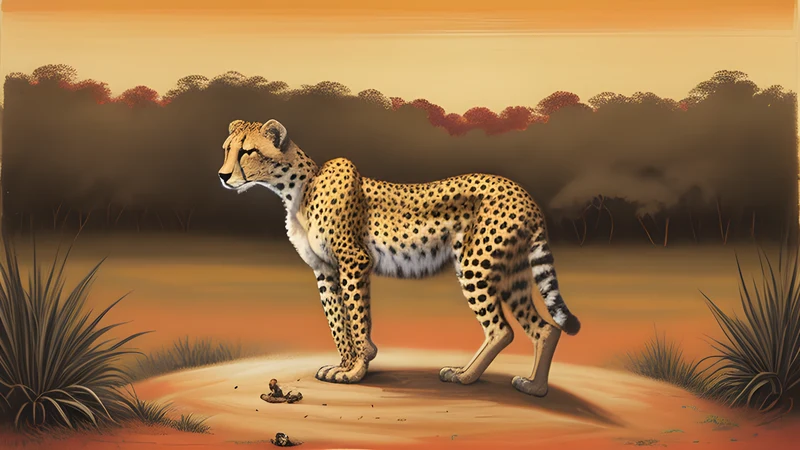
The cheetah’s distinctive markings make it instantly recognisable and central to the day’s imagery: the golden coat scattered with solid black spots, and the two dark “tear lines” running from the inner corners of each eye down to the mouth. Those tear marks are thought to cut glare from the bright savannah sun, helping the cat fix on distant prey, and they double as the animal’s visual signature in art and logos. The image of a cheetah poised on a raised termite mound, scanning the horizon, has become the emblem of the day.
Fun facts
The cheetah cannot roar because of the structure of its voice box; instead it makes a high chirping call, remarkably like a bird’s, to locate cubs or other cheetahs across open ground.
During a full sprint a cheetah spends more than half of each stride with all four feet off the ground, effectively flying between bounds, and its flexible spine flexes and extends to lengthen each leap.
A rare coat variant called the king cheetah, marked by bold stripes and blotches rather than spots, was once thought to be a separate species; it is now known to result from a single recessive gene.
Cheetahs hunt by day, unlike most big cats, partly to avoid competition with the lions, leopards and hyenas that hunt at night and would happily steal a cheetah’s kill or kill its cubs.
Despite their speed, cheetahs succeed in only about half of their hunts and must eat quickly, because a cheetah exhausted by a sprint often loses its meal to stronger scavengers before it can recover its breath.
The illegal cub trade
One of the gravest modern threats is invisible out on the savannah: the smuggling of cheetah cubs out of the Horn of Africa to be sold as status pets in parts of the Arabian Peninsula. Traffickers take cubs from the wild while they are only weeks old, and most die in transit from dehydration, malnutrition or disease before they ever reach a buyer. Conservationists estimate that for every cub delivered alive, several perish along the way, a loss the small East African population can ill afford. The Cheetah Conservation Fund runs a safe house in Somaliland to care for confiscated cubs, hand-rearing the survivors, which can almost never be returned to the wild because they were taken too young to learn how to hunt. International Cheetah Day is used each year to press governments to enforce the trade bans that already exist on paper, and to shrink the demand that makes a stolen wild cub worth the journey in the first place.
A closing reflection
An animal shaped so completely for a single purpose is a marvel and a liability at once; the cheetah’s brilliant speed is useless against a fence, a rifle or a shrinking map. The day Laurie Marker built around the memory of one hand-raised cheetah asks a simple question of everyone who marks it — whether the fastest creature on land, having outrun everything in nature for millions of years, can outlast the century in which it finally met something faster than itself.
Related Content