Icelandic Thorrablot
On a Friday in the dead of the Icelandic winter, when the wind drives off the North Atlantic and the daylight lasts only a few grey hours, a hall fills with people sitting down to eat fermented shark, singed sheep’s head and a caraway spirit nicknamed “Black Death”. This is Þorrablót, Iceland’s midwinter feast, and the willingness to eat such things is the point of it. The festival is tied to the old Icelandic month of Þorri, which begins deep in January, and it turns the bleakest stretch of the year into an occasion for song, poetry and a defiantly hearty spread of food.
What the name preserves
The name itself is a small piece of the old Norse calendar lodged inside modern Icelandic. Þorri was the fourth winter month of the historical Icelandic reckoning, running roughly from mid-January to mid-February, and according to the old calendar it began on the first Friday after the nineteenth of January, a day still known as Bóndadagur, or “Husband’s Day”. The second half of the name, blót, is an Old Norse word for a sacrificial feast or offering. Together they describe, literally, a sacrificial feast held in the month of Þorri.
There was once a figure to match the name. The Orkneyinga saga and the Flateyjarbók manuscript preserve a story in which Þorri appears as an early king, the son of Snær (“Snow”), and the Kvens are said to have made a yearly midwinter sacrifice to him. How much of that mythic material connects to any real ancient rite, and how much is later literary embellishment, is genuinely uncertain and debated among scholars. What is not in doubt is that the month of Þorri has long stood in the Icelandic imagination for the hard middle of winter.
A nineteenth-century revival
The Þorrablót that Icelanders celebrate today is largely a deliberate revival rather than an unbroken ancient custom, and it has a surprisingly specific birthplace. The first known modern celebration was organised in 1873 not in Iceland but in Copenhagen, by the association of Icelandic students living in the Danish capital. This was the great age of Romantic nationalism across Europe, and Iceland’s own independence movement was gathering force; reviving an old midwinter feast was a way for expatriate Icelanders to honour the Norse past and assert a distinct national identity. The parallel often drawn is to Scotland’s Burns Night, another nineteenth-century invention that wrapped national feeling around a shared meal.
From those student gatherings the festival spread back to Iceland and grew steadily, becoming a fixture of community life through the twentieth century. The food that defines it today, however, draws on something older than the revival: the genuine survival diet of a people who once had to preserve every scrap of protein to last the winter.
Why it matters to Icelanders
To sit down to a Þorrablót platter is to eat, deliberately, the foods that kept earlier generations alive through lean and lightless winters before refrigeration existed. The cured lamb, the dried fish, the fermented shark and the boiled sheep’s head were not delicacies in their origin but necessities, the products of every technique a cold, isolated society could devise to stop meat and fish from rotting. Eating them now is an act of remembrance, a way of touching the hardship that shaped the country.
There is also defiance in it. Þorrablót falls at the lowest point of the year, when it would be easy to retreat indoors and wait for spring. Instead, Icelanders gather precisely then, turning the worst of the season into the reason for a party. The feast binds a community together at the moment it is most tempted to scatter, which is no small thing in a country of long, dark, weather-bound nights.
The food’s strangeness to outside palates is, for Icelanders, part of its value rather than an embarrassment. In an age when supermarkets sell the same products in Reykjavík as in any European capital, the þorramatur platter is unmistakably and only Icelandic. To eat it is to taste something that cannot be bought as a global commodity, a flavour that belongs to one island and one history, and that distinctiveness has become more precious, not less, as everything else has grown more uniform.
How it is celebrated
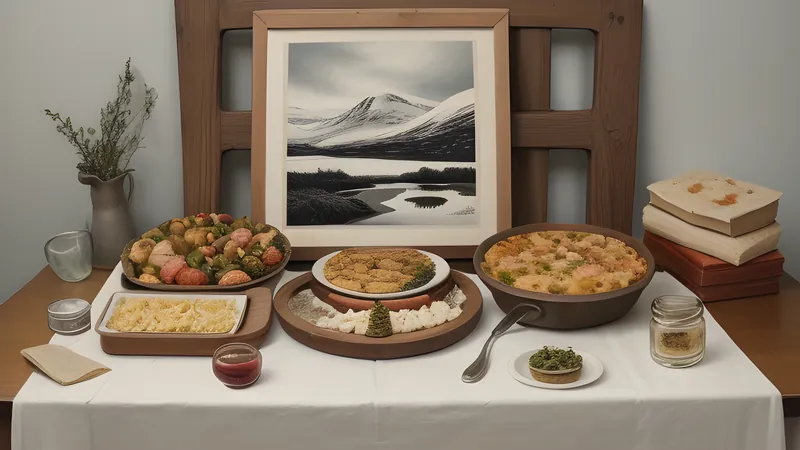
A Þorrablót takes the form of a communal dinner, held in halls, restaurants or community centres, and built around speeches, toasts, singing and the recitation of poetry. The verse tradition is strong; the gathering was originally a place to declaim and to honour, and old songs and newly written satirical poems both feature. The centrepiece is the food, served as a shared platter known as þorramatur.
Lubricating all of it is brennivín, the unsweetened, caraway-flavoured Icelandic schnapps whose grim black label and fierce reputation earned it the nickname svartidauði, “Black Death”. The drink has an odd origin: when Iceland imposed restrictions on alcohol in the early twentieth century, the bottle was reportedly given a stark black label partly to discourage drinkers, an attempt at deterrence that instead handed the spirit its sinister, memorable identity. A shot of it is the traditional accompaniment to the more challenging dishes, and the merriment tends to rise as the platter is worked through. The format owes something to its Romantic-nationalist cousins across Europe; like Burns Night, a Þorrablót is as much an evening of recitation and toasting as it is a meal, the food and the words doing equal work.
The platter and what it means
The þorramatur is the festival’s defining symbol, and almost every item on it is a lesson in preservation. There is hangikjöt, smoked lamb, and harðfiskur, wind-dried fish torn into strips. There are blood and liver sausages, slátur, sewn into sheep’s stomachs. There is súrmatur, an array of meats soured in fermented whey, the old Icelandic answer to the lack of salt. And there are the two famously confronting dishes: svið, a singed and boiled sheep’s head sometimes served whole and sometimes pressed into a kind of brawn, and hákarl, the fermented Greenland shark.
Hákarl deserves its reputation. The flesh of the Greenland shark is laced with compounds, including high levels of urea and trimethylamine oxide, that make it poisonous when fresh. To render it edible, Icelanders bury or press the meat to drain its fluids, then hang it to dry for months, a slow curing that breaks down the toxins and leaves behind a soft, ammoniac, deeply pungent fish. Eating a cube of it, chased with brennivín, is the rite of passage at the heart of the feast.
Thorrablot beyond Iceland
The festival travels. Icelandic communities abroad, from North America to mainland Europe, host their own Þorrablót dinners, shipping in or improvising the traditional foods so that expatriates can keep a taste of home in midwinter. For outsiders and curious guests, the meal is a vivid, sometimes daunting introduction to Icelandic culture, and the readiness with which hosts press fermented shark and sheep’s head on visitors is itself a gesture of pride and welcome. The festival’s roots among expatriate students in Copenhagen mean that celebrating it far from home is, in a sense, exactly how it began.
That impulse to safeguard a distinct identity at the table mirrors the same national feeling that bursts into the open each summer on Icelandic National Day, the celebration of the republic founded in 1944. Both occasions, the dark-winter feast and the midsummer parade, are bound up with the same fierce attachment to language and inherited story that Iceland shares with the wider world each year on International Mother Language Day.
Fun facts
- Fermented shark is poisonous when fresh, and only the months-long curing process, which breaks down the toxic urea and trimethylamine oxide in the meat, makes it safe to eat.
- The first modern Þorrablót was held in 1873 in Copenhagen, organised by Icelandic students living in Denmark rather than by anyone in Iceland itself.
- The festival’s name embeds a fragment of the old Norse calendar, the winter month of Þorri, in everyday modern Icelandic.
- Brennivín, the spirit that accompanies the feast, is nicknamed svartidauði, “Black Death”, a label that hints at its strength and its grim black bottle.
- The month of Þorri traditionally opens on Bóndadagur, “Husband’s Day”, and closes on Konudagur, “Women’s Day”, framing the whole stretch of deep winter between two domestic celebrations.
A closing reflection
Most cultures meet their hardest season by withdrawing from it. Iceland chose, in the nineteenth century and then ever since, to sit down in the middle of it and eat the very things that once stood between its ancestors and starvation. There is something bracing in that decision: a refusal to be diminished by the dark, and an insistence that even the bleakest weeks are worth gathering for. The fermented shark on the platter is not really a test of nerve so much as a reminder of how thin the margin once was, and how a people learned to make a feast of survival itself.
Related Content