Fibonacci Day
Write out the twenty-third of November the American way and you get 11/23, which is the opening of one of the most recognisable number sequences in mathematics: 1, 1, 2, 3, where each term is the sum of the two before it. That small coincidence of the calendar is the whole reason for Fibonacci Day, an informal observance kept by mathematicians, teachers and puzzle enthusiasts. It honours Leonardo of Pisa, a merchant’s son who around the year 1202 wrote a fat commercial manual that, almost as an aside, planted a sequence and a numbering system that would outlast every ledger he ever balanced. The date is fixed, the mood is playful, and the underlying idea is genuinely one of the tidiest in all of arithmetic.
The Man Called Fibonacci
Leonardo of Pisa was born around 1170 in the Republic of Pisa, then a formidable Mediterranean trading power. His father, Guglielmo, was a customs official posted to Bugia (modern Béjaïa, in Algeria), a bustling port on the North African coast, and the boy travelled out to join him. There, and on later trading journeys around the Mediterranean — Egypt, Syria, Greece, Sicily and Provence all appear in his own account — he was schooled by Arab merchants and mathematicians in a method of calculation far superior to anything in use back home. Christian Europe still reckoned with Roman numerals and the abacus, a clumsy business once you tried to multiply CCXLVII by anything at all. The Arab world, drawing on Indian sources, used a system of nine digits and a symbol for nothing, and Leonardo saw at once how powerful it was.
The name “Fibonacci” is a later invention, not one he used. It is a contraction of filius Bonacci, “son of the Bonacci family,” coined by historians centuries after his death; in his own writings he signed himself Leonardo Pisano, or Leonardo Bigollo, the second word possibly meaning “traveller” or “idler.” He died around 1240 to 1250, honoured enough in his home city that in 1240 the Republic of Pisa granted him a salary in recognition of his advice on accounting and instruction. For a mathematician of the Middle Ages, that is a remarkably concrete trace of esteem.
Liber Abaci and the Book That Changed Counting
In 1202 Leonardo completed Liber Abaci, the “Book of Calculation,” and it is one of the pivotal books in the history of European mathematics. Despite the title’s nod to the abacus, its purpose was to make the abacus obsolete. Across its chapters he introduced the Hindu-Arabic numerals — the 0 through 9 we still use — and explained, with the patience of a man who knew his readers were sceptical, how to add, subtract, multiply and divide with them, how to handle fractions, and how to apply all of this to the daily grind of commerce: currency conversion, the calculation of interest, the splitting of profits, the weighing and pricing of goods. It was, above all, a practical manual for merchants, and that practicality is exactly why it spread.
Change did not come overnight. The city of Florence went so far as to ban Arabic numerals from its banking records in 1299, on the suspicion that symbols like 0 and 6 were too easily altered by a dishonest hand, and that a firm Roman C or X was harder to forge. For a long time the two systems ran side by side. But the sheer efficiency of positional notation — where a digit’s place tells you whether it means units, tens or hundreds — was unanswerable, and over the following centuries it won out completely. Almost every sum you have ever done, you owe in part to the merchant’s manual of 1202.
The Rabbits That Never Die
Tucked into Liber Abaci is a small recreational puzzle that has utterly eclipsed the rest of the book in popular memory. Leonardo posed it as an exercise: suppose you place a single pair of rabbits, one male and one female, in an enclosed field. Assume that a pair becomes fertile after one month, and that from the second month onward each mature pair produces one new pair every month. Assume also, conveniently, that no rabbit ever dies. How many pairs will there be after a year?
Counting month by month, you begin with one pair, then still one pair, then two, then three, then five, then eight, then thirteen. Each figure is the sum of the two preceding it, because every pair alive two months ago is now old enough to have added a new pair. Follow it to the twelfth month and you reach 233 pairs. The sequence — 1, 1, 2, 3, 5, 8, 13, 21, 34, 55, 89, 144 and onward — is what we now call the Fibonacci numbers.
Leonardo did not, in truth, discover it. The same sequence appears centuries earlier in Indian mathematics, in the work of scholars such as Pingala, Virahanka, Gopala and Hemachandra, who ran into it while counting the possible arrangements of long and short syllables in Sanskrit poetry. Leonardo’s rabbits carried it into Europe, and the sequence acquired his name only in the nineteenth century, when the French mathematician Édouard Lucas studied its properties and christened it after him. Lucas gave his own closely related sequence its name too, the Lucas numbers, a cousin that shares the same adding rule from a different start.
The Golden Ratio Hiding Inside
The Fibonacci numbers hold a secret that keeps mathematicians fond of them. Take any term and divide it by the one before: 8 divided by 5 is 1.6, 13 divided by 8 is 1.625, 21 divided by 13 is about 1.615, and so on. As the numbers grow, that ratio homes in ever closer on a single irrational value, roughly 1.6180339887, known since antiquity as the golden ratio and written with the Greek letter phi. The ancient Greeks, Euclid among them, had described this proportion geometrically long before Leonardo, defining it as the division of a line such that the whole is to the larger part as the larger part is to the smaller. That the humble rabbit sequence should converge on it is one of those connections that feels like a reward for paying attention.
There is even a closed formula, worked out and named after the French mathematician Jacques Philippe Marie Binet in 1843, that spits out any Fibonacci number directly from phi without your having to add your way up the whole ladder. The strange part is that a formula bristling with irrational square roots always, when the dust settles, returns a whole number.
The Sequence Out in the World
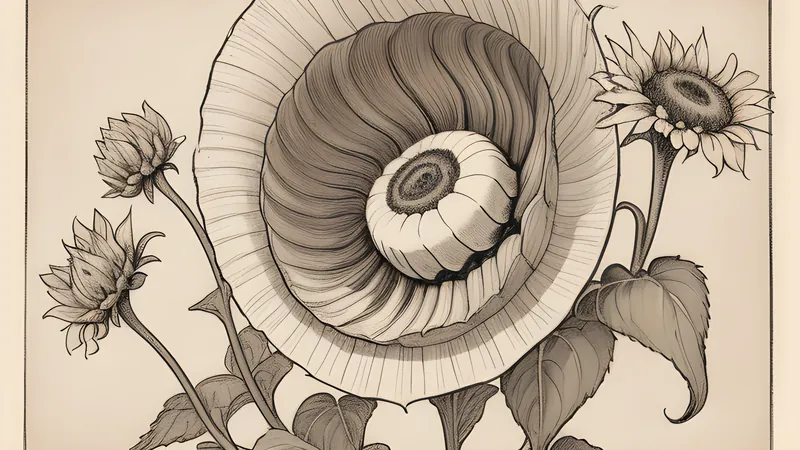
What lifts the Fibonacci numbers above a mere party trick is how stubbornly they turn up in living things. The arrangement of leaves around a stem, a pattern botanists call phyllotaxis, very often follows Fibonacci ratios, because spacing each new leaf at an angle related to the golden ratio lets a plant catch the most light with the least overlap. Count the spirals in the head of a sunflower and you will typically find they run in two interlocking sets — often 34 one way and 55 the other, or 55 and 89 — consecutive Fibonacci numbers, an arrangement that packs the seeds with beautiful economy. Pineapples, pinecones and the scales of a Romanesco broccoli tell the same story.
The nautilus shell is the popular emblem of all this, its chambers spiralling outward in a logarithmic curve, and it is frequently trotted out as proof of Fibonacci in nature. Honesty compels a footnote: the nautilus grows as a smooth logarithmic spiral, but its expansion rate does not actually match the golden ratio very closely, and careful measurement has punctured the tidiest versions of the claim. Much of the mystique around phi has been inflated over the years, with buildings and paintings retrofitted to the ratio on flimsy evidence. The verifiable cases — sunflowers, pinecones, leaf arrangement — are marvellous enough without the embroidery, and separating the solid from the sentimental is part of the fun of the day.
How the Day Is Kept
Fibonacci Day is grassroots and unofficial, with no founding committee and no single origin, which suits a subject that spread by word of mouth for eight hundred years. Schools use it as an excuse for a livelier maths lesson: pupils count sunflower spirals, build spiralling patterns out of squares whose sides follow the sequence, or hunt for the numbers in fruit and flowers. Museums and science centres run activities, and online the day produces a cheerful flood of puzzles, artwork and appreciations. It sits comfortably beside the calendar’s other mathematical festivities, chiefly Pi Day on 14 March, and shares its spirit with the physics-minded World Quantum Day — three occasions where the point is to make an abstract idea feel like play.
Fun Facts
- Every third Fibonacci number is even, and no others are — a small rhythm that falls straight out of the adding rule, since even plus odd gives odd, and only odd plus odd gives even.
- The greatest common divisor of two Fibonacci numbers is itself a Fibonacci number, one of many elegant divisibility patterns lurking in the sequence.
- The numbers give a neat trick for converting between miles and kilometres: 5 miles is roughly 8 km, 8 miles roughly 13 km, 13 miles roughly 21 km — because the conversion factor, about 1.609, sits so close to the golden ratio.
- Leonardo’s byname “Fibonacci” appears in none of his own manuscripts; it was pieced together by later scholars, so the man never once heard the name by which the world now knows him.
- Fibonacci numbers underpin real algorithms in computer science, including an efficient search method and a data structure called the Fibonacci heap, so a thirteenth-century rabbit puzzle still earns its keep inside modern software.
A Closing Reflection
There is something fitting in a holiday built from a date that merely looks like a piece of mathematics. Leonardo of Pisa set out to teach shopkeepers how to keep honest books, and the durable thing he left behind was a chain of numbers he borrowed to count imaginary rabbits, long outliving the accounting he wrote it for. The sequence has since been found in flowers he never examined and used in machines he could not have dreamed of, which says something about how ideas travel: rarely in the direction their author intended, and often further. Keeping the day is a way of noticing that the tidiest patterns are usually the ones already growing quietly all around us, waiting for someone to count the spirals.
Related Content