Epiphany
By the year 361, when the pilgrim traveller Egeria described the churches of Jerusalem keeping a great festival in early January, Epiphany was already one of the oldest fixed feasts in the Christian calendar — older, in fact, than the celebration of Christmas as most of the world now knows it. Kept on 6 January across most of the Christian world, Epiphany closes the twelve days that begin at Christmas and marks the moment the infant Christ was first shown to those beyond the stable: in the Western churches, the arrival of the Magi from the East; in the Eastern churches, the baptism of Jesus in the River Jordan. The Greek word epiphaneia means a manifestation or a shining-forth, and that is the day’s whole business — the revealing of who the child was.
Where the Day Comes From
Epiphany’s origins lie in the Greek-speaking Christian East, probably in Egypt and the surrounding provinces, during the third century. The earliest reference comes from Clement of Alexandria, writing around the year 200, who noted that certain Gnostic followers of the teacher Basilides already kept a night-time vigil on the equivalent of 6 January commemorating the baptism of Jesus. Whether the mainstream Church borrowed the date from these groups or arrived at it independently is disputed, but by the fourth century a unified January feast was firmly established from Egypt to Asia Minor, honouring the manifestations of Christ’s divinity.
For a long time the Eastern feast bundled several events together under one heading: the Nativity, the visit of the wise men, the baptism in the Jordan, and even the first miracle at the wedding of Cana. Only later did the calendar separate them. When the 25 December celebration of Christ’s birth spread from Rome to the East in the late fourth century, the older January feast was left to concentrate on the baptism and, in the West, on the Magi. The two dates — 25 December and 6 January — became the two ends of the Christmas season, the span of the Twelve Days sung about in the familiar carol.
History and the Julian Divide
The reason some Christians still keep Christmas itself on 6 or 7 January comes down to a quarrel about arithmetic that is nearly four and a half centuries old. In 1582 Pope Gregory XIII reformed the Julian calendar, which had drifted about ten days out of step with the solar year, and introduced the Gregorian calendar now used worldwide for civil purposes. Many Eastern Orthodox churches never adopted the change for their liturgical reckoning. Because the Julian calendar now lags thirteen days behind the Gregorian, churches following the old reckoning — the Russian, Serbian, Georgian and Jerusalem patriarchates among them — celebrate the Nativity on what the civil calendar calls 7 January, and keep their Epiphany, the Theophany, thirteen days after that. The same underlying dispute governs the movable feasts, which is why Easter Sunday so often falls on different dates for Eastern and Western Christians.
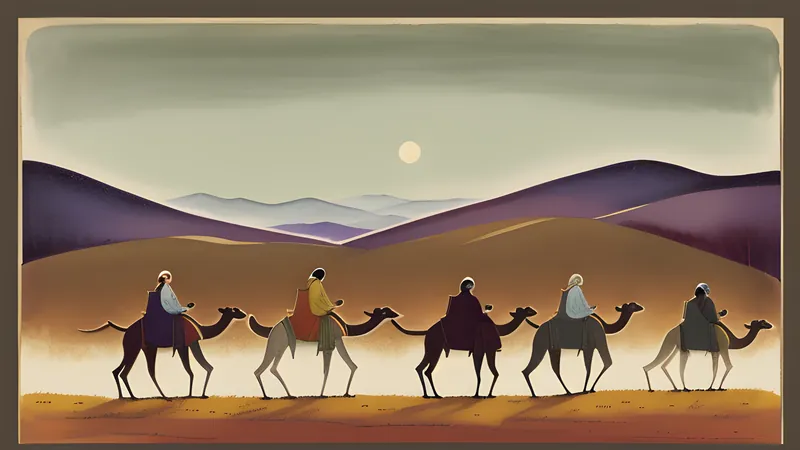
The Western emphasis on the Magi owes much to how the story was elaborated over the centuries. The Gospel of Matthew never numbers the visitors and never calls them kings; it says only that magoi — a Persian word for astrologers or wise men — came from the East following a star, and brought gold, frankincense and myrrh. The number three was inferred from the three gifts. By the eighth century the tradition had given them names — Caspar, Melchior and Balthasar — and later medieval piety made them kings and assigned them to three ages of life and, eventually, three continents, turning them into an emblem of the whole world coming to worship.
Why It Matters
Theologically, Epiphany completes something Christmas only begins. The Nativity is a birth witnessed by shepherds and animals, an intimate, local scene; Epiphany is the child shown to strangers, to foreigners, to the learned men of another religion who read the sky and travelled far. In Christian reading, the Magi represent the Gentiles — the non-Jewish world — recognising Christ, and so the feast carries the claim that the message was meant for everyone from the start. For the Eastern churches, the baptism in the Jordan matters even more, because it is the moment the adult Jesus begins his public ministry and, in the Gospel accounts, the voice from heaven and the descending dove reveal the Trinity in a single scene.
The day also marks a threshold in the rhythm of the year. In much of Europe the festive season traditionally ends with Epiphany rather than Christmas Day: it is the Twelfth Night on which decorations come down and the greenery is taken from the house. To leave them up past 6 January was, in old English folk belief, to invite bad luck for the coming year.
How It Is Celebrated
Across the Spanish-speaking world, 6 January — Día de los Reyes, the Day of the Kings — is the great gift-giving day of the season, outshining Christmas morning in many households. Children leave out shoes to be filled and set hay or water for the kings’ camels, and the day is crowned by the Roscón de Reyes, a ring-shaped sweet bread baked with a small figurine hidden inside; whoever finds it is named king or queen of the feast, and in Mexico is expected to host the next celebration at Candlemas. The custom of the hidden token runs deep in Epiphany baking, appearing again in the French galette des rois, a puff-pastry cake concealing a fève, and the crown that comes with it.
In much of central Europe the day belongs to processions of costumed children. In Germany, Austria and Poland the Sternsinger, or star singers, dress as the three kings, go from door to door singing, collect money for charity, and chalk a blessing above the doorway: the year split around the letters C, M and B — for the traditional names of the kings, and also for the Latin Christus Mansionem Benedicat, “may Christ bless this house”. In Orthodox countries the baptism theme takes over, and the central rite is the Great Blessing of the Waters, in which a priest blesses a river, lake or font. In Greece, Bulgaria and Russia young men dive into freezing water to retrieve a cross thrown by the priest, an act of icy devotion that draws crowds every January.
Variations Across the World
The name of the day shifts as the emphasis shifts. In the Christian East it is Theophany — “the appearing of God” — and centres wholly on the Jordan. In Ethiopia the baptism festival, Timkat, is among the grandest religious spectacles in Africa: replicas of the Ark of the Covenant are carried in procession from the churches, and vast open-air gatherings celebrate with all-night vigils, colour and song. In parts of the Alps the eve of Epiphany keeps older, half-pagan customs of driving out winter spirits with noise and masks, the festival brushing up against midwinter folklore.
Italy adds a figure found almost nowhere else: La Befana, a kindly old witch who, legend says, was asked by the Magi to join their search for the child, declined, then set out too late and has been flying from house to house on the eve of Epiphany ever since, leaving sweets for good children and lumps of coal — nowadays a sugar imitation — for the naughty. She is Italy’s true bringer of gifts, a folk survival grafted onto a Christian feast, and her broomstick and stockings owe more to the winter solstice than to the Gospel.
Symbols and Their Meaning
The star is the day’s governing image, the light that led the Magi and, by extension, the light of Christ shown to the nations — the same imagery of light answering darkness that gives Diwali its rows of lamps — which is why so much Epiphany custom, from the star singers to the household chalk, revolves around it. The three gifts each carry a traditional reading: gold for kingship, frankincense for divinity, myrrh — a burial spice — foreshadowing the Passion. Water dominates the Eastern celebration, blessed and then carried home to sprinkle on houses and fields. And the hidden token in the festive cake, whether bean, coin or porcelain figure, turns the theology of a revealed king into a game of chance at the table.
Fun Facts
- Epiphany is almost certainly older than Christmas: a fixed January feast of Christ’s manifestation was being kept in the Greek East before 25 December was widely observed as his birthday.
- The three kings were never called kings, never numbered, and never named in the Bible — every one of those details was added by later tradition, the names first appearing in full around the sixth to eighth centuries.
- The cathedral of Cologne claims to hold the relics of the three Magi, brought there in 1164, and its enormous golden reliquary shrine is one of the largest in the medieval West — the reason the city built so vast a cathedral in the first place.
- In Wales the day was once marked by the Mari Lwyd, a horse’s skull on a pole carried house to house in a ritual of rhyming insult-exchange at the door — a midwinter custom now enjoying a modern revival.
- The English phrase “Twelfth Night” gave Shakespeare the title of a play written for the Epiphany revels, a season historically associated with misrule, disguise and the temporary overturning of the ordinary order.
A Closing Reflection
There is something fitting in a feast that has spent most of its history being about several things at once — a birth shown to foreigners, a baptism in a cold river, a wedding turned to wine, an old witch on a broomstick. Epiphany resists being pinned to a single meaning, and perhaps that is its strength: it is the day the Christian story insists on being seen, and being seen is a messier, more various business than being born. The season that opened in the quiet of a stable ends in noise: processions, the plunge into freezing water, and a hidden bean in a slice of cake. The light, once shown, scatters everywhere.
Related Content