Day of the Ninja
In 2003 a website called Ninja Burger was selling a joke. It claimed, with mock seriousness, to deliver fast food anywhere in the world via a fleet of black-clad ninja couriers who scaled walls and dropped through skylights to bring you your order in thirty minutes or less, “guaranteed, or we commit seppuku.” Out of this absurd premise came an equally absurd holiday: Day of the Ninja, planted on 5 December to celebrate the speed and stealth with which Ninja Burger’s imaginary assassins delivered their imaginary burgers. The date was not random. The Last Samurai, the Tom Cruise epic featuring a memorable night-time ambush by ninjas, opened in American cinemas that very day, and the holiday’s creators tied their celebration to its release.
Day of the Ninja, then, is an internet-born, tongue-in-cheek tribute to one of popular culture’s most enduring figures: the silent, masked master of stealth who moves unseen across moonlit rooftops. It is part affectionate homage to the historical shadow-warriors of feudal Japan and part celebration of the ninja of films, comics and games — and it is entirely unserious.
Where the day came from
The early 2000s internet had a peculiar obsession: pirates versus ninjas. The debate over which was cooler raged across forums, comment threads and webcomics with a passion entirely disproportionate to the question, becoming one of the era’s signature pieces of online silliness. Pirates had been given a holiday of their own — International Talk Like a Pirate Day, kept on 19 September — and the ninja faction wanted equal billing. Day of the Ninja was the answer, conceived so that the shadow-warriors’ partisans could have an occasion to rally around.
Ninja Burger, the parody operation behind it, registered the holiday for 5 December 2003 to coincide with The Last Samurai. From there it spread in the grassroots, viral fashion typical of internet holidays — passed along through blogs, fan sites and message boards. The comedy series Ask a Ninja lent its support in 2006, and momentum built year on year, never official, never organised, but reliably resurfacing each December.
The real warriors behind the fantasy
The cartoon ninja rests on a genuine historical tradition, though a thinner one than the legend suggests. In feudal Japan the shinobi — the word “ninja” is an alternative reading of the same characters — were covert agents hired for espionage, scouting, sabotage and occasionally assassination. They worked in the unglamorous shadows of the samurai, whose code and battlefield exploits the culture openly celebrated. The provinces of Iga and Kōga are traditionally associated with their craft.
Almost everything the modern imagination “knows” about them, however, is later invention. The head-to-toe black costume, the throwing stars, the supernatural ability to vanish in smoke — these owe far more to Japanese theatre, Edo-period folklore and twentieth-century cinema than to any record of how covert agents actually operated. A real spy’s greatest asset was looking like an ordinary farmer or monk, not a conspicuous figure dressed entirely in black. Over the last century, film and animation transformed this modest historical reality into a global icon of stealth and martial wizardry, and it is that larger-than-life figure the holiday salutes.
Why a joke holiday endures
It would be easy to dismiss Day of the Ninja as pure frivolity, and in one sense it is exactly that. But its persistence says something about both the ninja and the internet. The ninja is one of the few cultural figures to have leapt fully from one civilisation into the imagination of the entire world, carried by decades of films, video games and animation until a child in Manchester or São Paulo recognises the silhouette as readily as one in Osaka. A holiday that thrives on that recognition is, in its small way, a monument to how thoroughly the figure has travelled.
It also shows the internet doing what it does best: manufacturing its own festivals out of nothing but shared enthusiasm and a good joke. No government declared this day, no charity sponsors it, no greeting-card industry props it up. It exists because enough people found it funny — the same democratic, bottom-up energy that powers offbeat workplace celebrations like Fun at Work Day.
How it is celebrated
Observance is cheerfully informal and demands nothing. Some fans dress the part, from a full costume down to a single black mask, and make a game of “sneaking” around the office or the house in exaggerated ninja fashion. Others mark it from the sofa: rewatching favourite ninja films, replaying the games — the Tenchu, Shinobi and Ninja Gaiden series, or Mark of the Ninja — that built their affection in the first place, reading manga, or sharing artwork and memes online. Martial arts schools sometimes use the date as a hook for open days. The unifying rule is that there are no rules, beyond a willingness to be playful.
Around the world
For a holiday rooted in Japanese history, Day of the Ninja is strikingly placeless. It belongs to the internet rather than to any nation, observed wherever the ninja has captured imaginations — which is to say almost everywhere films and games reach. There is no official ninja parade in Tokyo, no public holiday in Iga. Instead the day lives in the distributed, online community of fans who keep it going each December, a celebration without a capital city.
Japan itself, interestingly, treats the ninja with a lighter and more commercial touch than the reverence Western fans sometimes bring. The Iga-ryū Ninja Museum in Iga and the village of Kōka run ninja attractions complete with hidden doors, rope-climbing and shuriken-throwing for visitors, and costumed performers stage demonstrations for tourists rather than for any solemn observance. There is even a separate, semi-official “Ninja Day” promoted in Japan on 22 February — chosen because the date, 2-2-2, can be read as ni-n-ja in a pun on Japanese numbers — which has no connection to the December internet holiday at all. That two unrelated ninja days exist on opposite sides of the world, born of a Tom Cruise film in one case and a numerical pun (2-2-2 read as the ni-ni-ni echoing the ninja’s “nin-nin”) in the other, is itself a small monument to how thoroughly the figure has been adopted and reinvented by everyone who encountered it.
The figure in games and film
It is worth dwelling on just how saturated popular culture is with the ninja, because that saturation is the engine of the whole celebration. The 1980s brought a wave of ninja films to Western cinemas and a flood of ninja characters into the new medium of video games. The Teenage Mutant Ninja Turtles, created in 1984, turned the figure into a fixture of children’s cartoons and toy shelves. The Naruto manga and anime, which began in 1999, introduced an entire global generation to a stylised ninja world and remains one of the best-selling comic series ever produced. Across cinema, the ninja has been hero, villain, comic relief and tragic figure in turn. This relentless presence across every medium is exactly why a joke holiday invented by a burger parody could take root and persist: the cultural soil was already thick with ninjas, waiting for an occasion.
Symbols and the pirate rivalry
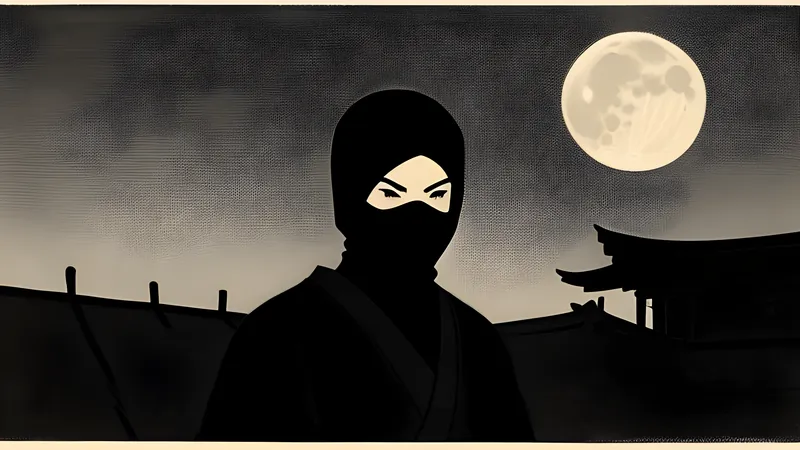
The iconography is instantly legible: the black hood and mask, the shuriken throwing star, the grappling hook, the soundless step across a tiled roof. None of it is historically faithful, and all of it is now the shared visual language of the celebration. Stealth, silence and a sly sense of humour are the prized virtues of the day. And running through it all is the enduring wink at the pirates — the cheerfully pointless rivalry that gave the holiday its reason to exist, and which still flares up online every September and December like a feud nobody wants to actually resolve.
Fun facts
- The 5 December date was chosen because The Last Samurai opened that day in 2003 — a film about samurai, fittingly featuring a scene in which ninjas attack under cover of darkness.
- The holiday was invented by Ninja Burger, a parody website that “delivered” fast food via ninja couriers and promised seppuku if an order arrived late.
- “Ninja” and “shinobi” are two readings of the very same Japanese characters; shinobi is the older native reading, while ninja is the Sino-Japanese pronunciation that became famous abroad.
- The all-black ninja outfit is thought to derive from kuroko, the black-clad stagehands of Japanese theatre whom audiences were trained to treat as invisible — a costume of dramatic convention, not espionage.
- Day of the Ninja was deliberately created as a counterweight to International Talk Like a Pirate Day, formalising the internet’s most enduring and most trivial rivalry.
A closing reflection
The figure at the centre of all this is, when you look closely, almost entirely a fiction — a costume borrowed from the theatre, draped over a handful of real spies, and inflated by a century of film into a myth. And yet the myth is more vivid and more beloved than the history ever was. There is a small lesson in that about how culture actually works: the version we cherish is rarely the accurate one, and a good story, repeated often enough, quietly becomes the truth we celebrate. On 5 December, the sensible response is not to correct the record but to pull on a mask and play along.
Related Content