Day of the Dead
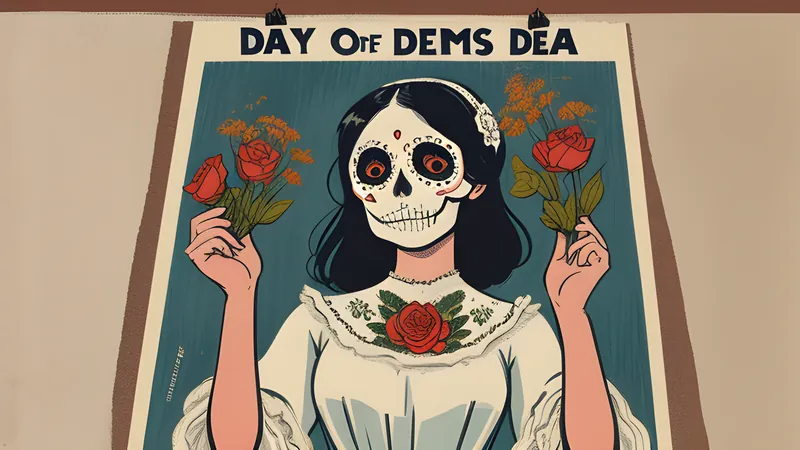
In 1910, a Mexican printmaker named José Guadalupe Posada etched a skeleton in a fine feathered hat and called her La Calavera Garbancera. He meant her as satire — a jab at Mexicans who powdered their faces and aped European fashions while denying their indigenous roots. Death, he was saying, strips away the pretensions; under the silk and the hat we are all bone. Decades later the muralist Diego Rivera painted that same elegant skeleton into a sweeping fresco, gave her the name La Catrina, and unwittingly handed the Day of the Dead its most enduring face. The grinning lady in the plumed hat now stands for the whole festival, which is a fitting irony: a celebration of memory shaped, in part, by a forgotten in-joke about social climbing.
The Day of the Dead — Día de los Muertos — is a Mexican tradition kept on 1 and 2 November, when families welcome back the spirits of the dead not with dread but with marigolds, food and music. It is among the most recognisable cultural traditions on earth, and one of the most misunderstood: less a Mexican Halloween than a public, joyful conversation with the departed.
Roots reaching back to the Aztecs
The festival blends two inheritances. Long before Spanish ships reached the coast, the peoples of Mesoamerica — Aztec, Maya, Toltec and others — held an understanding of death utterly unlike the European one. The Aztecs believed that a soul, after dying, made a long and arduous journey through the nine levels of Mictlan, the underworld, before reaching its rest. Presiding over that realm was Mictecacíhuatl, the Lady of the Dead, queen of Mictlan, whose task was to watch over the bones of the dead. Rituals honouring her and the deceased were woven into the Aztec calendar, treating death as a phase in an unbroken cycle rather than a final severing.
When Spanish missionaries arrived in the sixteenth century, they did what the Church had long done with stubborn local customs: they absorbed them. The indigenous commemorations were folded into the Catholic calendar of All Saints’ Day on 1 November and All Souls’ Day on 2 November. The result was neither purely Aztec nor purely Catholic but something new — a tradition that kept the indigenous warmth towards the dead and gave it a Christian frame. This habit of an incoming faith layering itself over an older one is precisely the pattern visible in the Day of the Assumption of the Virgin Mary, whose August date was likewise grafted onto a season already laden with older meaning.
How Posada and Rivera gave it a face
The Day of the Dead as the world now pictures it owes an enormous debt to two artists. Posada, working as a satirical printmaker in the years before and during the Mexican Revolution, churned out calaveras — skeleton prints used to lampoon politicians and the pretensions of the wealthy. His message was democratic and pointed: death levels everyone, the general and the beggar alike. His Calavera Garbancera of around 1910 was one such barb.
It was Diego Rivera who lifted her out of the satirical broadsheet and into high art. In his 1947 mural Dream of a Sunday Afternoon in Alameda Central Park, Rivera placed the skeleton at the centre, dressed her in full Edwardian finery, and christened her La Catrina. From that point she ceased to be a passing joke and became a national emblem. That an image so central to the festival was invented in living memory, by named artists working in a specific political moment, is a reminder that “ancient traditions” are often younger, and more authored, than they appear.
Ofrendas and what they hold
At the centre of the observance stands the ofrenda, the altar built at home or in public to welcome the returning dead. An ofrenda is not a place of mourning but of hospitality. Onto its tiers go photographs of the departed, the foods and drinks they loved in life, candles, water to slake the long journey, and personal mementoes. Each element is an invitation: come back, rest, eat, be remembered.
Marigolds — cempasúchil, in the Nahuatl-derived name — are everywhere, their fierce orange colour and pungent scent believed to guide the spirits home along petal-strewn paths. Calaveras, the sugar skulls, are moulded and painted in bright, cheerful patterns, often bearing the name of a living friend as a gift. Pan de muerto, a sweet bread dusted with sugar and shaped with bone-like ridges, is baked for the season, shared at the table and laid on the altar. None of it is morbid; all of it is affectionate.
How it is celebrated
In many Mexican towns and villages, families spend the nights of 1 and 2 November in the cemeteries themselves, cleaning and decorating graves, lighting candles until the headstones glow, and keeping vigil with food, music and conversation until dawn. The island town of Janitzio in Michoacán and the cemeteries of Oaxaca are famous for these candlelit night gatherings, where the boundary between a graveyard and a family reunion dissolves entirely.
Public celebration has grown alongside the private. Oaxaca’s comparsas — costumed street processions — wind through the city, and Mexico City now stages a grand Day of the Dead parade down its central avenues, an event that did not exist until 2016, when it was created partly in response to a fictional parade depicted in the opening scene of the James Bond film Spectre. Life imitating cinema imitating life is, by now, very much in keeping with the holiday’s spirit.
Variations beyond Mexico
The tradition has travelled with the Mexican diaspora, especially into the United States, where cities such as Los Angeles, San Antonio and Tucson hold large public celebrations that let Mexican-Americans keep faith with their heritage. Related observances exist across Latin America: in Guatemala, the town of Sumpango flies enormous handmade kites — barriletes gigantes — over the graves on 1 November, believed to carry messages to the dead. The impulse to set aside a fixed day for honouring the departed is far from unique to the Americas; the Dutch and northern European Remembrance of the Dead marks a comparable need, though in a far more sombre register.
How it differs from Halloween
The calendar puts the two side by side and the casual eye conflates them, but they pull in opposite directions. Halloween, descended from older European autumn customs, leans into fright and disguise — death as a thing to be spooked by and laughed off. The Day of the Dead turns to specific people, named and remembered, and meets them with love. Where one treats the skeleton as a scare, the other dresses it up, gives it a name, and offers it bread. The mood is reunion, not horror.
The structure of the days
The festival is not a single date but a short season with its own internal logic, and the distribution of days is deliberate. The night of 31 October into 1 November is often given to Día de los Angelitos — the day of the little angels — when the spirits of dead children are believed to return, their altars laid with sweets, toys and smaller portions suited to young appetites. The first of November, All Saints’ Day in the Catholic calendar, broadens the welcome, and 2 November, All Souls’ Day, is the day of the adult dead, when families complete the cycle in the cemeteries. Some regions extend the observance further back, beginning preparations in late October as marigolds are harvested and graves are weeded and whitewashed. The sequence mirrors the rhythm of a long-awaited family visit: the house is cleaned, the food prepared, the youngest welcomed first, and the whole gathering brought to its close together. This careful ordering of remembrance over several days, rather than a single solemn moment, is part of what gives the tradition its unhurried, hospitable character.
UNESCO recognition
In 2008 the Day of the Dead was inscribed on UNESCO’s Representative List of the Intangible Cultural Heritage of Humanity, in recognition of its depth of meaning to Mexico’s indigenous communities and the singular way it expresses a culture’s relationship with death. The listing helped raise the festival’s global profile and affirmed it as a living tradition rather than a museum piece — one still being made, parade by parade, ofrenda by ofrenda.
Fun facts
- La Catrina, now the festival’s defining image, began life around 1910 as Posada’s satire of social climbers and was named only later by Diego Rivera in a 1947 mural.
- Mexico City’s now-famous Day of the Dead parade was invented in 2016, inspired by a fictional parade in the 2015 James Bond film Spectre — the city built a real tradition to match a made-up one.
- Marigolds used on the altars are known as cempasúchil, from the Nahuatl word meaning roughly “twenty-flower”; their scent, not just their colour, is thought to lead spirits home.
- In Guatemala the dead are honoured with giant kites tens of feet across, flown over cemeteries to carry messages skyward — a regional cousin of the Mexican tradition.
- The festival’s presiding ancient figure, Mictecacíhuatl, was an Aztec goddess whose duty was to guard the bones of the dead — making the modern sugar skull a distant echo of a pre-Columbian deity.
A closing reflection
Most cultures handle grief by lowering the voice and closing the door. The Day of the Dead does the reverse: it props the door open, lays the table, and talks to the dead as if they were merely late. There is a kind of courage in that — the refusal to let death be the last word, or even an awkward one. To name your dead aloud, cook their favourite meal, and expect them at the table is to insist that remembering can be an act of joy rather than only of loss. That insistence, more than any marigold or sugar skull, is what the festival hands down.
Related Content


