Danish Sankt Hans Aften
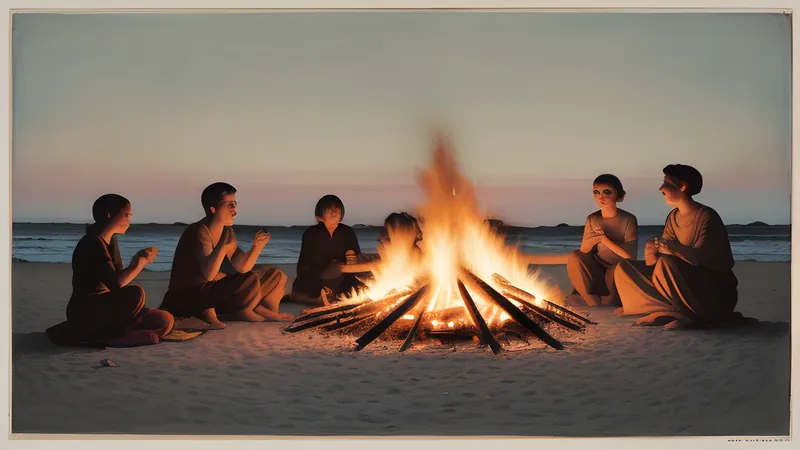
In June 1885, at Copenhagen’s Royal Theatre, the poet Holger Drachmann put words into the final scene of a fairy-tale play called Der var engang — “Once Upon a Time” — and the composer Peter Erasmus Lange-Müller set them to a tune. The song was the Midsommervise, opening “Vi elsker vort land” — “We love our country” — and within a generation it had escaped the theatre entirely to become the anthem every Dane now sings around the midsummer fire. Each year on 23 June, as the long Nordic evening refuses to darken, Denmark gathers at the water’s edge for Sankt Hans Aften — Saint John’s Eve — to light bonfires, send a straw witch up in smoke, and sing Drachmann’s lines into a sky that never quite turns black.
A night with two histories
Sankt Hans sits on a layered past, and the honest way to tell it is to keep the pagan and the Christian threads separate rather than blur them into a single neat origin myth. Long before Christianity reached Scandinavia, the summer solstice carried weight for communities living this far north, where the swing between near-endless winter darkness and luminous summer nights governs the whole rhythm of the year. Fire at midsummer was practised widely across pre-Christian Europe, understood to strengthen the waning sun, drive off ill fortune, and protect crops and livestock through the growing season.
When the Church established itself, it attached the solstice celebration to the feast of the Nativity of John the Baptist on 24 June — one of the few saints’ days marking a birth rather than a death, set six months before Christmas to mirror the Gospel account of John being born half a year before Christ. Its eve falls on the 23rd. “Sankt Hans” is simply the Danish contraction of Sankt Johannes. The older folk customs were not erased so much as folded into the Christian calendar, which is why the night still carries an unmistakably pre-modern flavour beneath its saintly name.
From healing wells to a communal fire
For centuries Sankt Hans was bound up with healing springs, herb gathering and protective ritual. Wells dedicated to Saint John, such as the famous Helene Kilde at Tisvilde on north Zealand, drew pilgrims hoping for cures, and certain plants picked on this particular night were believed to hold special potency. The bonfire endured as the central act through all of it, though its meaning drifted over time from solemn protection toward open communal festivity.
The straw witch perched atop so many modern bonfires is, despite the antique feel, a relatively recent arrival — it became common only in the late nineteenth and early twentieth centuries, likely borrowed from German custom. It nods to old beliefs that midsummer night was when witches flew off to gather; in Danish folklore the destination is the Brocken, the highest peak of the Harz mountains in Germany, long associated with witches’ sabbaths. Burning the effigy playfully speeds her on her way. It is worth saying plainly that this cheerful tradition has an uncomfortable shadow — Denmark, like the rest of early-modern Europe, executed real people, mostly women, for witchcraft, and some modern Danes have questioned whether the burning figure deserves its place at all.
Why the evening still draws crowds
In a country where hygge — cosy, convivial togetherness — is treated almost as a civic virtue, Sankt Hans is one of its grandest outdoor expressions. It is not a public holiday; people work the next morning. Yet the evening pulls enormous crowds to beaches, lakesides and harbour fronts, because it marks a genuine seasonal hinge: a collective acknowledgement that the light has reached its peak and that high summer has arrived.
The night also carries a faint undertow of melancholy that Danes rarely state outright but seem to feel. The solstice is the year’s high-water mark of light, which means that from 24 June onward the days, imperceptibly at first, begin to shorten again. To gather at the very moment the light starts its long retreat is to celebrate and mourn in the same gesture — a quietly Scandinavian thing to do. Drachmann’s song, with its wish for peace and its slightly wistful tone, fits that mood precisely, which may be part of why it has held its place at the fireside for well over a century while flashier anthems have come and gone. The festival’s communal warmth places it alongside the other great Danish gathering of early summer, Constitution Day on 5 June, so that the weeks around the solstice become a season of Danes meeting outdoors in the brightest part of the year.
How it unfolds
The shape of the evening is reassuringly consistent across the country. People arrive in the late afternoon and early evening at a chosen bonfire site — many towns and harbours host large public events, while smaller fires dot private gardens and allotments. Food is informal and shared: open sandwiches, grilled fare, cold beer. As the fire is lit, the crowd sings the Midsommervise, “Vi elsker vort land,” its opening lines known to nearly everyone present, often led by a local choir or simply carried by the crowd. A local figure — a mayor, a clergyman, an invited guest — frequently gives a short båltale, a “bonfire speech,” before the flames take proper hold.
Weather permitting, the fire is lit somewhere between nine and ten in the evening, when the light has finally begun to soften — though “darkness” is the wrong word for it this far north. Larger events at places such as the harbour at Tivoli in Copenhagen or along the beaches of north Zealand can draw thousands, with food stalls, music and a hired speaker, while a family allotment fire might be a dozen people and a modest stack of garden cuttings. Both feel recognisably like the same festival.
That ritual of a whole community speaking and singing the same words aloud, year after year, is a kind of oral inheritance in its own right — the sort of shared spoken-word tradition that observances like world read-aloud day celebrate, where the act of voicing a text together is the point rather than the words alone.
Symbols of fire and water
The bonfire is the enduring symbol, its light a small human answer to the lingering sun. The straw witch stands for the banishing of misfortune, sent off — the song hopes — with goodwill rather than malice. Water features strongly too, since the fires cluster along coastlines and lakes, their reflections doubling the flames across still surfaces. The full scene — fire, water, song, and the pale never-quite-dark sky — gives the night its singular atmosphere, one no other Danish festival quite reproduces.
One branch of a Nordic tradition
Denmark’s celebration is a single limb of a shared Nordic and Baltic midsummer tree. Norway keeps a closely related Sankthans or Jonsok with its own bonfires; Sweden marks Midsommar with flower-crowned maypoles and pickled herring, and treats it almost as a second national day; Finland lights great kokko fires for Juhannus, and the cities empty as people head to lakeside cottages. Estonia, Latvia and Lithuania observe parallel solstice festivals — Latvia’s Jāņi is among the most exuberant in Europe. Each nation places its emphasis differently, yet all share the same impulse: to meet the brightest nights of the year with light, food and company.
Fun facts
- The herb Saint John’s wort — Perikon in Danish — takes its English name from this feast; traditionally gathered around Sankt Hans, it was hung in homes to ward off evil, and is now studied as a mild treatment for depression.
- Because Denmark lies far enough north, the sky on 23 June never fully blackens — astronomical twilight lingers all night — which is exactly why the bonfires glow so strikingly against a luminous dusk rather than true dark.
- Drachmann’s beloved song is gently ironic in mood: while a witch is being set ablaze on the fire, the lyrics wish openly for “peace in our land” — a contrast singers rarely pause to notice.
- The straw witch is younger than the song that accompanies it: the Midsommervise dates from 1885, while the witch-burning custom only became widespread in Denmark in the decades that followed.
- The fairy-tale play that birthed the anthem, Der var engang, was such a hit that the Royal Theatre staged it for decades — but the song long outlived the play, surviving today in a context its author never wrote it for.
A closing reflection
Strip away the saint, the witch and the song, and Sankt Hans Aften comes down to a very old and very simple human gesture: at the year’s brightest hinge, people leave their houses, build a fire by the water, and stand together watching it burn. The fears that once justified it — failing crops, flying witches, the slow return of winter dark — have faded into folklore, but the act itself has proved more durable than any of the beliefs that produced it. What endures is not the magic but the gathering, and perhaps that is the truer reason the fires are still lit.
Related Content