Cherry pie day
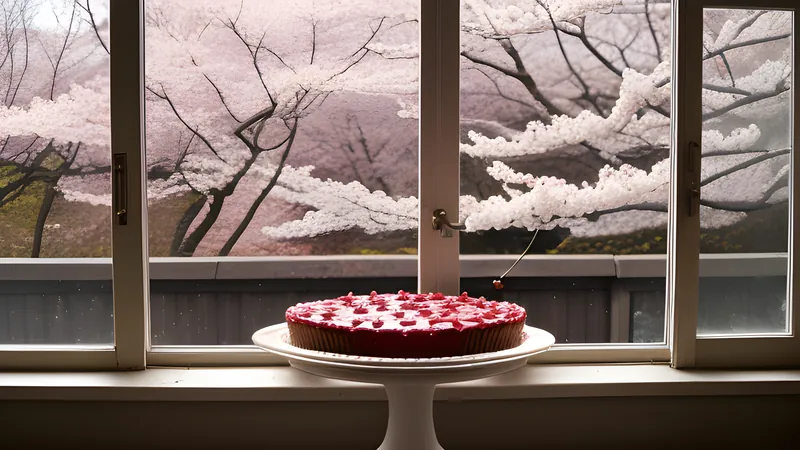
In 1806, a travelling bookseller and part-time clergyman named Mason Locke Weems slipped a small story into the fifth edition of his bestselling biography of George Washington. A six-year-old George, given a hatchet, hacks at his father’s cherry tree, and when challenged cannot tell a lie. The tale was almost certainly invented to sell a moral, and Washington’s own home at Mount Vernon says flatly that it never happened. Yet it lodged the cherry firmly in the American imagination, tangled it up with national virtue, and very probably explains why Cherry Pie Day falls on 20 February — two days before Washington’s birthday on the 22nd. That is the curious thing about this small February observance: a pie that tastes of late summer is celebrated in the dead of winter, because of a fib about a founding father.
A pie older than the United States
Cherry pie did not begin in America at all. The technique of sealing fruit inside pastry was perfected in medieval and Tudor England, where the pastry shell was often a sturdy, barely edible “coffin” built to hold and preserve the filling rather than to be eaten. One persistent claim holds that a cherry pie was baked for Queen Elizabeth I in the sixteenth century, and while that particular detail is hard to pin down, fruit pies were unquestionably a fixture of English kitchens long before the first colonists sailed. When English settlers crossed the Atlantic in the seventeenth century, they brought their pie-making with them, along with cuttings and seeds. The American cherry pie is, in that sense, an English recipe that found a better orchard.
What it found in the New World was room to grow. The Great Lakes region in particular turned out to be ideal cherry country, and the cool, fruit-friendly air rolling off Grand Traverse Bay in northern Michigan eventually made one town the undisputed capital of the trade.
Traverse City and the rise of the tart cherry
Traverse City, Michigan, calls itself the Cherry Capital of the World, and the boast is well earned: the surrounding region grows a very large share of the United States’ tart cherries, thanks to a climate and soil that suit the fruit precisely. The town’s relationship with the cherry became a civic festival in 1925, when local people held a “Blessing of the Blossoms” each spring to mark the flowering of the orchards. The Michigan legislature renamed it the National Cherry Festival in 1931, and it has run almost every year since, drawing crowds to Traverse City every July to eat, parade and crown a Cherry Queen.
The cherry at the heart of all this is not the dark, sweet kind you eat from a paper bag. The classic pie cherry is the Montmorency, a tart or “sour” variety, and the choice is a matter of chemistry rather than sentiment. Sweet cherries collapse into mush and lose their character under heat and sugar, whereas the bright, almost sharp acidity of a Montmorency survives the oven and pushes back against the sweetness of the filling. The result is a flavour with edges — the tang that makes a good cherry pie taste of more than sugar. A baker reaching for sweet cherries to be kind to the palate usually ends up with something flatter and duller.
How the day landed on 20 February
There is no founding document for Cherry Pie Day, no committee minute or presidential proclamation that started it. What the record does show is a cluster of cherry-and-Washington observances drifting around late February through the twentieth century, many of them pinned to or near the 22nd, the President’s birthday, and openly trading on the Weems legend. The settling of the modern date on 20 February seems to owe everything to that gravitational pull: the cherry’s folkloric link to Washington kept the celebration anchored to his birthday week. One often-repeated account credits a 1987 proclamation by the mayor of Rockport, Indiana, with formalising the 20 February date, though as with many food “days” the truth is a slow accretion of local custom rather than a single decree. Either way, the pie ended up commemorated in February not because cherries are in season — they emphatically are not — but because of a story a bookseller told to sell virtue.
That winter timing is part of why the day belongs to the tinned and frozen pie as much as the fresh one. Marked in the depths of February, it is necessarily a celebration of preserved cherries — canned filling, frozen fruit, the larder rather than the orchard — and there is no shame in that. The pie was a way of carrying summer through winter long before anyone gave it a date.
Why a small pie carries weight
The interest of Cherry Pie Day is not really culinary; it is the way a humble dessert became a carrier of national myth. The cherry pie sits alongside apple pie in American shorthand for home, honesty and a certain idealised past, and it got there partly on the back of a tale that never happened. There is something quietly revealing in that. A food becomes “traditional” not only through what is true about it but through the stories a culture decides to attach to it, and the cherry pie is a near-perfect specimen: an English recipe, grown on Michigan trees, fixed to its date by a Virginian legend.
It is also a reminder of how seasonal eating worked before refrigeration. To eat cherry pie in February at all was once an act of foresight — fruit picked at its July peak, preserved, and brought out months later. The modern freezer aisle has made that effortless, but the pie still quietly encodes the old logic of the storeroom.
How it is marked, and the wider family of pies
Cherry Pie Day tends to be observed in the most direct way imaginable: people bake a pie, or buy a slice, and eat it. American bakeries and diners run specials, county-fair bakers trade closely guarded crust recipes, and home cooks debate the merits of a woven lattice top against a full double crust. The lattice is not merely decorative — the open weave lets steam escape and stops the filling boiling over, which is why generations of bakers have used it.
The cherry is, of course, only one fruit in a vast pastry family, and the day fits into a broader calendar of pie observances that food enthusiasts have accumulated. Cherries find a natural companion in chocolate, a pairing celebrated in its own right on Chocolate-Covered Cherry Day, and the nut and custard schools of pie-making each command their own dates, from the deep filling honoured on Pecan Pie Day to the silky tradition marked on Bavarian Cream Pie Day. Set against that crowd, the cherry pie’s claim to fame is less its taste than its mythology.
Cherries beyond the pie tin
The cherry’s reach extends well past the American pie. The French clafoutis bakes whole cherries — traditionally unpitted, on the theory that the stones add an almond note — into a custardy batter. Germany’s Black Forest gateau, the Schwarzwälder Kirschtorte, layers chocolate sponge with cherries and Kirschwasser, the clear cherry brandy of the Black Forest region. Across the Alps and into Eastern Europe, cherries fill strudels, dumplings and tarts. The American cherry pie is one regional answer to a question that orchard-growing cultures across the northern hemisphere have all asked: what do you do with a brief, glorious glut of cherries?
Fun facts
- Cherry Pie Day falls in February, when fresh cherries are entirely out of season — the date tracks George Washington’s birthday, not the harvest, so it is effectively a celebration of tinned and frozen fruit.
- The cherry tree story that links Washington to the fruit was invented by his biographer Parson Weems and first appeared only in the fifth edition of his book, in 1806; Mount Vernon confirms it is fiction.
- Pie cherries are deliberately sour: the Montmorency variety is prized because its acidity survives baking, whereas sweet eating-cherries turn flat and mushy in the oven.
- Traverse City, Michigan, grows a very large share of America’s tart cherries and has run a National Cherry Festival since 1925, when it began as a spring “Blessing of the Blossoms”.
- The lattice top is engineering as much as decoration — the gaps vent steam and stop the bubbling filling from overflowing the crust.
- The traditional clafoutis leaves the cherry stones in on purpose, because the pits release a faint almond flavour as the dessert bakes.
A closing reflection
It is worth pausing on the fact that the cherry pie owes its calendar slot to a lie. Weems wanted to teach children that honesty matters, and to do it he made something up — and the made-up thing was so charming that it reshaped how a nation thought about a dessert. Two centuries later, people bake a winter pie from preserved fruit on a date chosen by that fable, mostly unaware of any of it. There is a gentle irony in a pie associated forever with “I cannot tell a lie” being celebrated on a day built on a fiction. Perhaps that is the most honest thing about it: the cherry pie reminds us that the foods we call traditional are held together as much by the stories we tell as by anything we can taste.
Related Content


