Candlemas
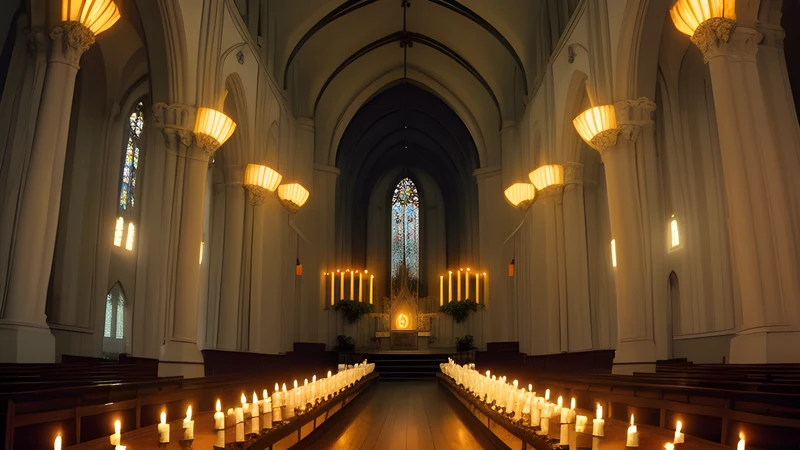
Around the year 384, a Spanish nun named Egeria travelled to Jerusalem and wrote home about the ceremonies she saw there. Among them was a feast kept forty days after Epiphany, celebrated with great solemnity and a procession, marking the day the infant Jesus was brought to the Temple. Her account is one of the earliest firm records of the observance the West came to call Candlemas — the feast of the Presentation of Christ in the Temple, kept on 2 February. Its English name comes from its most beautiful custom: on this day the church blesses the candles it will use through the coming year, and the faithful carry lit candles in procession, so that the darkest stretch of winter closes in a building full of small flames.
What the Feast Marks
Candlemas commemorates an event described in the Gospel of Luke. According to Jewish law, a mother was to present herself at the Temple forty days after the birth of a son for a rite of purification, and a firstborn son was to be presented and dedicated to God. So Mary and Joseph brought the infant Jesus to the Temple in Jerusalem, offering the poor family’s sacrifice of two young pigeons. There an aged, devout man named Simeon, who had been promised he would not die before he saw the Messiah, took the child in his arms and spoke the words known as the Nunc Dimittis, calling the infant “a light to lighten the Gentiles.” An elderly prophetess, Anna, likewise recognised the child. The feast therefore carries two names in different traditions — the Presentation of the Lord and the Purification of the Blessed Virgin Mary — and the imagery of Christ as a “light” is exactly why candles became its emblem.
Why It Falls on 2 February
The date is a simple piece of arithmetic. If the birth of Christ is kept on 25 December, then forty days later — counting inclusively in the old manner — brings you to 2 February, the fortieth day and the correct moment for the Temple rites of Luke’s account. Candlemas thus marks the formal close of the extended Christmas and Epiphany season. In the older reckoning of the church year, the whole span from Advent through to Candlemas formed a single great arc of the Incarnation, and 2 February was its final station, the last backward glance at Christmas before the calendar turned toward Lent and Easter.
History and the Blessing of Candles
The feast was well established in Jerusalem by the late fourth century, as Egeria attests, and spread through the Eastern and then the Western church over the following centuries. The distinctive Western custom of blessing candles and carrying them in procession is usually associated with the seventh and eighth centuries; Pope Sergius I, around the turn of the eighth century, is credited with promoting the processions in Rome. By the later Middle Ages the blessing of candles at Candlemas was one of the great set-pieces of the parish year. The candles blessed on the day were carried home and kept, lit in times of storm, sickness and death, and treated as objects of protection through the year — a tangible link between the church’s liturgy and the anxieties of ordinary life.
The custom carried real economic weight too: beeswax candles were expensive, and the year’s supply for both church and household was a significant matter, which gave the blessing of candles a practical as well as a spiritual charge.
Weather Lore and Groundhog Day
Candlemas gathered to itself a rich tradition of weather prophecy, built on the idea that the weather on this hinge-day foretold the length of the winter still to come. An old English rhyme runs: “If Candlemas be fair and bright, winter will have another flight; but if Candlemas brings cloud and rain, winter will not come again.” A bright, clear Candlemas, in other words, was a bad sign — it promised more cold ahead — while a grey, wet one meant the worst of winter was over. German settlers carried this lore to Pennsylvania, where it fused with the notion of an animal emerging from hibernation and checking for its shadow, and became the modern American Groundhog Day, celebrated on the very same 2 February. The link is direct: the groundhog seeing its shadow on a bright day, and so predicting six more weeks of winter, is the old Candlemas weather rhyme in a furry new costume.
Imbolc and the Turning of the Season
The date sits at one of the natural quarter-points of the year, roughly midway between the winter solstice and the spring equinox, and it coincides with the Gaelic festival of Imbolc, associated with the goddess and later saint Brigid and with the first stirrings of spring — the lactation of ewes, the earliest lengthening of the light. Whether Candlemas absorbed older seasonal observances or simply landed on the same instinctive turning-point, the two share a mood: a sense that the deepest dark is passing and the first faint promise of spring can be felt, even under snow.
How It Is Celebrated
Roman Catholic, Orthodox, Anglican and Lutheran churches keep Candlemas with the blessing of candles, a candlelit procession and the singing of the Nunc Dimittis. In some countries the day is a lively popular festival: in Mexico, Día de la Candelaria on 2 February is celebrated with tamales, hosted by whoever found the hidden figurine in the Epiphany king-cake weeks earlier, and with the dressing and blessing of a Christ-child figure. In France the day is Chandeleur, the “day of crêpes,” when families make and flip pancakes, a golden round like a small sun to greet the returning light. In many homes that still keep the old rule, Candlemas is the very last day on which Christmas greenery and decorations may remain before they must come down for good.
Traditions and Symbols
The lit candle is the day’s central symbol, standing for Christ as the light of the world proclaimed by Simeon. The snowdrop, one of the first flowers to appear in the frozen ground, is so tied to the feast that it is sometimes called the “Candlemas bell.” Crêpes and tamales carry the day’s culinary customs, and the taking-down of the last Christmas greenery — a task the poet Robert Herrick versified in the seventeenth century, warning that every leaf left up would summon a goblin — marks its role as the final farewell to the festive season that began at Twelfth Night and the crib.
The Feast in the Christian East
In the Orthodox and Eastern Catholic churches the day is one of the Twelve Great Feasts and carries a different name: the Hypapante, the “Meeting,” because it commemorates the encounter between the old covenant, embodied in Simeon and Anna, and the new, carried in the arms of the infant Christ. The emphasis falls on that meeting in the Temple rather than on purification or candles, the moment two aged servants of God recognise the salvation they had waited a lifetime to see. The Byzantine emperor Justinian is recorded as having raised the feast to great public prominence in Constantinople in the sixth century, reportedly after the city was delivered from a plague, which helped fix its place in the calendar of the whole Eastern church.
The two traditions, Eastern and Western, illuminate each other. The West gave the day its candles and its weather lore and its role as the last farewell to Christmas; the East kept it as a feast of recognition and encounter, tender and human, focused on two old people at the end of their lives finally holding the future in their hands. Both are drawing on the same short passage in Luke, and both find in it the same central image — a light appearing at the darkest, coldest point of the year, greeted by those who had almost given up hope of seeing it.
Fun Facts
The Nunc Dimittis, the song Simeon sang over the infant Christ at the Presentation, entered the daily prayers of the church as the canticle for the close of day, which means the words first spoken at Candlemas are sung every evening at Compline and Evensong the world over.
Robert Herrick’s poem “Ceremony upon Candlemas Eve” insists that all the Christmas rosemary, bay, holly and mistletoe must be cleared away by the feast, “lest one least branch there left behind” invite mischievous spirits into the house for the rest of the year.
In the French Chandeleur tradition, superstition holds that if you flip your crêpe successfully while holding a coin in your other hand, you will enjoy prosperity for the coming year — a small game of light and luck at the tail of winter.
The blessed Candlemas candle was long believed to hold protective power against thunderstorms and sudden death, and in many rural households it was lit and placed in the window during storms or set in the hands of the dying, carrying the church’s blessing straight into the most fearful moments of ordinary life.
A Closing Reflection
Candlemas is a quiet feast, easy to overlook between the noise of Christmas and the austerity of Lent, yet it does something no other day does: it gathers up the whole season of the Incarnation and lets it go, in a church lit only by blessed flame. Forty days after the crib, the old man Simeon holds the child and speaks of light, and the congregation answers by carrying light out into the coldest month. Whatever one believes, there is something deeply consoling in a festival that marks the exact moment the year’s darkness begins, at last, to give way.
Related Content