Arabic Language Day
On 18 December 1973, the United Nations General Assembly took a vote in New York that added Arabic to its roster of official languages, the sixth and, at the time, newest member of that select group. It was a procedural decision dressed in diplomatic language, but it acknowledged something that had been true for more than a thousand years: that Arabic was a language of empire, scripture, science and commerce whose reach demanded a seat at the table. Arabic Language Day, marked each year on that anniversary, celebrates a tongue spoken today by some four hundred million people and revered by well over a billion more as the language of the Qur’an.
Where the day comes from
The 1973 resolution gave the date its meaning, but the observance itself is younger. In February 2010 the United Nations Department of Public Information announced that it would create an international day for each of its six official languages, a gesture intended to promote multilingualism and to give each language its own moment in the calendar. French was assigned 20 March, English 23 April, Russian 6 June, Spanish 12 October, Chinese 13 November, and Arabic 18 December, tying it neatly to the 1973 vote.
UNESCO then took the idea further. At its 190th Executive Board session in 2012, acting on a proposal put forward by Morocco and Saudi Arabia, the organisation formally adopted 18 December as World Arabic Language Day. From 2012 onward the day acquired its present shape: an annual commemoration backed by UNESCO, the UN’s various offices, and Arabic-speaking states, usually built around a theme that changes each year.
A language with a long history
The history of Arabic dwarfs the history of the day that honours it. The earliest substantial written evidence of the language appears in inscriptions from the centuries before Islam, but it was the seventh century that fixed Arabic in the form still studied today. The text of the Qur’an, compiled in the decades after the Prophet Muhammad, established a prestige register so authoritative that it has remained remarkably stable for fourteen hundred years, an unusual feat for any living language.
What followed was one of the great intellectual movements in human history. During the Abbasid Caliphate, with its capital at Baghdad founded in 762, scholars gathered at institutions associated with the so-called House of Wisdom to translate the works of Greek, Persian and Indian thinkers into Arabic. The mathematician Muhammad ibn Musa al-Khwarizmi, working in ninth-century Baghdad, wrote a treatise whose title gave Europe the word algebra, and whose Latinised name gave us the word algorithm. The physician Ibn Sina, known in the West as Avicenna, produced a medical encyclopaedia in Arabic that was still being taught in European universities five centuries later. For roughly half a millennium, Arabic was the working language of the most advanced science on the planet.
When that knowledge eventually reached medieval Europe, much of it arrived through Arabic, often via the translation workshops of Toledo in twelfth-century Spain. The debt is visible in the night sky: stars such as Aldebaran, Rigel, Betelgeuse and Vega carry names worn down from Arabic, a fossil record of the astronomers who once charted them. The same story plays out in the language of remembrance and reflection that runs through occasions like International Mother Language Day, which honours exactly this kind of linguistic inheritance.
Why it matters
Arabic occupies an unusual position among the world’s major languages. Modern Standard Arabic, the formal register descended from the classical language, binds the Arab world together in writing, broadcasting, newspapers and formal speech, so that a leader in Rabat and a journalist in Baghdad can be understood by the same reader. Yet everyday conversation happens in regional varieties so distinct that a Moroccan and an Iraqi speaking their home dialects may struggle to follow one another. Arabic is therefore both one language and many at once, a single written civilisation resting on a chorus of spoken voices.
That tension is what makes the language matter beyond the Arab world. It is a working illustration of how cultures hold common ground while guarding local character, the same balance examined by observances such as the UNESCO International Mother Language Day. As one of six UN official languages, Arabic also carries genuine weight in international diplomacy, law and trade, far from the poetry and scripture with which it is most often associated.
There is a second, larger constituency for whom the language matters in a quite different way. For the world’s Muslims, currently estimated at around 1.9 billion people, Arabic is the language of ritual prayer regardless of mother tongue. A worshipper in Jakarta or Lagos performing the five daily prayers recites the same Arabic verses as one in Cairo, even if neither speaks the language conversationally. This has made classical Arabic perhaps the most widely recited language on earth, learned not for conversation but for devotion, and it has carried the script into communities that have never been part of the Arab world at all.
Arabic across the map
As a living spoken language, Arabic is official or co-official in more than twenty countries, stretching from Morocco on the Atlantic to Oman on the Arabian Sea, and southward into Sudan and the Horn of Africa. Its varieties form a continuum: Egyptian Arabic, spread for decades through Cairo’s dominant film and television industry, is among the most widely understood dialects, while Maghrebi Arabic in the west, shaped by Berber and French, can sound almost foreign to an eastern speaker.
Beyond its heartlands, large diaspora communities keep the language alive in France, Germany, the United Kingdom, the Americas and beyond, often running weekend schools so that children born abroad can read the script of their grandparents. The number of foreign learners has also grown, driven by faith, by scholarship, by diplomacy and by the practical demands of business across the Gulf, where Arabic remains the language of contracts, courts and government even in cities full of English speakers.
How it is celebrated
UNESCO marks the day at its Paris headquarters with lectures, panels and performances, and the UN offices in New York, Geneva and Vienna mount their own programmes. Embassies, universities and cultural institutes such as the network of Arab cultural centres organise calligraphy exhibitions, poetry recitals, film screenings and language workshops. Each year’s chosen theme steers the focus: recent editions have examined Arabic’s relationship with technology, its role in artistic expression, and the challenges of teaching it to a new generation of learners.
For students and teachers the day often becomes a practical occasion. Schools hold recitation competitions, libraries display rare manuscripts, and calligraphers give live demonstrations in which a reed pen is loaded with ink and a single graceful line of script is drawn before an audience.
Calligraphy and the written word
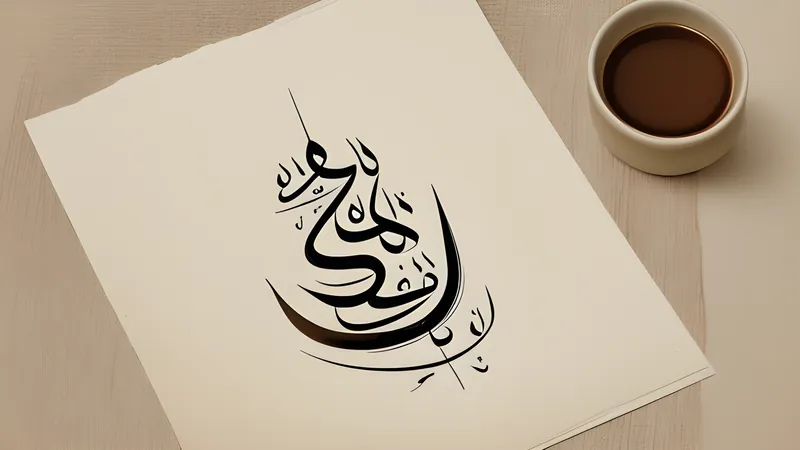
If the day has a defining image, it is calligraphy. Because much Islamic art has historically avoided figurative representation, the written word itself became the principal vehicle for visual beauty, and Arabic letters were elevated into an art of extraordinary sophistication. Distinct styles emerged for distinct purposes: the angular Kufic script favoured for early Qur’ans and architectural inscriptions, the rounded and highly legible Naskh used for everyday text, the elegant Thuluth seen on mosque walls, and the dense, ornamental Diwani developed in the Ottoman chancery.
The script’s right-to-left flow, its system of letters that change shape depending on whether they sit at the start, middle or end of a word, and its reliance on a baseline that the calligrapher can stretch and curve, all give Arabic writing a fluidity that has fascinated artists well beyond the Muslim world. Contemporary practitioners now blend classical letterforms with abstract painting in a movement sometimes called calligraffiti, carrying a fourteen-hundred-year-old craft onto city walls and gallery canvases.
Fun facts
- English borrowed a startling number of everyday words from Arabic, often through trade across the medieval Mediterranean: coffee, sugar, cotton, lemon, magazine, admiral, alcohol, mattress and the algebra already mentioned all trace back to Arabic roots.
- The Arabic alphabet has twenty-eight letters, and most of them change shape depending on their position in a word, which is why the script flows in connected, cursive forms rather than the separated capitals of the Latin alphabet.
- Many of the brightest stars in the night sky bear Arabic-derived names, including Betelgeuse, Rigel, Aldebaran and Altair, preserving the work of medieval Arab astronomers.
- The Qur’an’s role as a fixed reference text has kept classical Arabic so stable that a literate speaker today can read seventh-century verse with far less difficulty than an English speaker reading the English of Chaucer, written seven centuries more recently.
A closing reflection
A language survives not because it is useful but because people choose to carry it, copying its script by hand, memorising its scripture, arguing over its grammar and pouring its poetry into new forms. The vote taken in New York in 1973 simply recognised a decision that hundreds of millions of speakers had already made, generation after generation. To trace a single line of Arabic calligraphy is to follow the same path that once carried algebra and Avicenna across continents, and to be reminded that the most durable inheritances are the ones written down.
Related Content