Zardoz: Boorman's Folly and the Case for Watching It Anyway
A giant flying stone head, Sean Connery in thigh boots, and the most sincere failure in 1970s science fiction
Contents
The image that has followed Zardoz around for fifty years is Sean Connery in a red loincloth and thigh-high leather boots, a bandolier across his bare chest and a ponytail down his back, glowering out from beneath a Zapata moustache. It is a genuinely funny costume, and it has done the film a lasting disservice, because the still gets shared and the film goes unwatched. John Boorman made Zardoz in 1974, one film after Deliverance had turned him into a director studios would hand money to, and he spent that credit on the strangest, most self-serious science-fiction picture a major had bankrolled that decade. It flopped, it was mocked, and it has spent half a century as a punchline. I want to argue for it as a real film — imperfect, overreaching, sometimes ridiculous, and far more alive than most of the tidy dystopias that get respectful retrospectives.
The premise nobody warns you about
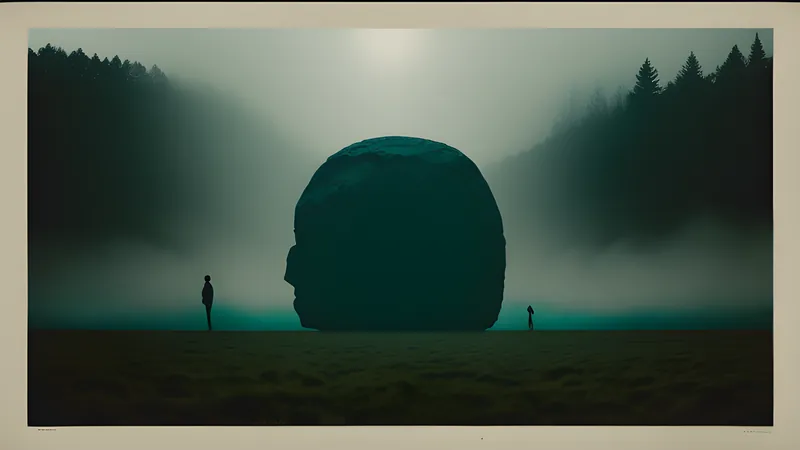
The year is 2293. Humanity has split into two castes. The Brutals live outside on a ruined Earth, farming and dying. The Eternals live inside the Vortex, an invisible pastoral commune where nobody ages, nobody dies, and everybody is bored past the edge of sanity. Policing the gap between them are the Exterminators, a horseback murder cult who worship a god called Zardoz — a colossal stone head that flies through the sky, vomits rifles from its mouth, and preaches that the gun is good and the act of procreation is evil. Zed, played by Connery, is an Exterminator who stows away inside the flying head and is carried into the Vortex, where the immortals keep him as a specimen and slowly discover that this grunting barbarian is the instrument of their undoing.
Boorman wrote it himself, and you can feel the absence of anyone in the room to say no. He had been developing an adaptation of The Lord of the Rings that collapsed, and some of that thwarted mythic ambition clearly poured into this instead. The budget was around a million dollars, which for the scale of idea on display is almost nothing, and the strain shows. What does not show any strain at all is the confidence. Zardoz never once behaves like a film that suspects it might be silly.
Why it looks so much better than it should
Here is the fact that reframes the whole picture: Zardoz was shot by Geoffrey Unsworth, the cinematographer of 2001: A Space Odyssey. That is not a footnote. Unsworth brings a diffused, misty, almost devotional light to the Irish countryside standing in for the Vortex, and he shoots the immortals’ idyll as a soft-focus Pre-Raphaelite dream that is quietly rotting from within. When the film wants unease it gets it through the lens rather than through effects it could not afford. The famous floating head is a physical model, and the compositing is what a million dollars in 1974 could buy, which is to say visibly seamed — and yet the thing has a genuine dream-logic menace, a pagan idol drifting over a green world.
Boorman also understands montage as a way to compress an education. One of the film’s better passages watches Zed being schooled by the Vortex against its own will — the immortals pour their accumulated learning into his skull hoping to overload him, and instead he absorbs it, images of art and mathematics and history flickering past as the barbarian becomes something the Eternals cannot control. Boorman stages the transfer of knowledge as an assault, and it doubles as the film’s own method: Zardoz is forever dumping ideas into you faster than you can process them, trusting the excess to do the work. When it succeeds, the overload is exhilarating. When it fails, you feel lectured. The film lives and dies on that gamble scene to scene.
The craft that holds Zardoz together is Boorman’s sense of ritual. He stages information as ceremony. When the Eternals interrogate Zed they do it through psychic projection, a whole community reading a single mind at once, and Boorman films it as a kind of hostile séance. When the immortals decay into the Apathetics — the ones who have simply given up on consciousness — or the Renegades, the ones punished with premature ageing, he treats these as castes in a functioning cosmology rather than as plot mechanics. The film has a worked-out theology, and it commits to it with a straight face that reads now as either lunacy or nerve, depending on your mood. My argument is that the nerve is the point. The films that survive from this loose 1970s wave of paranoid, idea-drunk science fiction are the ones that went all the way in.
The idea underneath the loincloth
Strip away the costume and Zardoz is asking a serious question: what does a mind do with eternity? Boorman’s immortals have solved death and been ruined by it. Nothing is at stake for them, so nothing means anything, and their society has curdled into petty tyranny and terminal ennui. Into this Boorman drops Zed, mortality made flesh, carrying the one thing the immortals secretly crave — an ending. The film treats death as the missing ingredient that makes life legible, and it is entirely sincere about this. That sincerity is what the mockery misses. Zardoz is not camping it up. It believes every word.
You can trace the family it belongs to. This is the same 1970s that produced Logan’s Run and Soylent Green and A Boy and His Dog, the American dystopias where the future is a trap with the truth hidden in the basement. Boorman is playing that game with a European art-cinema accent and a mystic’s temperament, closer in spirit to the cosmic reach of 2001 than to the pulp of its shelf-mates. If you want the cheaper, meaner, more punk version of the low-budget dystopia, John Carpenter would deliver it a few years later, and I have written about that in Escape from New York. If you want the other end of the 1980s spectrum — the gleeful, knowing, expensive kind of ridiculous — the Flash Gordon of 1980 is the film Zardoz is often lazily lumped in with, and the comparison is instructive precisely because Flash Gordon knows exactly what it is and Zardoz has no idea.
Watching it in a bad mood, and in a good one
I will be honest about the failures, because pretending they aren’t there is how you lose an argument. The middle section sags. Boorman keeps stopping the film to explain his cosmology, and some of those explanations are inert, actors reciting the rules of a world we would rather be shown. The gender politics are a 1974 man’s idea of provocation and land now as more embarrassing than transgressive. Charlotte Rampling, as the immortal Consuella who first wants Zed dissected and then wants something else entirely, does more with an arched eyebrow than the script deserves, and she is repeatedly stranded by dialogue that mistakes portent for depth. There are stretches where the only honest response is a laugh.
And yet. When Zardoz works, it produces images and ideas that no sensible film would risk. A god that is a hoax operated by a bored man. A paradise that begs to be destroyed. An immortal caste that has forgotten how to want anything. Boorman reaches so far past his budget and his good taste that the reach itself becomes the experience. This is a film best watched late, a little tired, willing to meet it halfway — the way you would approach Beyond the Black Rainbow, another slow, self-hypnotising sci-fi object that only opens up if you stop resisting its tempo.
The case for Zardoz is not that it is secretly a masterpiece with a bad wardrobe. The case is that a sincere, swing-for-the-fences failure is a rarer and more nourishing thing than a competent success, and that the culture of the shareable still has trained us to laugh at exactly the wrong quality — ambition without a safety net. Boorman made something nobody else could have made and nobody has dared remake. Watch it for that.
Spoilers below
The film’s structure is a slow reveal that the god is a fraud. Zardoz — the name is a joke, a contraction of The Wonderful Wizard of Oz, the book glimpsed as the source — is the invention of Arthur Frayn, an Eternal who has been breeding the Exterminators as a controlled population and grooming Zed specifically to be a weapon against immortality. The barbarian who seems to blunder into the Vortex was engineered to arrive there. Boorman plants the mechanism early and lets it detonate late, and the twist recasts every ritual we have watched as stage management.
What Zed brings the immortals is death, and the ending grants it as mercy. The Vortex’s central intelligence, the Tabernacle, is destroyed, the immortals’ defences fail, and the Exterminators ride in to kill the ones who have longed to die. Consuella and Zed survive together, and Boorman closes on one of the strangest final movements in 1970s cinema: a time-lapse of the two of them ageing, raising a child, growing old, and dying in the same seated position, until only their skeletal handprints remain on the wall. It is unabashedly a benediction. The film argues that death is the gift that makes a life a life, and it stakes its whole final movement on making you feel that rather than merely hear it. Ridiculous costume and all, that closing passage is genuinely moving, and it is the best evidence for taking the whole daft, magnificent thing seriously.
Related Content