Youth of the Beast: Suzuki's Kinetic Gangster Breakthrough
The 1963 Nikkatsu programme picture where a studio hack quietly became an artist
Contents
By 1963 Seijun Suzuki had made roughly thirty films for Nikkatsu, and almost nobody outside the studio’s release schedule had noticed. That was the arrangement. Nikkatsu, the oldest film company in Japan, ran a factory: contract directors were handed a script, a star, a budget and a deadline, and were expected to return a ninety-minute programme picture that played the bottom of a double bill and vanished. Suzuki delivered. He delivered on time, he delivered on budget, and for most of a decade he delivered the sort of borderless action pictures — mukokuseki akushon, the studio’s own coinage for its rootless tough-guy genre — that were designed to be forgotten by the following Tuesday.
Youth of the Beast is the film where the arrangement started to fray. It is still a programme picture. It still has the star, the deadline, the pulp source novel, the running time that fits a double bill. What it also has, for the first time in a way you cannot miss, is a director who has worked out that the studio will not actually stop him if he makes the assignment strange. The result is the hinge on which Suzuki’s whole career turns, and one of the most purely enjoyable crime films of the 1960s.
The setup
Jo Shishido plays a man calling himself Jo Mizuno, who arrives in Tokyo’s underworld with no history anyone can verify and a gift for making himself useful. He attaches himself to one yakuza organisation, then to its rival, and proceeds to work both sides with a straight face and a very fast pair of hands. Neither gang trusts him. Both need him. He knows things he should not know and turns up where he should not be, and the film’s first hour is largely the pleasure of watching two sets of hard men slowly realise that the freelancer they hired might be the worst thing that has ever happened to them.
Shishido is the reason the whole contraption flies. He is one of cinema’s great strange faces — he had cheek augmentation surgery in 1957, on the theory that a more distinctive face would get him better parts, and the resulting chipmunk severity turned a competent supporting player into an icon. The gamble paid off, and Youth of the Beast is where the payoff arrives. Shishido plays Mizuno with a flat, amused insolence, a man who has already calculated the room and found it disappointing. He absorbs punishment with a shrug and dispenses it without raising his voice.
The source is a novel by Haruhiko Ōyabu, one of the hardboiled writers who supplied Nikkatsu with a decade of tough men in bad situations. Suzuki keeps the skeleton and throws away the tone.
The office behind the cinema screen
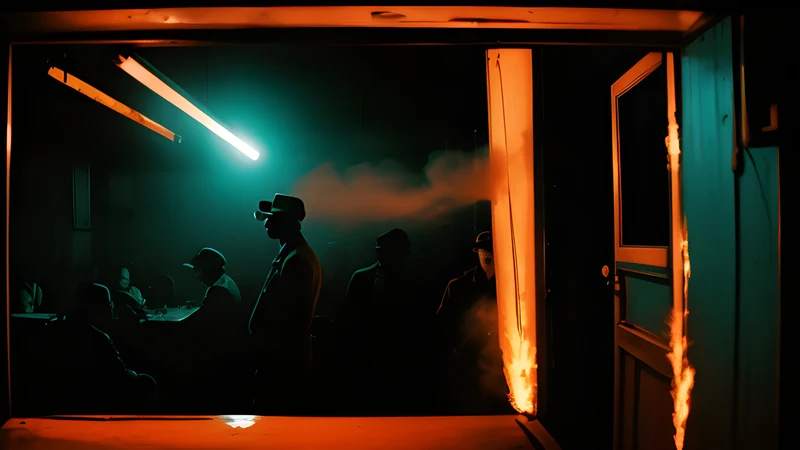
Here is the shot that tells you what film you are in. One of the gangs runs its business out of a room that backs directly onto the screen of a working cinema. The projector is throwing a picture at the other side of that screen while the gangsters conduct their meetings on this side, which means the men are permanently silhouetted, permanently washed in the flicker of somebody else’s movie, permanently backlit by an image we cannot see and they do not care about.
It is a gag. It is also a thesis. Suzuki is telling you, in one set, that these men live inside a genre — that the yakuza picture is a projection, and they are standing in it, and if you look closely you can see the light leaking round the edges. He does not explain the set. He does not have a character comment on it. He builds it, shoots it, and moves on, and it does more work in ten seconds than a monologue would do in ten minutes.
The whole film runs on that principle. Suzuki opens in black and white and then floods into colour, a jolt calibrated to arrive before the audience has settled. He composes for Nikkatsu’s widescreen frame by loading one side and leaving the other side aggressively, wrongly empty. He cuts on the wrong beat. He lets a wall of a room turn out to be a window. The programme-picture economy is still visible everywhere — a handful of rooms, a handful of exteriors, a schedule you can feel — and Suzuki’s response to the poverty is to make each cheap space do something that no expensive space could.
Why it works
The received line on Suzuki is that he is a stylist, which is true and also a slander, because it implies the style is decoration laid over a story. In Youth of the Beast the style is load-bearing. The film is genuinely hard to follow in stretches, and that difficulty is the point: Mizuno’s scheme depends on nobody in the film understanding what is happening, and Suzuki extends that condition to the audience. You are as off-balance as the gangs are. When the picture finally lets you see the shape of the thing, the relief is the same relief the characters never get.
The other engine is tempo. Suzuki’s cutting is faster than his contemporaries’ and, more importantly, it is impatient in a specific way — he removes the connective tissue that a Hollywood crime film of the same year would consider mandatory. A man decides to go somewhere; the next shot, he is there, mid-fight. Nobody walks to a car. Nobody explains a plan you are about to watch. A ninety-odd-minute picture with this much plot in it should feel congested, and instead it feels like it is being flicked past your face.
And the violence lands because Suzuki keeps it unglamorous even while the frame around it is beautiful. Beatings in this film are clumsy, drawn-out and humiliating. The bodies are inconvenient. There is a real streak of cruelty running under the pop surface, which is the thing that separates Suzuki from the imitators who took the colours and left the meanness behind.
The ancestor
The real forebear of Youth of the Beast is Dashiell Hammett’s Red Harvest, the 1929 novel in which a nameless operative walks into a corrupt town and destroys it by setting its factions on each other. Kurosawa lifted that structure for Yojimbo in 1961, moved it to a dusty village and gave it a masterless samurai. Two years later Suzuki lifted it again, moved it to Tokyo, and gave it a man with surgically enhanced cheeks and a shoulder holster.
Then it kept going. Sergio Leone made A Fistful of Dollars from Yojimbo in 1964. The Coens ran the same wiring through Prohibition in Miller’s Crossing, where Gabriel Byrne’s Tom Reagan is doing precisely what Mizuno does, with more talking and better hats. Walter Hill filmed Yojimbo almost straight as Last Man Standing in 1996. The play-both-sides plot is one of the most durable machines in crime fiction, and Youth of the Beast is the version where somebody finally noticed that the machine is funny.
If you want the Nikkatsu context that produced this thing, the studio’s own trajectory from tough-guy action into the erotic programme pictures of the 1970s is the subject of our primer on pinku eiga and Nikkatsu Roman Porno — the same factory, the same economics, a different product line.
The case against
Youth of the Beast is not the best Suzuki film, and anyone who tells you it is has probably not sat with the others. Tokyo Drifter is more beautiful and more completely deranged. Branded to Kill goes further and pays for it — the studio fired him over that one and blacklisted him for the better part of a decade. Next to those, this film is compromised: it still wants you to follow the plot, it still resolves, it still behaves.
The women in it are thin, even by 1963 standards, functioning mostly as leverage. The plot’s coincidences are pulp coincidences and Suzuki has no interest in disguising them. And the film’s method has a cost: when Suzuki removes connective tissue, some of the tissue turns out to have been load-bearing, and there are two or three transitions where you will genuinely lose the thread and have to wait to be told.
I think the compromise is what makes it the right place to start. This is Suzuki with one foot still inside the studio system, using genre against itself while the genre is still recognisably present. The later films are more astonishing and less legible. This one lets you watch the transformation happen in real time.
The verdict
The most interesting thing about Youth of the Beast is that it did not get anyone fired. Suzuki made a film that visibly does not believe in its own genre, and Nikkatsu shrugged and put it out, because it came in on time and the fights were good. That tells you something about how art actually escapes from a factory: quietly, inside the deliverable, while management checks the schedule.
It has been well served on disc in the West and turns up regularly in repertory Suzuki runs, usually paired with Tokyo Drifter. Watch it first. Watch it before the reputation arrives and tells you what to admire, because the film’s best trick is how casually it does the impossible thing — a work-for-hire crime picture that quietly rewires the crime picture, delivered on deadline, filed and forgotten, waiting sixty years for you to notice.
Spoilers below
The reveal is that Mizuno is a former detective, and his entire campaign against both gangs is a private revenge: he is avenging a colleague whose death was staged to look like something else. The black-and-white opening is the scene of that staging, and the film’s colour is, in retrospect, the lie the gangs are living inside.
What makes the reveal good is that it costs Mizuno nothing emotionally and everything practically. Suzuki declines the catharsis. Mizuno gets what he came for and the film gives him no music, no held close-up, no moment of arrival — the same flat, amused insolence he wore in the first reel. The gangs destroy each other more or less as planned, which is the Red Harvest ending, and the man who engineered it stands in the wreckage with nothing to show for it.
That flatness is the film’s real argument, and it is why the last act lands harder than the fireworks that precede it. Suzuki spends ninety minutes making the underworld look like the most exciting place on earth, and then declines to let anyone enjoy the victory. The pop surface was the bait.
Related Content