You Won't Be Alone: The Shape-Shifting-Witch Poem
Goran Stolevski films Macedonian folklore with Malick's camera and a butcher's honesty
Contents
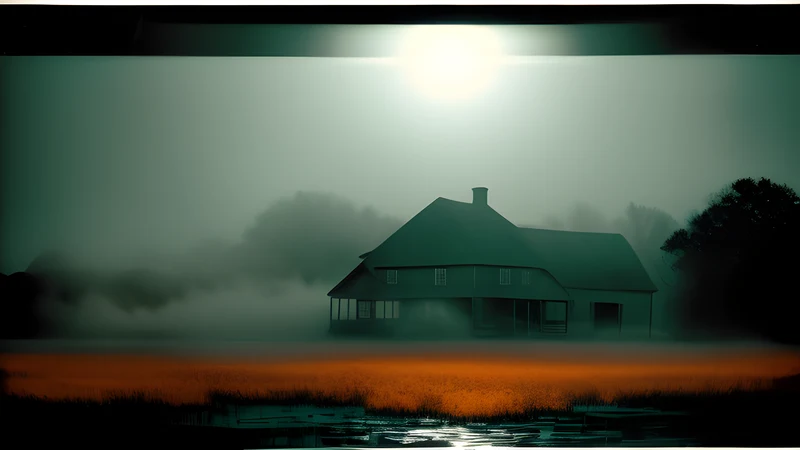
You Won’t Be Alone was sold as a horror film and marketed to the Witch audience, and the people who turned up expecting a slow-burn about a Macedonian witch got something considerably harder to categorise: a film about a creature learning what human beings are for, told in fragmentary voice-over, shot handheld in available light, with the occasional interlude of somebody being opened up.
Goran Stolevski’s debut premiered at Sundance in January 2022. It is a Macedonian-language film made by a Macedonian-Australian writer-director, shot in Serbia, financed partly through Focus Features, and it belongs to no obvious tradition at all. Which is why it has quietly become one of the essential folk-horror films of the decade — it is doing something the genre had not thought to do.
The premise, which is not really a plot
Nineteenth-century Macedonia. A witch called Old Maid Maria — the Wolf-Eateress — comes to a mountain village and marks an infant girl as her own. The mother strikes a bargain: she may keep the child until she is sixteen. To honour it she hides Nevena in a cave and raises her there in near-total isolation, without language, without other people, without any of the apparatus that makes a person a person.
Then Maria comes back, takes her, and makes her a witch.
What follows is not a revenge story or an initiation story. Nevena, now able to take the body of a person or an animal, spends the rest of the film wearing other lives. She inhabits a village woman, then a man, then a girl, and in each body she is trying to work out the rules — what this arrangement of limbs is supposed to do, why these people touch each other, what the sounds mean, why anyone would choose any of it. Sara Klimoska plays Nevena in her original form; Noomi Rapace, Carloto Cotta and Alice Englert are among the bodies she borrows. The performance is passed between actors like a relay baton, and it holds, because they are all playing the same alien intelligence with the same specific wrongness.
The craft: Malick’s camera pointed at a horror film
Stolevski and cinematographer Matthew Chuang shoot almost the entire film handheld, close, in natural light, at wide angle, drifting past faces rather than settling on them. This is the Days of Heaven and The New World grammar — Terrence Malick’s method, borrowed wholesale and pointed somewhere Malick would never go.
The reason it works is precise, and it is the best craft argument in the film. Malick’s camera behaves the way it does because it is trying to render consciousness as attention: the shot drifts because a mind drifts, the frame catches a hand or a shaft of light because a person would. Stolevski takes that grammar and hands it to a protagonist who has no frame of reference. Nevena’s attention is genuinely unstructured — she has never been taught what is significant — so the drifting camera stops being a lyrical affectation and becomes a literal transcription of her perception. She looks at a wrist for as long as she looks at a death, because nobody has told her which one matters.
The voice-over does the same job in language. Nevena’s interior monologue is broken, unpunctuated, syntactically wrong in a way that sounds like somebody assembling grammar from overheard fragments. It would be intolerable if it were a stylistic flourish. It is instead the sound of a mind being built in real time, and it is the reason the film’s tenderness registers rather than curdling.
Then there is the counterweight: the body work. When Nevena takes a form, Stolevski shows you the mechanism — the opening, the transfer, the wet reality of it — in unblinking close-up, with the same handheld naturalism he uses for a woman baking bread. There is no shift in register. The film does not signal that this is the horror bit. That flatness is the whole design: for Nevena, changing bodies and kneading dough are equally novel procedures, and the film refuses to rank them for you.
Mark Bradshaw’s score stays largely out of the way, which is correct. A film about a creature learning to interpret sensation cannot afford a soundtrack telling you how to feel.
The real ancestor
Everyone reaches for Eggers, and there is a surface case — period, folklore, subtitled-adjacent authenticity, a witch treated as a real thing. But The Witch is a tightening trap. It has a structure, a theology, and a destination. You Won’t Be Alone has none of those.
The genuine ancestor is Valerie and Her Week of Wonders, Jaromil Jireš’s 1970 Czech film — another Eastern European folk-fantasy about a girl on the threshold of adulthood, another film built from associative fragments rather than plot, another work where the horror imagery and the erotic imagery and the pastoral imagery are all the same imagery because the protagonist has not yet learned to separate them. Jireš understood that a coming-of-age film could be structured like a dream and still be rigorous. Stolevski has clearly seen it.
The second ancestor is the werewolf film, of all things — specifically the strain running from The Wolf Man onward that treats transformation as an affliction inflicted by another sufferer. Maria is a maker of witches for exactly the reason Lawrence Talbot is a maker of werewolves: loneliness. She was disfigured and cast out and had a child taken from her, and she creates a daughter because the alternative is more centuries alone. The title is her promise and her sentence.
The relay performance
The casting is the film’s boldest structural gamble and it deserves separate credit. Nevena is played by different actors in different bodies, which means the audience has to carry a character across faces, genders and languages of gesture with almost no verbal continuity to hold onto. Films attempt this occasionally and it usually collapses, because each actor plays their own version and the through-line dissolves.
Stolevski solved it by fixing on a physical vocabulary and drilling everyone in it. Whoever is wearing Nevena moves with the same hesitation — a fractional lag before every action, as though the body is being operated at a slight remove by someone reading instructions. Rapace, who has more screen time in the role than anyone, does this so consistently that you can identify Nevena in a wide shot before the film confirms it. Cotta does it too, and the effect in a male body is strange in a different way: the village reads his hesitancy as simple-mindedness rather than as menace, which tells you a great deal about the village.
Anamaria Marinca, as Maria, plays against all of it. Maria is fluent. She has had centuries to learn the operation of a body and she moves through the film with total physical authority, and that fluency is what marks her as the monster. The film’s cruellest joke is that the witch who has mastered being human is the one who has forgotten how to be a person.
The case against
It is a difficult sit, and the difficulty is not always productive. Stolevski’s commitment to fragmentary construction means the film has no gear beyond drift. There is no sequence in it that builds — no set-piece, no tightening, nothing that would let a viewer feel the film accelerating. Two hours of exquisite floating attention is a lot to ask, and the middle stretch, where Nevena is learning village life in a borrowed body, repeats its discoveries more than it deepens them.
The horror audience it was sold to has a fair grievance. This film is not frightening. It contains gore and it contains cruelty, and it deploys neither for dread. Anybody who bought a ticket on the strength of the trailer’s marked-baby imagery was mis-sold.
The defence is that the film’s project requires the drift. A story about a being with no sense of narrative cannot itself have a strong narrative without lying about its protagonist. Stolevski chose fidelity to the premise over shape, and the payoff is a film that achieves something no folk-horror film had managed: it makes the witch’s interiority the subject rather than the mystery.
Where it sits
You Won’t Be Alone is the third point of a triangle with Hagazussa and November — three European folk-horror films from the same handful of years that take their regional folklore as a source text rather than set dressing, and none of which is remotely interested in scaring you. Together they are the most interesting thing to happen to the genre since the 1970s British cycle.
It streams on the usual services and is worth seeking on the best screen you can find, because the film is almost entirely made of light on skin and the compression on a phone destroys it. Watch it awake, early, with subtitles and no distractions.
Spoilers below
Everything from here assumes you have seen it.
The film’s argument resolves in Nevena’s final body and what she does with it. Having spent the film borrowing lives — a wife, a man, a girl — and having been repeatedly shown that the village’s cruelty is distributed by gender and status rather than by any moral logic, she ends by making a choice Maria never made: she takes a child that is not hers and raises it, and she does it without the coercion that produced her.
That is the answer to Maria’s title. Maria’s promise — you won’t be alone — was a threat, delivered by a creature who solved her loneliness by manufacturing a companion out of somebody else’s daughter. Nevena arrives at the same problem and solves it by attachment rather than capture. The film has spent two hours establishing that she has no moral instruction whatsoever, which makes the choice extraordinary; she has reasoned her way to tenderness from raw data.
The most disturbing material is the male body. Stolevski gives Nevena a stretch as a man, and what she learns is the sheer administrative ease of it — how much less is demanded, how much more is permitted, how differently the same village behaves towards the same intelligence in different packaging. He films this with no commentary at all, which is far more damning than a speech.
Maria’s own history — burned, mutilated, robbed of her infant by the people she lived among — arrives late and reframes her entirely. She is not the film’s villain. She is its first victim, and the horror of the ending is that Nevena escapes a fate Maria never had the chance to refuse.
Related Content