You, the Living: Andersson's Comic Melancholy
Fifty tableaux, one tuba, and the warmest film Roy Andersson ever made
Contents
The epigraph of You, the Living (2007) is from Goethe, and Roy Andersson puts it on screen before anything else happens: be pleased, you the living, in your delightfully warmed bed, before Lethe’s ice-cold wave licks your escaping foot. It is an instruction to enjoy yourself, issued to people who are about to die, and the ninety-five minutes that follow are an anthology of Swedes comprehensively failing to comply.
This is the middle panel of what became the Living trilogy — Songs from the Second Floor (2000), this, and A Pigeon Sat on a Branch Reflecting on Existence (2014), which took the Golden Lion at Venice. It is also, by some distance, my favourite of the three, because it is the one where Andersson allows for the possibility of joy and then shows you exactly how narrowly everyone misses it.
What it is
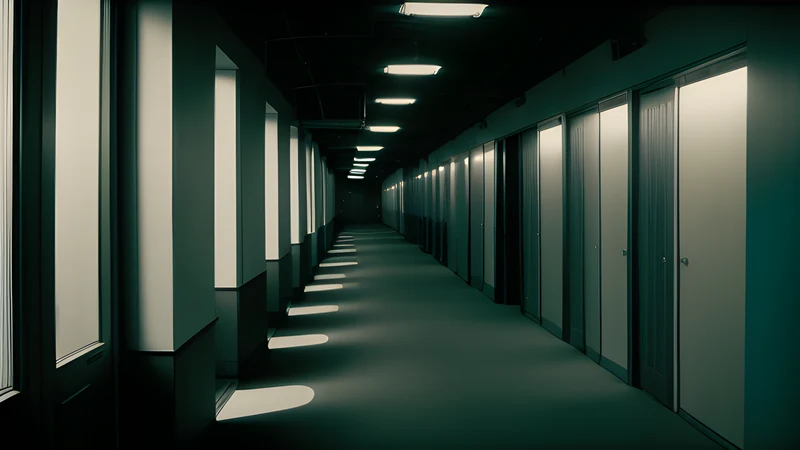
Fifty-odd tableaux, each a single locked-off shot, each running as long as it needs to. Some characters recur; most appear once and are gone. There is no story. There is a city — drained to that particular Andersson grey-green, built almost entirely inside his Stockholm studio — and there are people in it, and the film moves between them the way you might move between windows on a long walk home.
Anna (Jessica Lundberg) is in love with Micke Larsson, a rock guitarist who does not know she exists, and she is the closest thing the film has to a heroine. A woman sits on a bench sobbing that nobody understands her while a man and a dog wait for her to finish. A man practises the tuba in a small flat and his wife would like him to stop. A psychiatrist explains, to camera, in flat professional Swedish, that he spent years trying to make people happy, found them mean and impossible to satisfy, and now simply prescribes pills. A barber attends to a customer who has said the wrong thing. A Dixieland band plays for an audience of almost nobody.
And there is thunder. It runs under the whole film. Nobody remarks on it.
The two great dream sequences — one of Anna’s and one belonging to a man at a dinner party — are the film’s most quoted material, and both live below the spoiler line, though the dinner-party one is not a spoiler so much as a promise: it is the single funniest thing in Andersson’s filmography and I do not want to take the first viewing away from you.
Why it works: the method with the thermostat turned up
Structurally this is Songs from the Second Floor again — fixed camera, deep focus, wide lens, built sets, drained faces, everybody responding half a second late. What changed is the temperature, and the changes are specific enough to name.
The film cuts more often between shorter scenes. Songs held its tableaux until they ached. You, the Living moves. The average scene is shorter, the density of incident higher, and the effect is a film that plays as a joke book rather than a diagnosis. Same grammar, different meter.
Music is now inside the world. The tuba, the Dixieland band, Micke’s guitar, a brass ensemble in the street — this is a film full of amateur musicians who are all, without exception, playing for nobody. Andersson has found an image that carries his entire thesis without a word: a person making music in an empty room is both the saddest thing you can film and evidence that the person has not given up. He uses it about eight times and it never wears out.
The dreams are shot exactly like the waking scenes. No soft focus, no ripple, no cue. A dream in this film is a locked-off wide with everything in focus, identical to the shot before it, and you only work out you were in one when it ends. This is where Andersson’s refusal to move the camera pays its biggest dividend: because the form makes no distinction between real and imagined, the film’s fantasies carry the same evidentiary weight as its bus stops. Anna’s happiness is as real as her disappointment. That is a genuinely radical thing to do with a lens.
The faces are cast for kindness rather than grotesquerie. Andersson still uses non-professionals and still rehearses a single shot for weeks. But where Songs went for blotched, sweating, unbeautiful men, You, the Living is full of perfectly ordinary Swedes with mild, patient faces. It is a smaller cruelty, and the film gains enormously from it. You laugh with these people more often than at them.
Lundberg’s Anna is the performance to watch. She does almost nothing — she waits, she hopes, she looks slightly to the left of whatever she wants — and she carries the only uncomplicated tenderness Andersson has ever put on screen.
The real ancestor
The honest answer is Andersson himself, which makes for the best kind of collector’s recommendation: go and find World of Glory (Härlig är jorden, 1991), his fourteen-minute short. It opens with a shot of people being murdered in the back of a lorry, holds it, and then cuts to a middle-aged man who turns to the camera and shows you around his ordinary Swedish life — his flat, his family, his car — in exactly the deadpan register the features would later run on. Every technique in the Living trilogy is fully formed in that short, made nine years before Songs. It is the Rosetta stone of this filmography and it takes a quarter of an hour.
The outside ancestor is Buñuel, and specifically The Discreet Charm of the Bourgeoisie (1972). Buñuel’s dinner parties collapse into dreams which collapse into other dreams, with no marker anywhere and no eventual return to solid ground, and the joke is always that the dreamers are impeccably polite about it. The dinner-party sequence in You, the Living is that film’s direct descendant, down to the etiquette.
And behind both, Buster Keaton — the face that refuses to editorialise while catastrophe assembles itself in the background of the shot. Andersson’s actors are all doing Keaton at half speed.
The shelf: Songs from the Second Floor is the harder, angrier version of this film and the one to watch second. Themroc attacks the same European respectability from the opposite direction, with grunting. The Turin Horse shares the conviction that duration is a moral instrument. And The Phantom Carriage is the Swedish original of the idea that the dead simply carry on doing their jobs.
The case against
Fifty tableaux is a lot of setups and they are not equal. Perhaps a dozen are extraordinary, twenty are good, and the remainder are Andersson clearing his throat — a shot lands, you get the joke, and then the film sits there for another forty seconds because the method demands it. A ruthless editor could find eighty superb minutes in here.
The trilogy problem is also real: having invented the grammar, Andersson never developed it. Watch all three in a month and the third feels like a man executing a house style with great precision. This film sits at the point where the method is still surprising and the surprise is starting to become a signature.
And the psychiatrist’s monologue — people are mean, so I hand out pills — is the one moment where Andersson tells rather than shows. It is a very good line. It is also a summary of a film that has been doing the work perfectly well without it.
The verdict
You, the Living is a comedy about people who cannot get what they want, made by a director who knows precisely what they want and finds it entirely reasonable. They are simply in the wrong room, at the wrong time, playing an instrument nobody has come to hear.
That is a warmer film than Andersson is usually credited with, and the warmth is what makes the last movement land as hard as it does. Goethe’s instruction stands at the top of the picture like a challenge: be pleased. Ninety-five minutes later you understand exactly how difficult a request that is, and that the difficulty is not anybody’s fault.
It streams on the arthouse platforms and has had good disc editions across Europe. Watch it before Songs if you want to like Andersson, and after it if you want to understand him.
Spoilers below
The dinner-party sequence: a man tells us he dreamed he was at a formal dinner, was asked to perform the tablecloth trick, and pulled the cloth from a table set with two-hundred-year-old porcelain. Everything smashes. The film cuts — with no transition at all, in the same register, the same flat light — to a courtroom, where he is being tried. Then to a chamber where he is strapped into an electric chair while an audience of ordinary Swedes sits in tiered seating, coats on, watching politely, some of them eating. The switch is thrown. The lights of the entire city dim.
It is the best joke Andersson has ever constructed, and it is a joke about proportionality: the crime is a broken plate, the punishment is death, and the reason it is funny rather than surreal is that everybody involved behaves as though this is the correct amount of consequence. That is the film’s whole argument about shame, delivered in about four minutes with no commentary.
Anna’s dream is the other pole. She is in her flat with Micke and the flat begins to move. It is a train carriage. It rolls through the countryside and into a station where an enormous crowd is waiting on the platform, applauding, and Anna and Micke stand in the window of their own home being celebrated for having got married. Andersson shot it as one continuous wide, and the scale of the crowd against the domestic clutter is the point: her fantasy asks only that somebody be pleased for her. Then she wakes up in a chair, alone, and the film says nothing about it.
And then the ending. The thunder that has been rolling under the whole film resolves. In the final shot, Andersson gives us the sky over the city and a formation of heavy bombers coming in, in daylight, unhurried. No characters. No reaction. Cut to black.
He never says whose bombers or why. He does not need to. The film has spent ninety minutes establishing that these people are wretched, petty, unloved and mildly ridiculous, and it has spent the same ninety minutes making you fond of every one of them. Then it puts the wave over their escaping foot, exactly as Goethe promised on the first frame, and leaves you sitting in the dark having failed, along with everybody in the picture, to be pleased in time.
Related Content