World on a Wire: Fassbinder's Simulation Epic
Three and a half hours of German television that got there twenty-six years before everyone else
Contents
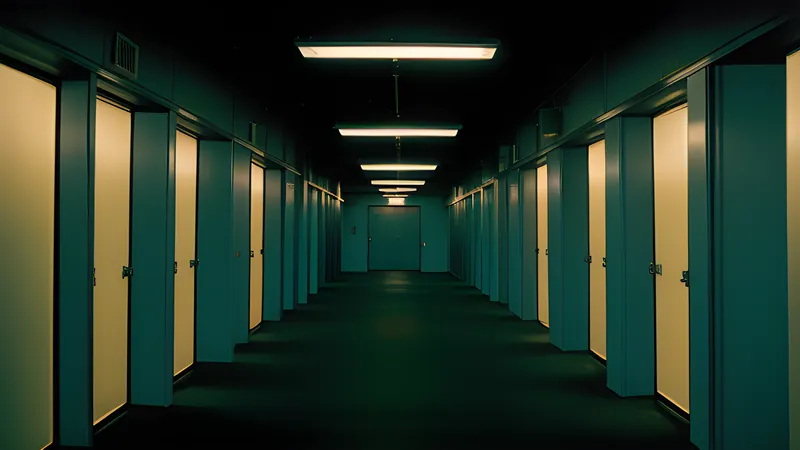
There is a shot in World on a Wire of a man walking down a corridor, and the corridor is mirrored, and the man is reflected, and the reflection is reflected, and somewhere in the receding stack of him you lose track of which one the camera is actually following. Rainer Werner Fassbinder does this for three and a half hours. He does it in offices, in lifts, in bars, in bathrooms. By the end you have been trained to check every frame for a duplicate, and the training is the film.
Welt am Draht was made in 1973 as a two-part film for West German television, shot fast on a television budget, broadcast, and then effectively lost for thirty-odd years. It is the earliest great film about simulated worlds, it is Fassbinder’s only science fiction, and it predates by a quarter-century almost every idea that a much louder film would be credited with in 1999.
The anomaly
Fassbinder made something like forty films in fifteen years, at a rate that should not have produced anything durable and repeatedly did. This one came out of that furnace in roughly six weeks of shooting, adapted from Daniel F. Galouye’s 1964 novel Simulacron-3, and its production circumstances are visible everywhere. Scenes run long because coverage costs time. Actors deliver enormous slabs of exposition in single takes. The camera moves rather than cuts.
None of that reads as poverty. It reads as unease. A television budget forced Fassbinder to build his future out of things that already existed — modernist office blocks, glass lobbies, chrome furniture, the brutalist architecture of Paris and Cologne — and the result is a science-fiction film with no science-fiction production design at all. The future here is a conference suite. It is the most persuasive futurism in the genre precisely because nobody built any of it.
The premise: a research institute has constructed Simulacron, a simulated world populated by thousands of “identity units” — simulated people who do not know what they are — so that industry and government can run forecasts on them. Ask the simulation what people will buy in ten years and it will tell you, because the simulation contains people. Fred Stiller, played by Klaus Löwitsch with a magnificent slab-faced belligerence, takes over the project when his predecessor dies, and begins to notice that the people around him are behaving oddly about it.
Ballhaus, and the geometry of doubt
Michael Ballhaus shot it, years before Scorsese found him, and the camerawork is the film’s argument delivered without words. The signature is a slow, continuous, circling movement — the camera drifting around a conversation in a full circle, taking in the whole room, coming back. On a naturalistic film that would be a flourish. Here it does something specific: a circle establishes that the space is complete, that this is a whole world, and the repetition of it starts to feel like a scan.
Then the mirrors. Fassbinder frames almost nothing directly. Characters are shot in reflections, through glass, in mirrored columns, in the polished surfaces of a bar. Sometimes the reflection is sharper than the person. The technique is doing three jobs at once — it fills a cheap set with visual interest, it doubles every performer at no cost, and it plants the film’s whole thesis in the grammar before a single line of dialogue raises it. You spend three hours watching copies of people and then the film asks you whether these people are copies.
The best move is the smallest. Fassbinder shoots ordinary business — a man greeting a colleague, a woman crossing a lobby — with a fractional hesitation, a beat where an actor holds still a moment too long before responding. Nobody comments on it. It accumulates. By the second half, an unremarkable secretary saying good morning is genuinely frightening, and the film has never once told you why.
The joke about Eddie Constantine
Fassbinder puts Eddie Constantine in his film, and the casting is a message. Constantine was Lemmy Caution, the trenchcoated detective of Godard’s Alphaville — a film that had already established that you can make science fiction by pointing a camera at contemporary Paris after dark and refusing to explain. Fassbinder is naming his ancestor on screen.
That lineage matters, because it is where the film’s method comes from. Alphaville’s discovery was that the alienating future is already built and merely needs the right lighting. World on a Wire takes the discovery and applies it to a paranoid thriller, with the added twist that Godard’s dehumanised citizens were a metaphor and Fassbinder’s are a technical specification.
What it saw first
Everything. The nested-simulation structure, the character who suspects reality, the corporate ownership of a world, the people who exist to be forecast at, the horror of learning your own ontological status — this film has all of it in 1973, worked through with more rigour than most of its descendants managed later.
Galouye’s novel was filmed again in 1999 as The Thirteenth Floor, which had the profound misfortune of arriving in the same year as a film with better fights. That year’s whole crop of reality-doubt pictures — the noir dream of Dark City among them — is working ground Fassbinder had already turned over. The line runs on into eXistenZ, where the nesting becomes a joke about players, and back to Total Recall, which is the same anxiety wearing an action film.
What separates Fassbinder from all of them is what he is actually interested in. The others treat the simulation as a prison to escape. Fassbinder treats it as a labour relation. His simulated people are a workforce — created, consulted, exploited, deleted when inconvenient, and never informed. This is a film by a man whose subject was always power inside relationships, and the science fiction has not displaced that subject an inch. The horror is not metaphysical. It is that somebody owns you and files reports about it.
Lost, then found
The film vanished after broadcast into the German television archive, unseen for decades outside a handful of screenings. It was restored under Ballhaus’s supervision and premiered again at the Berlin festival in 2010, thirty-seven years late, and only then reached the audience it should have had. That history explains its odd position: it is simultaneously the origin of a genre and a film almost nobody had seen while the genre was being built. Its influence on what came after is close to nil, which makes the resemblances more unsettling rather than less. Everyone arrived independently at the room Fassbinder had already furnished.
The case against
It is three and a half hours long and it feels it. The middle of the first part is a procedural slog through institutional politics, and Fassbinder’s contempt for conventional pacing means scenes that make one point take six minutes to make it. The performances are pitched at the flat, mannered register he liked, which suits the material thematically and gives you very little to hold on to across a runtime this size.
The thriller mechanics are also perfunctory. When the film needs a chase or a fight it produces one with visible boredom. And the gender politics are of their time and their director — the women are enigmas, largely, functioning as signals rather than people.
The verdict
World on a Wire is a masterpiece assembled out of expedients: no money, no time, no effects, no sets, a television slot, and a director who was contractually incapable of slowing down. What it has instead is a camera that never stops circling, a world made entirely of reflections, and the coldest idea in science fiction handled by someone who understood that the truly frightening part of being simulated is not unreality. It is that somebody is using the results.
Watch it in two sittings, as it was broadcast, and pay attention to the mirrors from the first shot. The film is telling you everything immediately, in the only language it trusts.
Spoilers below
Stiller’s predecessor, Vollmer, dies after telling a colleague he has discovered something unbearable about the institute’s work. Then the man he told it to, Günther Lause, vanishes mid-conversation with Stiller — and everyone insists there was never anyone of that name. That is the film’s real hook, and it is a deletion rather than a murder: a person removed from the world and from the record, with the world seamlessly closing over the gap.
The revelation, when Stiller assembles it, is the nesting. His own world is itself a Simulacron — a simulation run by a level above, with Stiller as an identity unit inside somebody else’s forecasting tool. Fassbinder plays this with no spectacle whatsoever. There is no bullet time and no waking up in a pod. There is a man in a suit being told, in an office, by someone with a clipboard’s manner, that he is a component. Löwitsch’s reaction is the film’s peak: rage, entirely useless, in a room with no exit that is not also inside the room.
The contact unit, Einstein, is the one simulated person who knows what he is, and his ambition is simply to get out — to be uploaded into a body on the level above. Fassbinder treats his desperation as a class demand rather than a plot device. He is not a villain. He wants what everyone above him already has.
The ending is a transfer. Stiller’s consciousness is moved up a level into the body of the man who designed him, while his simulated body dies below, and he wakes into the arms of the woman who has engineered it. Fassbinder shoots the reunion as romance and lets the poison sit there unremarked: he has escaped into a world identical to the one he left, with no way of knowing how many levels remain above it, delivered there by the only person who ever had power over him. The mirrors go all the way up.
Related Content