Wild Zero: Rock and Roll, Zombies, and Guitar Wisdom
Guitar Wolf versus the alien dead in the greatest garage-rock movie ever made
Contents
Some cult films earn their reputation by testing the audience. Wild Zero (2000) earns its by rewarding them. It is a Japanese rock-and-roll zombie movie starring the real garage band Guitar Wolf as themselves, in which aliens raise the dead, motorcycles catch fire, heads explode in geysers, and the power of rock — stated plainly, repeatedly, as a law of the universe — is the only thing that can save the world. It runs a shade under a hundred minutes and contains more pure joy per reel than almost anything I can name.
I’ve watched it in a quiet room and I’ve watched it in a full one, and it is a different, better film in company. Wild Zero is built for an audience, and the cult that formed around it worked that out early: it comes with its own drinking game, printed on some releases, cueing you to raise a glass every time someone combs their hair or a fireball erupts. That participatory design is not a gimmick bolted on afterward. It is the film’s whole understanding of what rock and roll and cinema are for — a thing you do together, loud.
The plot, such as it gloriously is
Guitar Wolf — the band and the fictional trio share the name, the leader styling himself Guitar Wolf, his bandmates Bass Wolf and Drum Wolf — are the leather-clad demigods of this universe, and the story hangs off the band’s number-one fan, a young man named Ace who dreams of rock stardom. Early on, Guitar Wolf anoints Ace as a spiritual brother and hands him a whistle: blow it in a moment of crisis, and Guitar Wolf will come. The promise is absurd and the film treats it as sacred, which is exactly the tone the whole picture sustains.
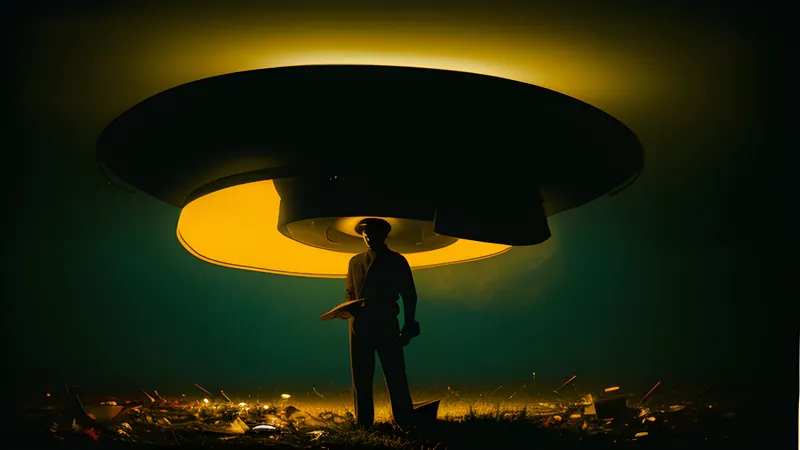
Then flying saucers appear over the town of Asahi and the dead begin to rise. Ace, fleeing the zombie apocalypse, meets and falls for a young woman named Tobio, and the two are separated in the chaos. What follows braids three strands — Ace’s quest to reunite with Tobio, a subplot involving a gang of thieves holed up against the horde, and Guitar Wolf’s ongoing war on the undead armed with a katana concealed in his guitar neck and a guitar pick that flies like a throwing star and detonates on impact. Every crisis is resolved by rock. When the situation is most hopeless, Ace blows the whistle, and across an impossible distance Guitar Wolf hears it and roars to the rescue. The film means this with its entire chest.
Why the sincerity is the special effect
The obvious read on Wild Zero is that it’s a so-bad-it’s-good lark, a pile-up of cheap gore and cheaper acting that you laugh at. That read misses what actually makes it work, and what makes it re-watchable long after the novelty of exploding heads wears off. The film is not laughing at itself. It is completely, disarmingly sincere about the two things it loves — rock and roll, and its lovers — and that sincerity is the effect no budget can buy.
Director Tetsuro Takeuchi came from music videos, and it shows in the best way: he shoots Guitar Wolf as genuine icons, low angles and back-light and slow-motion swagger, treating a garage band with the reverence a Hollywood film reserves for superheroes. Because the camera believes, we believe. The gore is gleeful rather than nasty; the practical effects are ambitious past their means and endearing precisely because you can see the reach exceeding the grasp. And the music is real — Guitar Wolf’s actual, ferocious, distortion-drowned garage punk powers the film, so that the recurring claim that rock can raise the dead and defeat aliens is backed, every time, by a soundtrack loud enough to make you believe it too.
The deeper mechanism, the one that lifts Wild Zero above novelty, is a single subplot handled with startling grace. When Ace discovers that Tobio is a transgender woman and briefly hesitates, Guitar Wolf delivers the film’s guiding commandment — that love knows no borders, nationalities, or genders, and that rock and roll draws no lines. In a gore comedy from 2000, played entirely straight and entirely without cruelty, that message lands with a sweetness the film never undercuts. The whole ludicrous universe turns out to have a genuine ethic at its centre, and it is one of tolerance. That’s why the film has kept its audience. The zombies are the hook; the heart is why people stay.
It helps to know that Guitar Wolf are a real band, and a genuinely extreme one — a Japanese garage-punk trio who built a reputation on volume so punishing it became a kind of ideology, records mixed into a glorious wall of noise, live shows staged as leather-clad rock ritual. Casting them as themselves is the film’s masterstroke, because none of the mythology is invented. The swagger the camera worships is the swagger they actually carry, and the music that saves the world is the music they actually make. That authenticity is why the film never curdles into parody: you cannot parody something this committed to being exactly what it is. When Guitar Wolf treats rock and roll as a sacred power the band is not acting, and the film borrows every ounce of that conviction.
Where it belongs on the shelf
Wild Zero descends from a specific and honourable tradition: the deliberately maximal cult film that dares you to keep up. Its closest spiritual sibling is the grubby, joyful excess of Troma, and anyone who loves The Toxic Avenger will recognise the same faith that sincerity and splatter can share a frame. It also belongs beside the great audacious cult imports — the gleeful, resource-poor, imagination-rich swing of something like Turkish Star Wars, which shares Wild Zero’s conviction that ambition matters more than money.
And it sits, of course, among its batch siblings in this desk’s run through the wilder end of turn-of-the-millennium Japanese cinema. Set it against Takashi Miike’s Gozu and Visitor Q and you get the full spread of what that moment produced — the same fearless, anything-goes energy pointed at nightmare, at taboo, and here at pure delight. Where Miike used the freedom to unsettle, Takeuchi used it to celebrate, and the three films illuminate one another.
The verdict
Wild Zero is the rare cult film I’d recommend to almost anyone, provided they arrive in the right spirit and, ideally, with company. It is loud, ridiculous, gory, generous, and — underneath the exploding heads — genuinely kind, which is a combination almost nobody else has pulled off. Come for the flaming guitar pick and the katana that lives inside a Fender; stay for a film that believes, with its whole ludicrous heart, that rock and roll can raise the dead and that love has no rules. It has aged into exactly the film it always wanted to be: a communal, blissful, deathless midnight movie.
Where to watch: it circulates on cult-distributor discs, some of which preserve the drinking-game subtitle track, and turns up on genre streaming outlets. Watch it loud, and if you possibly can, watch it with a room full of people. It was made for exactly that, and it has never once failed a crowd.
Spoilers below
The climax delivers on every promise the film has made, and it’s worth savouring how completely. With the zombie horde closing in and the alien menace looming over Asahi, Ace finally reunites with Tobio, and the film pays off its central romance without a trace of the caveat a lesser movie would have inserted — Guitar Wolf’s commandment about love holds, absolutely, and the couple’s reunion is treated as an unambiguous triumph. The mothership itself is dispatched by rock: Guitar Wolf destroys the alien threat with an impossible blast of amplified sound, the guitar as literal weapon of mass salvation.
The single most beloved beat comes when the situation is beyond hope and Ace blows the whistle. Across a distance no sound could carry, Guitar Wolf hears it, turns, and comes — the promise from the first act honoured in full, played with a straight face and scored to a wall of distortion. It’s a pay-off that should be too silly to move anyone, and it moves everyone, because the film has spent ninety minutes earning the right to mean it. The final image sends the survivors off into a dawn the band’s rock has bought them, the alien dead defeated, love intact, everyone still standing.
What makes the ending stick is its refusal to blink. A cannier film would have hedged the sincerity with a wink, protected itself with irony. Wild Zero protects nothing. It goes all in on the idea that rock and roll is a moral force and love is unconditional, and it wins the bet by simply believing harder than you thought a film about alien zombies could. That’s the whole trick, and no amount of money can teach it.
Related Content