Who Can Kill a Child?: The Sunlit Horror of the Innocent
Narciso Ibáñez Serrador's 1976 island nightmare made the Mediterranean daylight terrifying
Contents
Horror loves the dark because the dark does half the work. Narciso Ibáñez Serrador threw that crutch away. His 1976 film puts its terror under a blazing Mediterranean sun, on a whitewashed holiday island where the sea is postcard-blue and the light is merciless, and it is one of the most frightening films of its decade precisely because there is nowhere for the shadows to gather. Who Can Kill a Child? — ¿Quién puede matar a un niño? — is the great sunlit horror film, and it asks a question in its title that it fully intends to make you answer.
Serrador was a giant of Spanish television, the creator of the anthology series Historias para no dormir and director of the poisonous boarding-school horror The House That Screamed. He made very few features, and this is the one that has grown, over decades of poor prints and eventual restoration, from a cult obscurity into a film routinely named among the finest horror pictures Spain has produced. Its influence runs far wider than its viewership ever did.
The setup, and the prologue that fights it
An English couple, Tom and Evelyn — she is heavily pregnant — leave the mainland for a quiet island called Almanzora, hoping for a last calm holiday before the baby. They arrive to find the town eerily deserted. Adults are absent. Children are everywhere, playing, watching, smiling. And slowly, with a patience that is the film’s masterstroke, Tom and Evelyn come to understand that the children have killed every adult on the island, and are simply waiting to finish the job.
Before any of this, Serrador opens with something that still divides audiences: a long documentary prologue of real archival footage showing children as the victims of twentieth-century atrocity — war, famine, the camps. It is grim, confrontational, and it recontextualises everything that follows. The film is not a cheap “evil kids” shocker. Serrador is arguing that adults have spent a century visiting unimaginable horror upon children, and he is about to stage a reckoning in which the children, finally, hand it back. Some releases have cut the prologue, and the film survives without it, but with it the horror acquires a moral floor that most killer-kid movies never bother to build. The prologue is Serrador loading the question so the ending can fire it.
Why the daylight is the horror
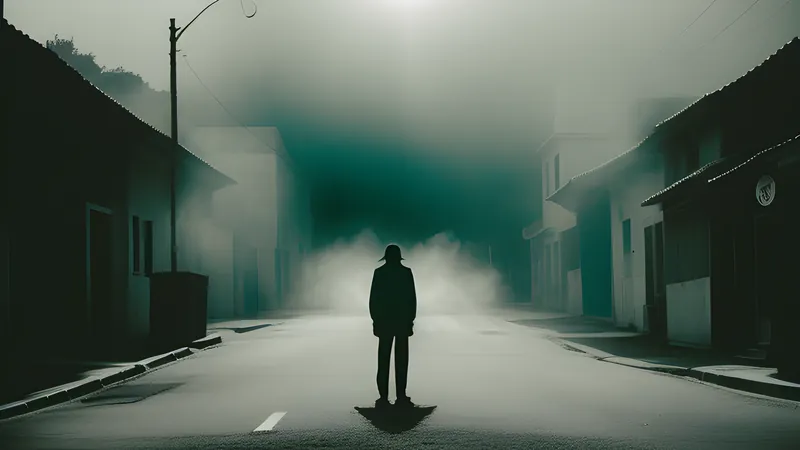
The formal decision that makes the film great is the light. Serrador and cinematographer José Luis Alcaine shoot in flat, bright, unshadowed exteriors — sun-blasted plazas, dazzling white walls, open water — and the effect is a slow suffocation of hope. In a dark horror film you are always waiting for dawn to save you. Here it is already noon, and noon is when the children come. There is no rescuing daylight because the daylight is already the setting for the slaughter. You watch a man scan a bright empty square for a threat and find only laughing children, and the brain refuses to file laughing children under danger until it is far too late.
Serrador compounds it with restraint. He does not fetishise the violence; much of the killing is glimpsed, implied, or shown with a documentary bluntness that denies the audience the release of spectacle. And he keeps the children childlike — they giggle, they play games, they use toys — so that the horror is never that they have become monsters. The horror is that they are exactly what they always were, turned against you, and that a child’s cruelty has a lightness to it that an adult’s cannot.
Why it works
The film’s engine is the title, and the trap it lays. Who Can Kill a Child? is not rhetorical. Tom, a decent modern man, is confronted with a situation where his own survival, and his pregnant wife’s, depends on raising his hand against children, and the film forces him — and us — to sit inside the paralysis of that taboo while the danger closes in. The deepest fear the picture generates is not of the kids at all. It is of the moment a good person discovers what he will do when the alternative is death, and of learning that the taboo he trusted to define him was always negotiable.
That places the film in a very particular strain of 1970s horror that used children to interrogate the adults around them. It rhymes directly with Lucio Fulci’s Don’t Torture a Duckling, the other great Mediterranean horror of the era to set the murder of and by children under a hard bright sun, and to make a whole community’s morality the true subject. It shares a bloodline with the ambiguous, watched children of The Innocents, where the terror also lives in an adult’s inability to be sure what a child is. And its willingness to stage horror as a matter of overwhelming, indifferent daylight anticipates the daylight atrocity of later folk horror and looks back, in spirit, to the ritual-in-the-sun tradition that The Wicker Man had crystallised three years before.
The film’s reach is longer than its fame. Its DNA is visible in Children of the Corn and the whole subsequent industry of murderous-children cinema, and it received a direct American remake — Come Out and Play — in 2012, which reproduced the plot and comprehensively missed the point, because it kept the killer kids and dropped the moral weight of the prologue and the title. Serrador’s original remains definitive because it never lets you enjoy the premise; it makes you responsible for it.
The man and the source
Serrador is worth knowing, because the film is the work of a craftsman who spent years learning how to frighten a living-room audience. Born into a theatrical family and raised between Spain and South America, he became the dominant genre voice on Spanish television, and Historias para no dormir — “Stories to Keep You Awake” — trained a whole country to expect the twist and the chill from him. That television discipline shows in the feature’s patience: Serrador knows how long to withhold, how to let unease accumulate before the first overt act, how to make a smiling child on an empty street do more work than any jump scare.
He adapted the film from Juan José Plans’s novel El juego de los niños — “The Children’s Game” — and kept the book’s central provocation while sharpening it for the eye. The choice to bookend the fiction with real atrocity footage is Serrador’s, not the novelist’s, and it is the decision that lifts the film out of exploitation. He is refusing to let you treat the killer children as arbitrary monsters. He has shown you, in documentary fact, what adults do to the young, and the fiction that follows is offered as a kind of judgment — the debt called in, in blinding sunlight, on a holiday island where no one thought the bill would ever arrive.
Where to watch
For years this was a film spoken of more than seen, circulating in washed-out copies that flattened the very sunlight the whole design depended on. The restorations that horror-preservation labels have since produced are essential, because a good transfer restores the glare, and the glare is the film. Watch it in daylight, if you can bear the joke, and watch it with the prologue intact. It will spoil the beach for you, which is exactly what Serrador intended.
Spoilers below
The film’s cruellest stroke is that the contagion is not confined to the island, and not confined to children who were born there. In the film’s most unsettling sequence, Evelyn feels her unborn child turn against her in the womb — the malignancy has reached inside her, and the baby she has crossed the sea to protect becomes another of the enemy. It is a horror image that goes far beyond the “creepy kid” formula: the future itself, the next generation, has decided the adults are the problem and is acting accordingly, from before birth. There is no safe distance to retreat to, because the thing hunting them is simply the young, and the young are everywhere and unstoppable.
The ending closes the trap the title set. Tom, to survive and to save Evelyn, does the unthinkable — he takes up a gun and kills children, crossing the line the whole film has dared him to approach. And Serrador’s final irony is merciless: the moment Tom is seen by the mainland authorities doing exactly that, he is shot as a child-murderer, because from the outside there is no way to distinguish a man defending his life from a monster gunning down the innocent. The horror is completed by the discovery that the island is not an aberration to be contained. The contagion spreads to the mainland in the final frames, the children there beginning to gather and watch in the same silent way, and the film ends with the plague of the young stepping quietly off the island and into the wider world. Serrador’s answer to his own title is that anyone can kill a child, given the right terror — and that having done it, you will look exactly like the evil you were fighting.
Related Content