White Zombie: Lugosi and the First Zombie Film
An eleven-day independent quickie from 1932 invented a monster the whole century would keep re-using
Contents
Every zombie film you have ever seen descends from a picture shot in roughly eleven days by two brothers who could not afford their own sets. White Zombie came out in the summer of 1932, made independently by Victor and Edward Halperin, released through United Artists, and assembled largely on standing sets borrowed from Universal — the castle interiors, the staircases, the fragments of European gothic that had already served Dracula and Frankenstein the year before. It cost somewhere in the region of $50,000. The New York critics filed it under junk. It is now the foundation stone of the most durable monster of the last hundred years, and the strange thing is that watching it today, you can see exactly why: it is bad in ways that do not matter and eerie in ways that do.
The word arrives from a travel book
The zombie entered American English through print before it ever reached a screen. William Seabrook’s The Magic Island, published in 1929, was a lurid traveller’s account of Haiti under American occupation, and it carried back a word and an image: the zombi, a corpse raised by a sorcerer and set to work in the fields. Seabrook’s book was a bestseller, Kenneth Webb turned the material into a Broadway play called Zombie in early 1932, and the Halperins had their film in cinemas within months. Webb sued. He lost. The speed of the whole operation tells you what kind of picture this was meant to be — a cash-in on a fashionable word.
What the Halperins seized on, and what almost every later filmmaker quietly dropped, is that the original zombie was an economic horror rather than a biological one. Seabrook’s Haitian zombies are labour. They are dead men marched into cane fields because dead men do not eat, sleep, complain or organise, in a country whose sugar economy was at that moment being reshaped by American capital. The Halperins were opportunists with a camera, and yet they kept that meaning intact, which makes White Zombie the only truly Haitian zombie film Hollywood made before the idea mutated beyond recognition.
The mutation is worth marking, since the modern audience arrives with the wrong monster in its head. The flesh-eating ghoul dates from 1968, when George Romero fused Richard Matheson’s vampire plague from I Am Legend with a farmhouse siege and then, crucially, never used the word in the film at all. The label got attached afterwards by critics and stuck, so that a Haitian folkloric slave became an American cannibal corpse — a lineage the desk has traced in full in the zombie canon and picked apart again in why zombies keep changing what they mean. Romero’s dead are contagion. Lugosi’s dead are property.
The mill
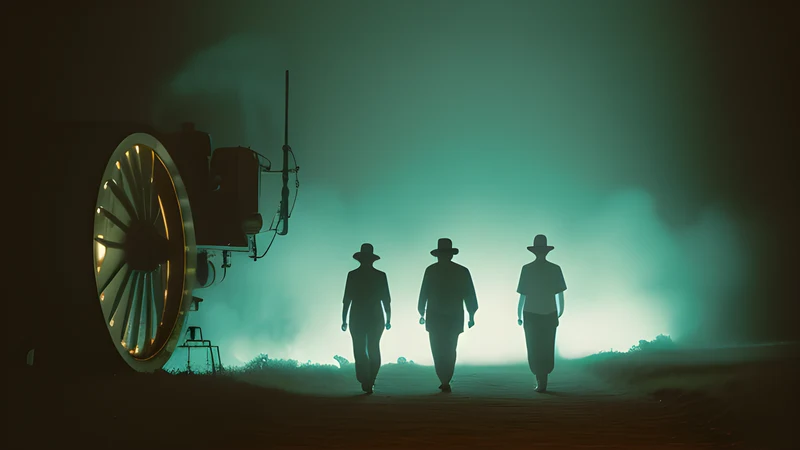
The scene everyone remembers costs nothing and does everything. Legendre’s sugar mill grinds in the Haitian night, powered by a great wooden wheel, and around it his zombies push the capstan in a slow unbroken circle. One of them stumbles and falls into the grinder. The others keep walking. The wheel keeps turning. Nobody reacts, because there is nobody there to react — that is the whole point, delivered in about forty seconds of screen time without a line of dialogue.
Arthur Martinelli’s camera stays back and lets the geometry work: the wheel, the ring of walking bodies, the mechanical repetition. The sound design helps by being cheap. White Zombie was made at the moment when early talkies were still frightened of silence, and this one embraces it — long passages carry only drums, wind, the creak of the mill, a patchwork of borrowed and library music cues stitched together with no regard for continuity. The result sounds unlike a 1932 studio picture and closer to a fever, and modern audiences read the technical poverty as atmosphere. The film gets credit for an accident, though it is an accident it commits to.
That gap between intention and effect runs through the whole picture. The performances of the young lovers, Madge Bellamy’s Madeleine and John Harron’s Neil, are stiff even by the standards of the year — Bellamy was directed to play much of her role in a trance and does so by simply not moving her face, which is either a masterstroke or the path of least resistance. The plot is a creaky melodrama: a plantation owner, Charles Beaumont, wants another man’s bride, so he asks the local sorcerer for help and receives it on terms that destroy him. Robert Frazer plays Beaumont’s dawning horror with real conviction, and he is the film’s only genuine character arc.
Lugosi’s hands
Bela Lugosi plays Murder Legendre — a name no screenwriter would dare now — with a widow’s peak, a spiked beard and a stillness that is more disciplined than anything in his Dracula. He had been a Universal star for barely a year and was already sliding towards the independents, which is how a picture like this could afford him at all. Legendre is the best thing he ever did outside the Count, and the reason is that Halperin found a piece of business for him that nobody else did.
Lugosi acts with his hands. He interlocks his fingers, knuckles up, in a slow deliberate clasp whenever he takes control of a mind, and the film cuts to it repeatedly — a gesture of grasping, of something closing. Paired with the huge lit close-ups of his eyes floating in darkness, superimposed over the victim, it gives the film a vocabulary of possession that requires no effects budget whatsoever. The whole supernatural apparatus of White Zombie is two eyes and a pair of hands, and it works because Lugosi commits to it with total seriousness in a film that does not deserve him. There is a lesson here that the desk keeps rediscovering in the creature restraint principle: the cheapest possible image, held with conviction, outlasts the expensive one.
Why the print was terrible for fifty years
White Zombie has an afterlife shaped almost entirely by paperwork. The copyright lapsed, the film fell into the public domain, and for decades it circulated in dupes of dupes — muddy, jumpy, missing frames, the sound wobbling, precisely the fourth-generation VHS smear that a certain kind of collector mistook for atmosphere. Its reputation was built on those prints. Anyone who found it in a video shop bargain bin in the early nineties met a film that looked like it had been exhumed, which for this particular title felt like a bonus.
The Film Detective’s 4K restoration, drawn from surviving 35mm elements and released in 2018, changed the argument. Cleaned up, the film loses some of the accidental grot and gains what Martinelli actually shot: real depth in the mill sequence, legible faces in the castle scenes, and a visible seam where the borrowed Universal sets meet the Halperins’ own thin flats. The restoration is honest about the film being cheap, and it survives that honesty. Public domain rot had been doing the picture a disservice by hiding the craft that is there — a lesson worth carrying into the argument about cheap horror on Poverty Row, where the films that lasted were rarely the ones with the money.
Where to go next
The obvious companion is I Walked with a Zombie, which took the same Haitian material eleven years later and gave it to Jacques Tourneur and Val Lewton, who made something quiet and heartbroken out of it and kept the folkloric zombie intact for one last film before Hollywood forgot what the word meant. Watch the two back to back and the descent is clear: the Halperins found the image, Tourneur found the poetry, and everyone after 1968 was making a different film with a borrowed noun. For the Lugosi lineage specifically, The Black Cat two years later shows what a real budget and a real director could do with the same face.
The verdict comes down to what you want from a first draft. White Zombie is stiff, under-acted by everyone except its villain, and structurally a Victorian melodrama with a new coat of paint. It is also the film that gave cinema a monster defined by having no interior life at all, and it built that monster out of a wheel, a circle of walking men and a pair of interlocking hands. Sixty-seven minutes, and roughly ten of them are as good as any horror made in the decade.
Spoilers below
Beaumont’s fate is the film’s real cruelty and the reason it lingers. He asks Legendre to give him Madeleine and pays in a currency he does not understand: Legendre poisons him too, slowly, so that Beaumont spends the last act conscious, articulate, and progressively unable to move or speak — a man watching his own body become the thing he ordered made of someone else. Frazer plays the paralysis with his eyes and it is the most upsetting performance in the picture.
The climax obeys a rule the film establishes early and never explains: kill the master and the zombies stop. On the cliff-top castle, Legendre’s undead servants — the men he stole from every enemy he ever crushed, kept about him as trophies — march off the parapet into the sea when his control breaks, an image of enslaved labour walking into the water that the film almost certainly did not intend as commentary and cannot help delivering anyway. Legendre goes over after them. Madeleine wakes.
That final rule is the one piece of White Zombie that failed to survive. Romero’s dead answer to nobody, which is why they are frightening in a modern way — a plague has no negotiator. Legendre’s dead answer to a man, which means the horror has an address, and killing the man fixes it. The 1932 film ends with the master destroyed and the workers released. Every zombie film since has quietly agreed that no such ending is available.
Related Content