White Heat: Cagney on Top of the World
Two films in one: a police procedural with a radio direction-finder, and a man who sits in his mother's lap
Contents
White Heat (1949) should not work. It is two films spot-welded together, and they come from different planets. One is a sober, procedural, almost bureaucratic account of federal law enforcement using new technology to hunt a gang — men in hats, in vans, watching a needle. The other is a fever dream about a man with migraines who sits in his mother’s lap for comfort and murders people to settle his nerves. They should cancel each other out. Instead they generate the most alarming crime film Hollywood produced in the forties, because the plainness of one half makes the other half look like an infection.
Cagney comes back
He had been gone a decade. After the gangster cycle made him, The Public Enemy first among them, James Cagney had spent the forties escaping the type — he won an Academy Award singing and dancing in Yankee Doodle Dandy in 1942, set up his own production company, and by 1949 was returning to Warner Bros. and to the genre he had left, aged fifty, with something to prove.
What he brought back is unrecognisable. Tom Powers was a delighted hooligan. Cody Jarrett is ill. Cagney plays him with a physical vocabulary borrowed from epilepsy and grief: the headaches arrive as seizures, he keens, he claws at his own skull, he has to be held. Nobody had seen a leading man do this. Nobody had seen a star do this — the vanity required to be that ugly on screen at fifty, in a comeback, is enormous, and Cagney simply does not care.
The genius of it is that Cody is never pitiable. In between the attacks he is lucid, funny, and the most competent professional in the film; he plans well, he reads people accurately, and he kills without any of the ceremony the genre usually demands. There is a moment involving a man in the boot of a car and a complaint about the air supply that is the single coldest joke in American crime cinema, and Cagney tosses it away while eating.
Ma
Margaret Wycherly plays Ma Jarrett, and she is the reason this film is studied. The gangster’s mother had been a fixture of the cycle since 1931, and she had always been the moral counterweight — blind, devout, betrayed. White Heat takes that figure and makes her the source. Ma planned the jobs. Ma keeps the gang in line. Ma is harder than her son and she is the only person alive who can settle him, and the film shows you how: he sits on her knee, a fifty-year-old man, and she strokes his head and tells him he will be on top of the world.
Wycherly plays it without a flicker of camp, which is what makes it unbearable. She is not a grotesque. She is a mother with a business, and her business happens to be armed robbery, and her love for her son is real, total and the engine of every death in the picture. Ivan Goff and Ben Roberts’s screenplay, from Virginia Kellogg’s story, understood that the toast Ma raises — top of the world — is a promise, and that a man who has been promised that by the only person he trusts will eventually have to go and stand somewhere high.
The procedural half, and why it belongs
The other film is the reason White Heat is a noir rather than a period gangster picture. Postwar American crime cinema had gone documentary: shot on location, narrated with case numbers, admiring of forensic method. The template case is He Walked by Night (1948), which turned police procedure into suspense and spawned an entire television industry.
Walsh takes that mode and uses it as a vice. Treasury agents put a man inside the gang — Edmond O’Brien’s Hank Fallon, working under a name that is a lie he has to maintain hourly — and they track the gang’s vehicle with a radio direction-finder, triangulating from a following van. Long stretches of the film are just men watching an oscilloscope trace and doing arithmetic. It is genuinely gripping, and its real function is thermodynamic: every minute spent with the calm, patient, well-funded machinery of the state raises the pressure on the lunatic it is closing on.
O’Brien has the hardest job in the film and does it beautifully. Fallon’s performance-within-a-performance requires him to be liked by a man who kills casually, and O’Brien plays the exhaustion of it — the toll of being warm at someone eighteen hours a day while a van follows you at a distance.
Why the mess hall is the best scene ever staged in this genre
It is worth watching once purely as staging. Cody is at a long table in the prison mess. Word has to reach him, passed man to man down the row, and Walsh shoots the message travelling — a whisper, a turn of a head, a whisper — so that you know what is coming several seconds before Cody does and can do nothing about it. The dread is generated entirely by geometry.
Then Cagney receives it, and what follows is a controlled demolition: a sound that starts as a noise and becomes an animal, a man climbing onto a table, the entire population of the hall going up as guards converge. Walsh shoots it wide, letting you see the scale of what it takes to subdue one middle-aged man, and then follows him out of the room being dragged by six people, still making the noise. Cagney worked out the escalation himself. It is the moment the film stops being a genre exercise.
Walsh, who had done all of this before
Raoul Walsh was fifty-two years into a career when he made this, and the fluency shows in ways that are easy to miss. He had directed The Roaring Twenties in 1939 — the film that put Cagney and Humphrey Bogart together and closed the original gangster cycle with an elegy — and he had spent the intervening decade on westerns and war pictures, which is where he learned to shoot the landscape work that gives White Heat its scale.
That range is why the welding holds. The train robbery that opens the film is shot like a western: exteriors, machinery, distance, weather, a crime committed in daylight against a mountain. The prison material is shot like a war film, in institutional geometry, with men moving in formation. The domestic scenes are close and airless. Walsh changes register three times in the first half hour without ever announcing it, and a director with less mileage would have imposed a single style and lost the collision that makes the picture work.
The case against
Verna is a problem. Virginia Mayo is good in the part and the part is a function — a treacherous, mercenary wife who exists to trigger plot, and the film’s contempt for her is uncomplicated in a way its attitude to everyone else is not. Steve Cochran’s Big Ed is a stock rival with no interior.
The chemical-plant finale, tremendous as it is, arrives via a gambit so neat it belongs in a different film — the picture briefly turns into a caper, complete with a plan explained on a diagram. And the procedural sections do occasionally tip into advertisement; there are two or three passages where a federal agency is being flattered rather than filmed, a hazard of the entire semi-documentary cycle, and Walsh clearly found them dull because he shoots them flat.
The real ancestor
The line back is direct and it runs through Cagney’s own body of work. The Public Enemy built a gangster around a mother who could not see him; Scarface built one around a sister he wanted; White Heat fuses the two perversions into a single character and gets a psychosis out of it. Cody Jarrett is what happens when the pre-Code gangster’s family romance is taken seriously by a post-Freudian screenplay.
Forward, the descendants are the noirs that treat criminality as pathology rather than as ambition. Gun Crazy (1950) arrived a year later with the same conviction that the interesting thing about a criminal is a compulsion they cannot name. The Big Heat (1953) inverted the structure, putting the derangement on the side of the law. And Kiss Me Deadly (1955) ended the whole cycle by blowing it up, which is a debt to this film’s last reel that Aldrich never bothered to hide.
Restored, widely available, a hundred and fourteen minutes, and it has not softened by a degree.
Spoilers below
Ma dies offscreen, shot in the back by Big Ed and Verna while Cody is inside, and the film’s structure turns entirely on the delay. Cody learns it in the mess hall. That whisper travelling down the table is the news of his mother’s death, which makes the sequence a bereavement — the only real one in the picture, and the last human thing he does.
After it, Cody is a machine with a grievance. He breaks out, kills Big Ed without appetite, keeps Verna alive on a technicality, and the man he trusts most in the world is the federal agent sleeping in the next bunk. The film is merciless about that friendship. Fallon’s cover holds because Cody’s need for a substitute mother is so total that he hands it to the first person who comforts him during an attack, and the betrayal, when it lands, is the film’s genuine tragedy. Cody learns that his one remaining attachment was an assignment.
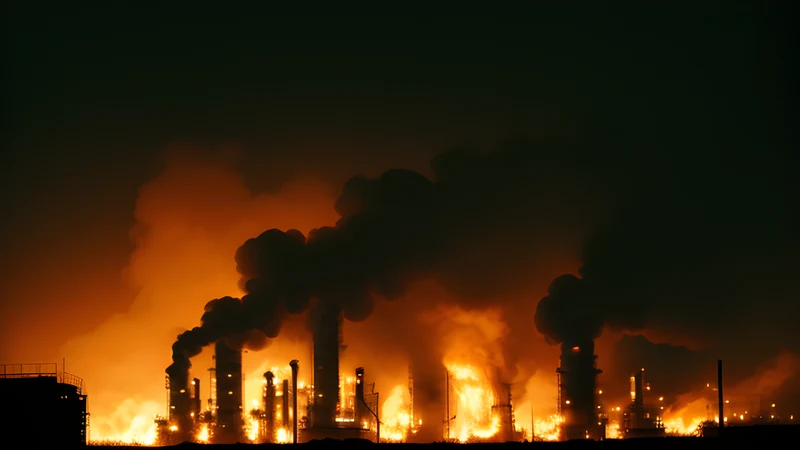
The chemical plant. Cody takes his gang in inside a tanker and the trap closes, and Walsh gives him the ending the whole film has been engineering: cornered on top of a spherical gas tank, shot repeatedly, refusing to fall, and finally emptying his gun into the sphere beneath his own feet. Made it, Ma — top of the world. He is standing on the highest thing in the frame and he has kept the promise, and the promise detonates.
The last image is a mushroom cloud over an industrial plant in 1949, four years after Hiroshima and two years before the genre worked out what it meant. Fallon watches it and says something dutiful about a criminal reaching the top. Nobody in the audience is listening to him. Aldrich saw that fireball, kept the ending, and threw away the moral.
Related Content