While the City Sleeps: Lang's Newsroom Manhunt
A strangler is loose, and the men who should be catching him are competing for a promotion
Contents
A media proprietor dies. His son inherits the empire, understands nothing about it, and hits on an idea he thinks is clever: he creates a new post of executive director and announces that whichever of his three senior men breaks the story of the strangler currently killing young women in the city will get the job. The manhunt in While the City Sleeps is therefore a personnel exercise. Fritz Lang made it in 1956 at RKO, in black-and-white CinemaScope, and it is the sourest film he ever directed, which is a considerable claim about the man who made M.
Casey Robinson adapted Charles Einstein’s novel The Bloody Spur, and the killer is modelled loosely on William Heirens, the Chicago case of 1946 in which a message was reportedly left in lipstick at a crime scene. Lang was near the end of his American career and working for a studio in visible decline; Howard Hughes had gutted RKO and the picture was made quickly and cheaply. The economics show, and they help. This is a film about people in offices, and it looks like one.
Nobody in this film wants to catch him
The structure is the argument. Lang shows you the killer in the first scene. Robert Manners (John Drew Barrymore) is a delivery boy, and the film establishes his identity, his method and his mother-haunted interior life before the newspaper plot begins. There is no whodunit here. The audience knows everything the police want to know, from the beginning, and Lang uses that knowledge as a scalpel: every scene of the newsmen theorising is a scene of clever people performing intelligence about a question the film has already answered.
What replaces the mystery is an office. The three competitors are Mark Loving (George Sanders), who runs the wire service and is the most openly corrupt; Jon Day Griffith (Thomas Mitchell), the newspaper editor, older and shabbier and marginally more decent; and Harry Kritzer (James Craig), the photo-service head, whose competitive advantage is that he is sleeping with the proprietor’s wife (Rhonda Fleming). Vincent Price plays the proprietor, Walter Kyne, and plays him as a genuinely startling piece of casting — no menace at all, just a spoiled, weak, petulant boy in an expensive office, entirely aware that everyone who works for him was hired by his father and thinks he is a joke.
Dana Andrews is Edward Mobley, the star reporter and television commentator, who declines to compete because he already has what he wants and is drinking his way through it. Sally Forrest is Nancy, his fiancée, and Ida Lupino is Mildred, a columnist who works for Loving and is used as a lure, socially and professionally, more or less continuously.
The plot machinery is that each of the three men deploys the women available to them as instruments. That is the film’s real subject, and Lang states it without a shred of editorialising. The strangler kills women. The newsmen use women. The film puts the two facts adjacent, in the same building, in the same week, and declines to draw the line for you.
Why it works: CinemaScope as a cage
The craft point worth naming is the widescreen. In 1956 CinemaScope was still being sold as a format for spectacle — landscapes, chariots, the things television could not do. Lang, working in black-and-white with Ernest Laszlo photographing, uses the shape for the opposite purpose. He fills the width with office furniture and puts people at the far edges of it.
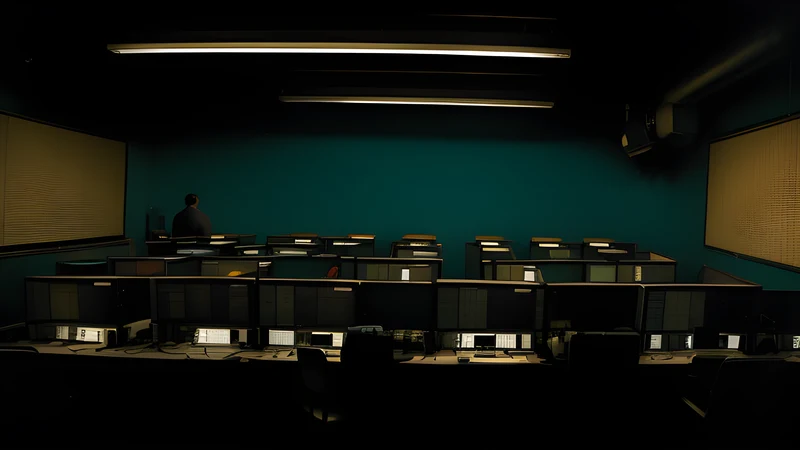
Watch the composition in the newsroom scenes and you find the same figure repeatedly: a wide, flat frame with a character stranded at one end and another at the other, a great trough of desks and telephones and teletype machines between them. The men are never physically close, and the format makes their distance a fact of the image rather than a matter of blocking. In a bar scene, the frame is so wide and so shallow that a conversation across a table looks like a negotiation across a border. Lang had trained as an architect and had spent his German years constructing space as meaning; here, handed a shape he reportedly disliked, he turned it into a diagram of an institution in which nobody can reach anybody.
The other craft decision is sound. The teletypes never stop. Lang lets the machines chatter under dialogue continuously, a mechanical, indifferent noise underneath every human conversation about death, and the effect is precise: the news is being manufactured whatever anyone in the room decides.
The killings themselves Lang handles with almost no exploitation. The violence is brief, mostly implied, and shot without relish, and the restraint reads as contempt — for the audience that came for it, and for the newspapers in the film that are selling it by the column inch.
The late Lang problem
While the City Sleeps is usually filed as minor, and the case against it is real. The romantic subplot between Mobley and Nancy is thin, the film’s use of Nancy as bait is queasy in a way the picture does not fully own, and the pace sags in the third quarter while the office politics recirculate. Andrews is playing tired, and there is a persistent question about how much of that is performance.
The case for it is that no other American film of the decade is this coldly precise about how an institution behaves when a crisis arrives. The strangler is an opportunity. He is a promotion, a circulation spike, a way to embarrass a rival, and the film’s most quietly devastating scene is a group of professionals discussing a dead girl with genuine animation, because she is useful. Lang had come to America to escape one machine and spent twenty-two years documenting another, and this is his exit report. He made one more film at RKO — Beyond a Reasonable Doubt, also 1956, also with Andrews, also about the press and a rigged case — and then went home.
The collector’s shelf
The obvious ancestor is Lang’s own M, and the comparison is the whole point. In 1931 Lang made a film in which a city — police, criminals, ordinary people — unites in horror to hunt a child-killer, and the criminals do it because even they have a line. In 1956 he made a film in which a city’s newsmen hunt a killer for a job title. Twenty-five years and one emigration separate them, and the difference between them is the most eloquent thing in Lang’s American work.
Its true companions are the other films about the press with no illusions left. Ace in the Hole is the masterpiece of the type, Wilder’s ruthless account of a reporter who keeps a man trapped underground because the story is better that way, and the two films share a thesis and a temperature. Sweet Smell of Success arrives the following year with better dialogue and the same rot. And among Lang’s American crime films the essential neighbour is The Big Heat, where the institution failing to do its job is the police department instead of the press, and the man who breaks with it has to give up everything to do so — which is precisely what nobody in this newsroom is prepared to do.
The verdict, with the machinery below the line: While the City Sleeps is a great film with a slack middle, and the slackness is arguably the point — an office is slack, and Lang films it as one. It is not much interested in its manhunt and only intermittently interested in its romance. What it is interested in is a building full of people who have decided that a series of murders is a career development, and on that subject it is merciless and completely modern. Anyone who has watched a newsroom, or any other room, discover that a catastrophe is good for them will recognise every face in it.
It has floated in and out of availability for decades; the Warner Archive edition is the one that lets Laszlo’s compositions actually read across the width, which matters more here than in most films of its size.
Spoilers below
Mobley’s method is the film’s nastiest idea and it works. On television, he baits Manners directly — taunting him on air, characterising him as a mother’s boy, deliberately constructing the profile most likely to enrage a man with that particular wound — and then he uses his own fiancée as the bait. Nancy is set up in an apartment as a target, with police cover, and Manners takes it.
The pursuit runs Manners into the subway, and Lang stages a long chase through tunnels and a manhole and up onto the street that is the best pure filmmaking in the picture: a small, panicked, physically slight young man scrambling through the city’s underside while the machinery closes. It is also the only sequence in which the film permits Manners any humanity, and Lang lets it in through the back door, because the boy is pitiable and cornered and the men chasing him are chasing a byline. Mobley catches him. Manners is taken.
Then the film delivers its actual ending, which is about the office. Kritzer, the photo-service man, is exposed — Griffith works out that he has been sleeping with Dorothy Kyne, and the leverage evaporates. Loving loses. And Walter Kyne, who created this whole contest, gives the executive director’s job to Griffith, the old newspaperman, in a scene of stunning banality. Mobley, who actually caught the strangler, does not want the post and does not get it, and takes his winnings in the form of a wire-service credit and a wedding.
The last stroke is the one that seals the film’s argument. Mobley and Nancy go on honeymoon, and Lang gives the closing beat to a wire-room conversation about the story’s value. The capture and the wedding are both furniture by then. The strangler has been caught. The paper has its scoop. A man has been promoted. Everybody’s week has improved, including the killer’s mother’s, who is at last relieved of him. Nobody has learned anything, nobody has changed, and the teletypes are still going. Lang left America shortly afterwards, and it is difficult to read that final shot as anything other than a man putting on his coat.
Related Content