When Worlds Collide: The Disaster Film Before Disaster Films
Twenty years before Irwin Allen, George Pal built the entire template and then blew the last shot
Contents
Every disaster film you have ever seen is doing an impression of this one, and almost nobody knows it. The scientist with the data nobody will act on. The countdown clock cutting the film into acts. The financier who buys the project and then wants a seat as payment. The lottery. The crowd that turns on the survivors at the gate. The montage of famous places going under. All of it is here, assembled and functioning, in a Paramount picture from 1951 — twenty years before Irwin Allen turned the same parts into a franchise, and forty-seven years before Deep Impact reproduced the lottery almost beat for beat.
George Pal produced. Rudolph Maté directed, which is the detail that should make you sit up: Maté shot Dreyer’s The Passion of Joan of Arc and Vampyr before he ever directed anything, and he brought a cinematographer’s ruthlessness about what a frame is for. The source is the 1933 Philip Wylie and Edwin Balmer novel, which Paramount had owned since the mid-1930s and repeatedly failed to film. It won the Academy Award for Best Special Effects and picked up a cinematography nomination, and it is the film that convinced Paramount to let Pal make The War of the Worlds two years later.
The premise, delivered without flinching
A star called Bellus is falling towards Earth. It has a planet, Zyra, which will pass close first and wreck the place with tides and quakes; nineteen days later Bellus arrives and there is no Earth. Dr Cole Hendron (Larry Keating) has the figures. The United Nations does not believe the figures. A small consortium builds a rocket — an ark — to carry roughly forty people to Zyra, and the rest of the film is about who gets on.
What strikes me on every rewatch is the refusal to hedge. Modern apocalypse pictures spend their second act manufacturing a way out: drill the asteroid, nuke it, ram it. This film establishes in its first twenty minutes that Earth ends and there is nothing to be done about it, and then never revisits the question. There is no plan B. There is no clever physicist with a third option. The dramatic engine is entirely allocation — a lifeboat problem, played straight — and that is a far braver structure than anything Hollywood has attempted with the material since.
Richard Derr plays Dave Randall, a charter pilot hired to carry the data and who stays because of Joyce Hendron (Barbara Rush, two years before Jack Arnold cast her in It Came from Outer Space). John Hoyt plays Sidney Stanton, the industrialist in the wheelchair who funds the ark and expects the seat his cheque entitles him to. Hoyt is the best thing in the film by a distance, and the character is the template: every rich, sneering obstacle in every disaster picture from The Towering Inferno onwards is his descendant. He is written with more intelligence than the type usually gets — his argument is that he paid, that nobody else would have, and that without him the whole species would be dead. He is correct about all three, and the film knows he is correct, which is what makes him unbearable.
Why the ark sequence works
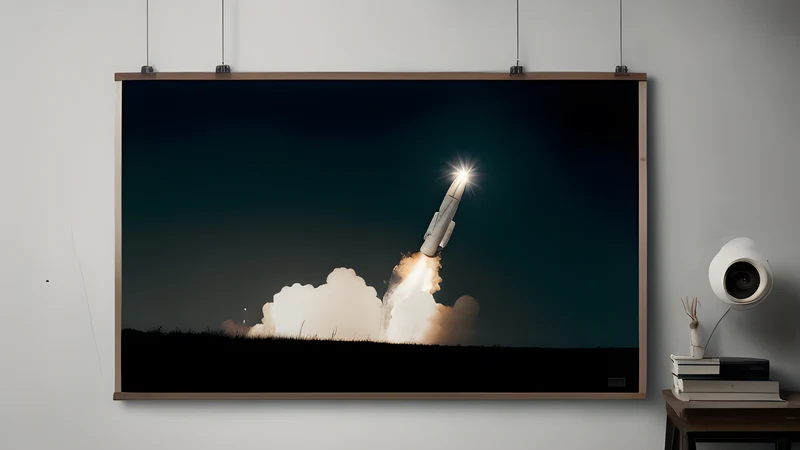
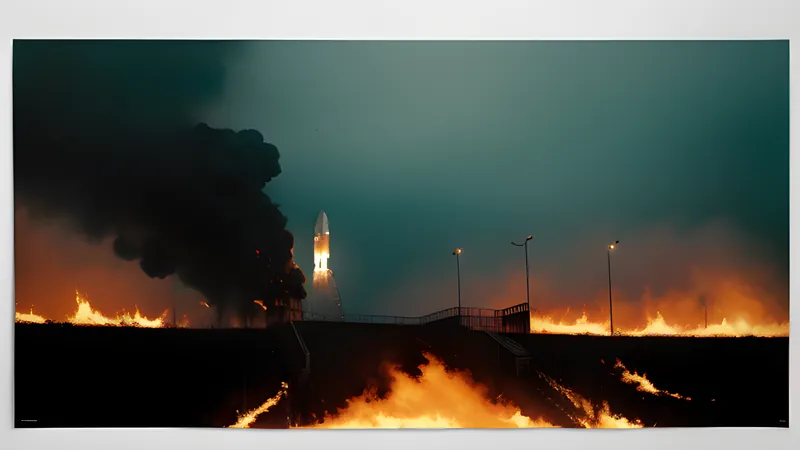
The launch is the reason to watch this. The ark sits on a rail — a steel ramp running down a mountainside — because the engineering conceit is that the rocket needs a running start, sliding down the incline under gravity before its own motors take over. It is dubious physics and superb cinema, because it turns a launch into a fall. Maté shoots the ramp in long, receding diagonals that make the frame feel like it is tipping, and when the ark releases, the camera goes with it downhill, so the ascent begins as an accelerating plunge. Every rocket launch in the genre before this was vertical, patient and stately, going back to Pal’s own Destination Moon the previous year. This one has the physical logic of a rollercoaster, and it earns a whole different set of reflexes from the body watching it.
The other craft achievement is the flooding of New York. It is miniature and matte work, and the tell is visible if you look for it — water at small scale moves too fast, it always has, and no amount of surfactant fixes the surface tension. The sequence survives anyway because of a structural decision. Maté does not present the drowning of Manhattan as spectacle to be admired; he cuts it in as reportage, brief, and always intercut with the ark project, so the destruction is a clock rather than a set piece. The camera never lingers to let you appreciate the model. Compare the modern instinct, which is to hold the collapsing city for ninety seconds of orchestral awe, and note which one still produces dread.
Chesley Bonestell’s astronomical art does the heavy lifting for the sky, as it would again for Pal’s Martians. The film also opens on a Bible, on the pages of Genesis and the Flood, and the ark framing is stated aloud rather than implied. This is heavy-handed. It is also load-bearing: once the Noah parallel is explicit, the audience knows the rules of the lottery before the lottery is explained, and the film saves fifteen minutes of exposition.
The case against
The people on the ark are furniture. Randall and Joyce have a triangle with Tony Drake (Peter Hansen), the doctor, which resolves through mechanical courtesy rather than any dramatic pressure — the film needs a romance because 1951 films needed one, and it discharges the obligation without conviction. Given that the entire subject is who deserves to live, the emotional thinness of the chosen is a genuine failure. We spend ninety minutes selecting forty people and the film cannot make us care about any of them individually.
The crowd business at the end is perfunctory too. A mob at the gate is a real idea — the film gestures at the violence implicit in a lottery, then hurries past it in a couple of minutes, because looking at it properly would sour the ending. And the science is decorative throughout; the physics of a wandering star with a habitable companion arriving at exactly the right velocity is nonsense, and the film’s confidence in Hendron’s blackboard is asking for a lot of goodwill.
None of that is the real problem. The real problem is the last shot, and we will get to it.
What it fathered
The disaster genre proper. Not through direct imitation — Irwin Allen’s 1970s cycle came out of Airport and the novel market — but through structure, because this is where the structure was proved. The Poseidon Adventure, The Towering Inferno, Deep Impact, 2012, every ticking-clock ensemble with a doomed expert and a moral queue: the shape is Wylie and Balmer’s, filtered through Pal’s production sense.
The collector’s cross-reference is upstream. The ancestor is Things to Come, Wells and William Cameron Menzies in 1936 — the first film that treated the future as a design problem and put an enormous amount of money into painting it. Pal is doing the American commercial version of Menzies’s project: the belief that if you render the impossible with enough craft, the audience will accept the argument attached to it. Go back further and you land at A Trip to the Moon, where the launch ramp idea is already sitting there in Méliès’s cannon.
Downstream, the film’s honest heir is Melancholia, which takes the same collision and refuses the ark entirely. Von Trier’s planet arrives, the shelter is a stick wigwam, and the film’s whole subject is the psychology of people who know the figures. Watching them back to back is the best argument I know for how much of a genre’s meaning lives in whether you grant the characters an exit.
Where to find it: Paramount has kept it circulating on disc and it turns up on the streaming services that carry the studio’s back catalogue. The Technicolor restoration matters here as much as it does for the Martians — the film’s palette is doing half the emotional work, particularly in the last third, when the sky starts going the wrong colour.
Spoilers below
The ark launches. Hendron does not go. Stanton does not go either, and the sequence is the best thing in the film: as the countdown runs, Hendron makes it clear that the old are staying, and Stanton — who has spent the entire picture immobile, wheeled everywhere, defined by that chair — hauls himself up onto his own legs and walks, for the first and last time, in an attempt to reach the ramp. Hendron holds him back. The ark slides away without them and Bellus arrives.
Hoyt plays it without a shred of self-pity, which is why it lands. It is the film keeping its bargain: the lifeboat problem has an answer, and the answer is that the man who built the boat and the man who paid for it both drown. Very few disaster films since have had the nerve to kill their financier with dignity rather than as punishment, and fewer still have let the scientist choose it.
Then Zyra. The ark lands, the doors open, the survivors step out — and the film cuts to a matte painting.
I want to be fair about this. Pal’s team had run out of money and, by most accounts, out of schedule; the plan had been a full landscape sequence and it was cut down to a single painted vista of a valley under a rising sun, held for a few seconds while the music swells. What appears on screen is flat, chalky, and lit like the cover of a children’s annual. After ninety minutes of miniature work good enough to win an Oscar, the promised land looks like a poster in a travel agent’s window.
It is the most notorious final shot in 1950s science fiction, and the damage is worse than aesthetic. The entire film is an argument about what forty people are for. The last image is the only chance to say something about what they inherited, and it says: somewhere pleasant, presumably. There is no strangeness in it, no cost, no hint that Zyra might have its own rules. The novel’s sequel went to the trouble of putting a dead civilisation on the new world. The film gives us a sunrise.
The frustrating part is how close it comes to not mattering. Everything before that cut — the ramp, the flood, Stanton on his feet, the doors opening — is a film with real conviction about the end of the world. Then it looks at the beginning of the next one and cannot think of anything to say. Watch it anyway. Just be ready to stop the disc about eight seconds early.
Related Content