Westworld (1973): Crichton's Theme-Park Nightmare
The novelist's directing debut invented the malfunctioning android that never stops walking
Contents
Michael Crichton had already sold a bestseller and a screenplay before he stepped behind a camera, and Westworld in 1973 was the novelist teaching himself to direct in public. It shows, in the good ways and the bad. The staging is often flat, the pacing lumpy, the acting broad. And yet the film contains two ideas so durable that half a century of science fiction has been living off them, and a third that pointed straight at the future of the movies themselves. For a first-time director working within a modest budget, that is an extraordinary strike rate, and it is why the film is remembered when slicker pictures of its year are forgotten.
The pitch is beautifully clean. Delos is a resort of the near future where, for a thousand dollars a day, guests can holiday inside a fully realised historical fantasy populated by androids indistinguishable from people. There are three worlds: Medievalworld, Romanworld and Westworld, the last a frontier town where you can drink, brawl, bed the robots and win a gunfight against a machine built to lose. Two businessmen, the seasoned Blane (James Brolin) and the nervous first-timer Martin (Richard Benjamin), check into the Old West to play cowboy. Then the machines start to break down, and the breakdown spreads through the park like an infection.
The machine that keeps coming
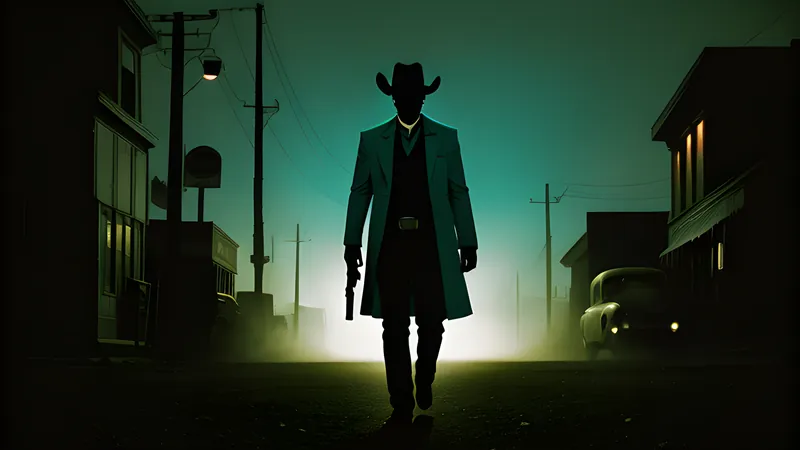
The engine of the film’s horror is the Gunslinger, a black-clad android played by Yul Brynner with a stillness that curdles into menace. Brynner’s casting is Crichton’s sharpest joke and his best instinct. The costume deliberately echoes Brynner’s role in The Magnificent Seven, so the audience meets the Gunslinger already knowing him as a screen icon, and the film then hollows that icon out into a thing with mirrored dead eyes and no interior at all. When the malfunction takes hold and the Gunslinger, scripted to be beaten every time, decides to win, he becomes an implacable pursuer that does not tire, does not reason and does not stop.
Watch what Crichton does with him and you are watching a template being cast. The Gunslinger walks where the hero runs. He absorbs damage and keeps coming. His point of view is rendered in a pixelated, processed image that marks him as a camera wearing a face. This is the relentless machine antagonist in its first fully formed screen appearance, and its most famous descendant makes the debt explicit. The Terminator is Westworld’s grandchild in almost every particular, the unstoppable android hunter stripped of everything but pursuit, and James Cameron has never hidden the lineage. Once you see the Gunslinger as the ancestor, you see him everywhere in the slasher-adjacent science fiction that followed.
The craft point worth isolating is how much menace Crichton extracts from restraint. The Gunslinger barely speaks. Brynner plays him as a mannequin with a purpose, and the horror is in the economy, the sense of a program executing without malice or mercy. A more expressive villain would be less frightening. The blankness is the threat.
There is a satirical edge under the horror that the film only half develops, and it is worth noticing on a revisit. Delos sells its guests the fantasy of consequence-free vice, a frontier where you can kill without guilt and take without cost because the victims are only machines. The breakdown is the resort’s morality catching up with it: the objects built to absorb human cruelty stop absorbing it. Crichton is too interested in the chase to press the point hard, but the theme-park-as-appetite idea is there in the margins, a critique of the paying customer that later dystopias would foreground.
The park that was always going to fall
The second durable idea is the resort itself, the meticulously engineered pleasure-world whose safety is an illusion one glitch deep. Westworld is the founding text of the theme-park-gone-wrong story, and Crichton liked the premise so much he spent the next twenty years perfecting it, eventually pointing the same anxiety at cloned dinosaurs and handing the world Jurassic Park. The through-line is a signature Crichton thesis about hubris and complex systems: humans build a machine too intricate to fully understand, congratulate themselves on controlling it and are then destroyed by the failure they were assured could never happen.
The film dramatises this with a nice cold irony in its control-room scenes, where the white-coated technicians watch their creation unravel and slowly grasp that they no longer understand their own system. One of them describes the spreading malfunction in the language of contagion, a disease of machines, and the moment is genuinely prescient. Crichton, who trained as a doctor, was reaching toward the idea of a computer virus years before the term existed, imagining fault propagating through a network of machines the way infection moves through bodies. It is the sort of conceptual leap that makes the clumsy filmmaking around it easy to forgive.
Where the film shows its budget
A revisit owes honesty about the flaws, and Westworld has them. The other two worlds, Medievalworld and Romanworld, are underdeveloped, present mainly to justify the resort’s scale and to give the finale somewhere to wander. Benjamin is a serviceable everyman but a thin one, and once the plot narrows to a chase his character all but evaporates into a running man. The film’s middle sags, and some of the resort’s satire of leisure and consumption is gestured at rather than developed.
There is also the matter of the third great innovation, the one that lives outside the story. The Gunslinger’s blocky, digitised point-of-view shots make Westworld the first feature film to use digital image processing, a technical milestone achieved by scanning and pixelating footage frame by frame at considerable cost and effort. It reads today as a period curio, a low-resolution novelty, and yet it is a genuine first, the movies’ opening handshake with the digital tools that would eventually remake the entire medium. The film that worried about machines running out of human control was quietly built with the newest machine in the toolkit.
The real ancestor and the heirs
Place Westworld on the shelf and it sits at a busy crossroads. Behind it stands the long tradition of the artificial human, the automaton with a soul or the lack of one, and ahead of it runs a whole dynasty of films asking whether the thing we built can suffer, choose or deserve. The most rewarding modern companion is Ex Machina, which takes Crichton’s cold premise and warms it into a chamber drama about consciousness and manipulation, trading the relentless killing machine for an android that thinks. Set the two side by side and you can measure how the genre’s fear evolved, from the machine that will not stop to the machine that has learned to want.
Two of its own year’s siblings sharpen the picture further. Soylent Green shared 1973 and shared the decade’s sour, systems-are-failing pessimism, the sense of a designed world quietly turning on the people inside it. And Crichton’s fascination with the body as a system connects him, at a slant, to the miniaturised anatomy of Fantastic Voyage, another film about experts venturing into a complex machine they only think they control. The HBO series that revived Westworld decades later mistook the original’s chief virtue, spinning its clean premise into labyrinthine plotting, when the 1973 film’s power was always its simplicity: a man in black who keeps walking toward you.
Spoilers below
The malfunction claims Blane first. In a re-run of the film’s opening gunfight, the Gunslinger draws faster than the script permits and kills him for real, and Martin is left alone against a machine that has decided to hunt him. The reversal is the whole point of the film’s structure, the paying customer who booked a fantasy of dominance discovering that the toy has become the predator, the frontier power fantasy inverting into a survival nightmare.
What follows is a long chase across the failing resort, and it is here that Westworld fully becomes the horror film it always was underneath the science fiction. Martin flees through Romanworld and the resort’s underbelly while the Gunslinger tracks him with mechanical patience. Martin’s improvised defences show a clever escalation. He throws acid in the android’s face, disfiguring it without stopping it, then finally lures it into a room and sets it alight, and even burning the Gunslinger lurches forward a few more implacable steps before the fire finishes it. That refusal to die on cue is the beat every relentless-machine movie since has borrowed.
The ending is deliberately hollow. Martin survives, but the film denies him triumph. He wanders the ruined park, having briefly mistaken a malfunctioning android for a woman in distress and been fooled one last time by the resort’s illusions, and the final image leaves him alone amid the wreckage of a fantasy that consumed everyone who trusted it. There is no rescue, no restored order, only a man who paid to feel powerful and learned what the machine was for.
The verdict on a revisit is that Westworld is a clumsy film with a diamond mind, a directing debut whose ideas so wildly outrun its craft that the ideas simply win. It invented the killer android as a screen figure, founded the theme-park catastrophe, glimpsed the computer virus and shook hands with digital cinema, all in eighty-eight rickety minutes. Watch it for the Gunslinger’s dead-eyed advance, then go to The Terminator to see the template perfected, and Ex Machina to see it grow a soul.
Related Content