Wake in Fright: The Outback as Waking Nightmare
A schoolteacher stops in an Australian mining town for one night, and Ted Kotcheff turns forced hospitality into one of cinema's great descents.
Contents
Wake in Fright is a horror film with no monster, no ghost and no killer, and it is one of the most frightening films ever made about a place. It was directed in 1971 by Ted Kotcheff — a Canadian, which turns out to matter — from Kenneth Cook’s 1961 novel, and it charts the collapse of a civilised man over a few days in an Australian mining town whose only crime is a generosity so relentless it becomes a trap. There is a heatwave of dread coming off this film that few things in the genre can match.
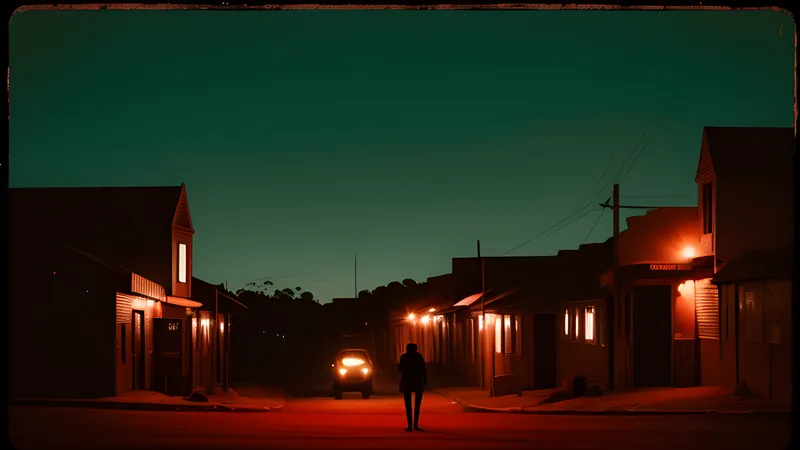
The horror is social. John Grant is a schoolteacher bonded by debt to a one-building settlement in the outback, working off the cost of his own training. On his way to Sydney for the Christmas holidays he stops overnight in a mining town everyone calls “the Yabba,” intending to catch a flight in the morning. He never makes the flight. Over a few blurred, escalating days the Yabba’s hospitality — the endless beer, the two-up gambling, the aggressive, wounded insistence that he drink and stay and become one of them — dissolves the person he thought he was. It is a descent told with the pitiless logic of a nightmare you cannot wake from.
Hospitality as horror
What makes Wake in Fright singular is that nothing in it is supernatural and almost nothing is, strictly, a crime. The men of the Yabba are hospitable to a fault. They buy Grant drinks, offer him beds, share their food and their sport. The terror is that the hospitality cannot be refused. To say no to the beer, the bet, the hunt, is to insult the whole code of mateship the town runs on, and the pressure to comply is total, physical, inescapable. Grant’s tragedy is that he is too weak, too proud and finally too drunk to resist, and the film watches him give himself away piece by piece.
Kotcheff, an outsider looking in, shoots the outback with a clarity no local sentiment could have allowed. The sun is a persecutor; the light bleaches everything flat and white; the town is all dust, corrugated iron and pub interiors thick with smoke and men. There is no romance in this landscape and no relief. The camera keeps finding faces that are friendly and frightening in the same instant, and the sound design — the roar of the pub, the clink of glasses, the drone of flies and heat — becomes a kind of continuous low scream.
Chips Rafferty, in his final role, plays the local policeman Jock Crawford as the embodiment of the trap: a genial, generous man who will not take no for an answer and whose kindness is a form of coercion. And Donald Pleasence gives one of his eeriest performances as Doc Tydon, an alcoholic ex-doctor who has surrendered to the Yabba entirely and serves as Grant’s guide and tempter, the man who shows him how far down there is to go.
The hunt, and the film that nearly disappeared
There is one sequence that has kept Wake in Fright controversial for over fifty years: a night-time kangaroo hunt into which the drunken men drag Grant. Kotcheff shot it using documentary footage of an actual licensed professional cull, real killing woven into the fiction, and the result is genuinely hard to watch — deliberately so. The film does not stage the horror for a thrill; it uses it as the point at which Grant’s degradation becomes irreversible, the moment he participates in something he cannot take back. A title card in the restored version notes the involvement of professional shooters and the animal-welfare context, and the scene remains the film’s most argued-over passage precisely because it refuses to be comfortable.
The film’s own history reads like a horror subplot. Wake in Fright was admired at Cannes in 1971 and then, astonishingly, slid out of circulation, its elements scattered and its reputation kept alive mostly by those who had caught it once and never forgotten it. For decades it was a genuinely endangered film, presumed by some to be effectively lost. Its editor, Anthony Buckley, spent years hunting for a usable negative and finally located one in 2004 in a Pittsburgh archive, in a box reportedly marked for destruction. The restoration premiered at Cannes in 2009, making Wake in Fright one of the very few films ever to screen at that festival twice, thirty-eight years apart. It is a rescue story that ought to be told every time someone claims the canon is settled.
Why it works, and where it belongs
The film works because it never breaks its own spell. There is no scene in which a character stands outside the Yabba and explains it to us, no comforting frame. Kotcheff traps the viewer inside Grant’s disintegrating perspective and keeps the exits locked, so that the escalating drunkenness, the lost time, the shame, all land as sensation rather than plot. By the end you feel hungover and complicit, which is the intended effect.
It also works as a study of masculinity gone feral. The Yabba is a world almost entirely without women, a closed loop of men performing toughness and generosity at each other until both curdle into violence. Grant arrives thinking of himself as superior — educated, restrained, above all this — and the film’s cruelty is to show how little that superiority is worth once the pressure comes on. He is not corrupted by the Yabba. He is revealed by it.
Gary Bond, largely a stage actor, is essential to this and rarely gets the credit. He plays Grant with just enough smugness at the outset that his fall is satisfying rather than merely pitiable, and then lets the composure erode in small, humiliating increments — the fixed smile that lasts a beat too long, the drink accepted against his own judgement, the moment he stops keeping count. Because Bond underplays the collapse, it never tips into melodrama; you watch a man drown while he is still insisting to himself that he can swim. The film sits, historically, at the front of the wave later nicknamed Ozploitation, the eruption of raw, confrontational Australian genre cinema through the 1970s, and much of what followed borrowed its willingness to look at the national self-image without flattery.
The lineage here is worth tracing for anyone building a shelf of great descents. Wake in Fright is a foundation stone of the tough, unsentimental strain of Australian genre cinema that would later give us the family-as-abyss of Animal Kingdom, where the menace again comes dressed in the language of kin and belonging. Its bright, sun-blasted terror — horror staged in merciless daylight rather than shadow — puts it in direct conversation with Who Can Kill a Child?, another film that understands the sun can be more frightening than any night. And its structure, an outsider trapped by a closed community whose warmth is a cage, is the secular cousin of The Wicker Man; swap the pagans for the drinkers and the descent is the same shape.
Where to find it: the restored version is the only one worth seeking, available on Blu-ray and streaming in editions that preserve Kotcheff’s bleached, sweltering images and the crucial sound. Watch it thirsty and in the heat if you can bear to.
Spoilers below
The film’s masterstroke is that it offers Grant no clean bottom and no redemptive escape. His lost days in the Yabba culminate in a morning-after sequence with Doc Tydon that the film handles with unnerving restraint, leaving Grant — and the viewer — unsure exactly what has happened and unable to face it, a final humiliation that strips away the last of his sense of himself. He has become, in every way that frightens him, a man of the Yabba.
Broken, ashamed and out of money, Grant reaches the end of his tether and turns a rifle on himself. The suicide attempt fails; he survives it, and is delivered back — patched up, hollowed out — with the town’s characteristic rough kindness. And then comes the ending that seals the film’s despair. Grant does not flee the Yabba a changed and wiser man. He gets on the transport and returns to Tiboonda, to his bonded schoolroom, to the exact life he left, as though the whole nightmare has simply closed over him without a trace. A townsman greets him warmly and asks if he had a good holiday, and Grant, ruined, agrees that he did.
That circularity is the horror. There is no lesson, no arrival, no escape. The Yabba did not need to keep Grant, because there was nowhere for him to go that would be different, and nothing in him strong enough to have resisted. The waking nightmare is that he wakes back into his own life and finds it indistinguishable from the pit he crawled out of. Few films have ever made the ordinary world feel so much like a trap already sprung.
Related Content