Village of the Damned (1960): The Cold-Eyed Children of Midwich
Wolf Rilla found the most frightening thing in English science fiction: a well-behaved child
Contents
At eleven in the morning, everyone in the village of Midwich falls over. A man collapses mid-stride behind a plough. A woman drops in her kitchen with the tap running. A bus rolls to a halt. A telephone rings in a house where nobody will answer it. Anyone who crosses the parish boundary goes down with them, which the army establishes by walking a soldier in on a rope and hauling him back out.
Wolf Rilla’s 1960 film runs seventy-seven minutes and spends the first ten of them on that. No monster, no ship, no explanation — just an English village lying in the road in broad daylight while men in uniform stand at the edge of it holding a rope and thinking. It is one of the great openings in British science fiction, and it establishes the film’s method immediately: the horror will be delivered flat, in daylight, by reasonable people, at conversational volume.
The morning after
They wake up. That is the first shock — the film gives you an apocalypse and then withdraws it, and everyone gets up, dusts themselves off, and goes back to work. The event becomes an anecdote. Then, some weeks later, every woman in Midwich capable of bearing a child is pregnant, including women whose husbands have been away, including women who have never been with anyone at all.
What the film does with this is the reason it lasts. The scenes that follow are about a village trying to hold its own social fabric together while doing arithmetic it does not want to do. Doctors are careful. Husbands are not. The film understands that in a place like Midwich the unbearable part is not cosmic — it is that everybody knows everybody, and now everybody is looking. Stella Gray, the vicar’s wife, and the young unmarried woman who cannot explain herself are handled in a few brief, mortifying beats that carry more social weight than most British films of the period managed at length.
The screenplay, adapted from John Wyndham’s 1957 novel The Midwich Cuckoos, was reportedly troublesome to get made — the parthenogenesis premise drew objections on religious grounds in America, and the production ended up in Britain, shot cheaply at MGM’s Borehamwood studios and in the Hertfordshire village of Letchmore Heath. Every constraint helped. American money would have bought explanation. What the film has instead is a lane, a church, a pub, and a green.
Sanders, and the temperature of the thing
George Sanders plays Gordon Zellaby, the village’s resident intellectual and the father — nominally — of the leader of the children. Sanders had built a career on urbane contempt, the cleverest and coldest man in any room, and Rilla uses that persona as a scientific instrument. Zellaby responds to the children with fascination before he responds with fear, and he keeps responding with fascination for far longer than a father should. He wants to teach them.
Barbara Shelley, who would shortly become one of Hammer’s most reliable presences in the British gothic cycle, plays his wife Anthea, and she does the work Sanders is constitutionally unable to do: she carries the animal fact of having borne this thing. The film’s marriage is its quiet engine. He studies their son. She mothers him. Only one of them is in any danger of being surprised.
The children
Martin Stephens plays David, and the performance is the film. He is polite. He is patient. He explains things to adults in the tone an adult uses on a slow child, and he never raises his voice, and he is nine years old. Stephens would follow this the next year with Miles in The Innocents, which between them gives him the two most disquieting child performances in British cinema inside eighteen months.
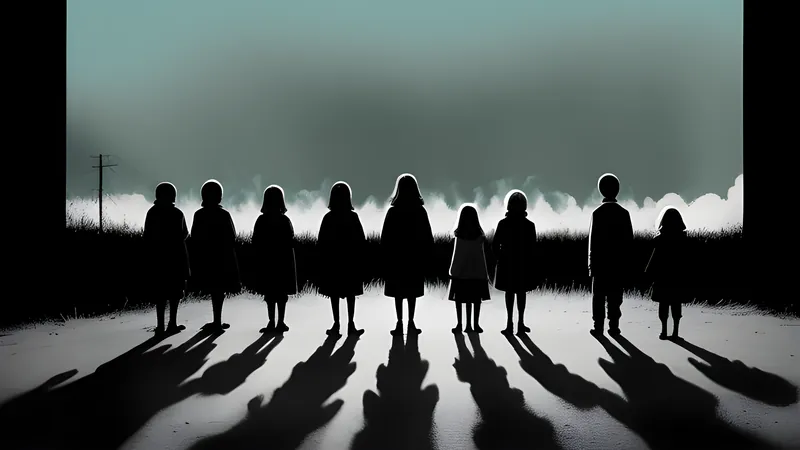
The craft point is stillness. Rilla blocks the children as a unit — they stand in a line, they walk in step, they turn their heads together — and then he does almost nothing else. No stings, no shock cuts, no crawling camera. The children are simply always framed as a single organism with twelve bodies, and the adults are always framed as individuals. You read the threat geometrically before you read it dramatically.
The eyes are the one effect, and it is an optical trick applied in post — a pale glow that arrives when the children exert their will. It is crude by any technical standard and it works completely, because the film has already taught you that the danger is a decision being made. The glow is not the weapon. It is the receipt.
Rilla’s other restraint is musical. Long stretches of the film carry no score at all, and the silence is doing structural work: without music the audience has no instruction about how to feel, which leaves it in exactly the position of the villagers, watching something inexplicable in good light and waiting for someone to tell them it is serious. When a British film of 1960 declines to underscore a scene of children walking down a lane, that is a choice made against the whole grain of the industry.
The other decision worth naming: the film almost never shows you what the children do. It shows you the child, then it shows you the result, and it leaves the transition off screen. A man walks into a wall. A driver turns the wheel. The camera stays on the small blond head, watching, and the withholding does what withholding always does — it makes you the one supplying the horror.
What Wyndham was afraid of
The cuckoo is the whole thesis and Wyndham put it in the title. A cuckoo does not attack the nest; it uses it. The host feeds the thing that has displaced its own young, because the host is built to feed whatever is in the nest. That is a more upsetting idea than invasion, and it is why the film has outlasted most of its decade: the enemy is inside the family, being cared for, growing, entirely legitimate in the eyes of everyone’s instincts.
Read the film against its immediate cousin, Invasion of the Body Snatchers, and the national difference is instructive. The American film is about the terror of your neighbour being replaced. The English one is about the terror of your child being fine — polite, bright, doing well at his lessons, and utterly closed to you. Both belong to the same tradition of paranoia and the body snatcher, and only one of them thinks the horror could be raised at home.
There is a post-war reading available too, and the film does not push it. Midwich is a village of adults who lived through a war and are now confronted with a generation they cannot reach, which will not explain itself, and which is quietly certain it will inherit everything. That anxiety was in the British air in 1960 and it is all over this film’s surface without a word of commentary.
The case against
The compression that gives the film its speed also flattens it. The village barely exists as a community — we get a pub, a vicar and a handful of faces, and Wyndham’s slower social observation is mostly gone. The military and Whitehall material is functional at best, a sequence of men in offices delivering exposition so the plot can move.
And the film’s moral seriousness only extends so far. It floats the question of what these children actually are, decides the question is unanswerable, and treats that as a resolution. A braver picture would have sat in the ambiguity longer. This one gets to the ambiguity and then reaches for the plot.
The verdict
Village of the Damned is the coldest good film in British science fiction, and its coldness is a technique rather than a temperament. Rilla worked out that the way to make an audience feel a village’s dread is to refuse the audience any release the village does not get — no score to cue you, no monster to point at, no scene where someone screams so you do not have to. What you get is a country lane, a row of children, and the growing understanding that reason has nothing to offer here.
Watch it for Stephens and for the first ten minutes, which are as good as the form gets. John Carpenter remade it in 1995 and could not improve it, though the fact that the great American paranoiac of siege and scepticism reached for this material at all tells you what it is worth. Rilla’s version needs seventy-seven minutes and a rope.
Spoilers below
The children’s power is coercive rather than merely telepathic: they can compel an adult to act against himself, and the film builds its body count out of people doing violence to themselves in front of witnesses. A motorist who clips one of them dies at the wheel. His brother comes for them with a shotgun and turns it round. The village assembles a mob, and the mob is dealt with as a matter of routine. The state’s response, when it arrives, is to consider Midwich a strategic problem — and we learn other such colonies appeared elsewhere in the world, and were destroyed, which lands the film’s most chilling implication: mercy was never on the table anywhere.
The ending belongs to Zellaby and it is a genuinely great piece of writing. He alone has understood that the children read minds continuously and cannot be lied to, so a plan against them can never be held in a mind they can reach. His solution is to hold the plan in his own head and build a wall around it — he sits with them for their evening lesson, a briefcase at his feet, concentrating on the image of a brick wall while the children press against it. Rilla intercuts the wall crumbling with David’s eyes, and the sequence is pure interior action: two people in a room, one thinking as hard as he has ever thought, the other beginning to see through.
The bomb goes off. Zellaby dies with them, having spent the film insisting they could be taught, and having finally taught them one thing. Then Rilla cuts to the pairs of eyes rising through the smoke — the film’s last image, and a refusal to close the door. Wyndham’s cuckoos were never a local problem.
Related Content