Videodrome: The Prophecy About the Screen
Cronenberg saw the feed coming in 1983
Contents
Some films age into their meaning. Videodrome was a commercial disappointment in 1983 — a strange, sticky, unclassifiable thing that confused audiences who wanted either a clean horror picture or a clean idea and got neither. Then the world caught up with it. Watch it now, in a house full of screens that watch back, and David Cronenberg’s fever about television reads like a document that was simply filed forty years early. It is a horror film, an addiction study, and a piece of media theory that happens to have a pulsing, breathing videocassette in it, and the reason it endures is that its central worry has only grown truer.
The setup, and the sleaze
Max Renn (James Woods) runs CIVIC-TV, a scrappy Toronto UHF station that survives on soft-core and violence — the stuff other broadcasters won’t touch. Max is a connoisseur of transgression, always chasing the next thing that will feel more real than the last. Through a pirate satellite feed his engineer has been skimming, he discovers Videodrome: a broadcast that appears to be nothing but a plotless loop of torture and murder, shot in a nondescript room with a clay wall. Max assumes it is staged, and he wants it, because staged extremity is his product. He is wrong about the staging, and that error eats him alive.
Around Max the film assembles a small, strange cast of prophets and predators. Nicki Brand (Debbie Harry, in a piece of casting that trades on her pop-icon aura and then complicates it) is a radio psychologist with an appetite for pain who is drawn to Videodrome as a participant rather than a viewer. Professor Brian O’Blivion (Jack Creley) is a media philosopher who only ever appears on television, because he has been dead for some time and exists now solely as videotape — a McLuhan figure, and Cronenberg has been open that Marshall McLuhan’s ideas about media as an extension of the human nervous system are the film’s intellectual bloodstream. O’Blivion’s line about the television screen being the retina of the mind’s eye is the whole movie’s thesis said out loud.
Why it works: the idea has a body
What makes Videodrome more than a lecture is that Cronenberg refuses to keep the concept abstract. The Videodrome signal, it turns out, induces a brain tumour that generates hallucinations — and once you are hallucinating, the film stops distinguishing between what is happening and what Max only believes is happening. This is a genuinely radical structural choice. Roughly halfway through, the narrative ground gives way and you can no longer trust a single image, because Max can’t either. The film becomes subjective the way a hallucination is subjective, and it never grants you the safe exit of a scene that reveals the trick.
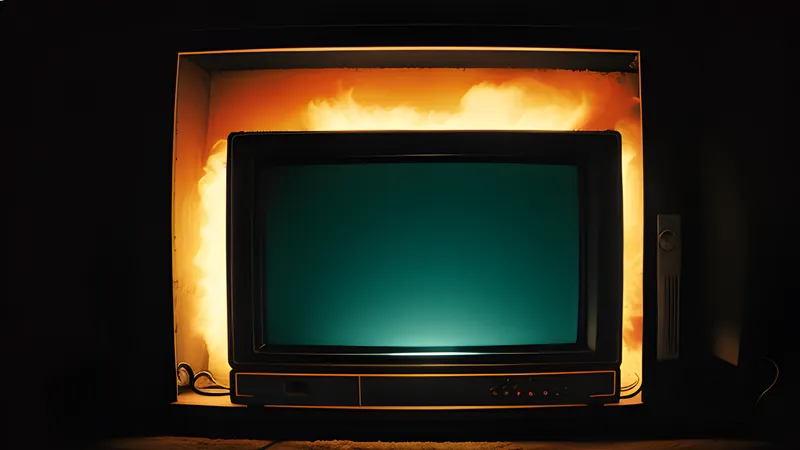
Rick Baker’s effects make the metaphor flesh. Max grows a vaginal slit in his abdomen into which cassettes and, eventually, a gun are inserted — the body becoming a VCR, programmable, penetrable, no longer sovereign. His television set bulges and breathes and begs. A gun fuses with his hand. Cronenberg’s insistence that the mutation be physical, tactile, glistening, is the same instinct that powers The Fly three years later: the idea only frightens once it has skin. Howard Shore’s score, part orchestral and part early electronic, keeps the whole thing queasy and unmoored, refusing the reassurance of a clean horror sting.
James Woods is essential here, and it is worth saying so about the performance rather than the man. Max has to be a smart cynic who thinks he is the most awake person in every room, so that his slow reprogramming registers as a fall. Woods gives him a fast, defended intelligence that curdles into confusion and terror, and the arc only lands because he starts so sure of himself.
The prophecy, precisely
It is easy to praise Videodrome loosely for “predicting the internet,” but the specific predictions are what impress. Cronenberg foresaw media as physically addictive, a hunger for ever-more-extreme content that recalibrates the nervous system so that yesterday’s shock reads as today’s baseline — the exact mechanics of a feed engineered to keep you scrolling. He foresaw the collapse of the line between viewer and participant, the way a screen stops being a window and becomes an organ. He foresaw content as a delivery vehicle for control, a signal that programmes the watcher while pretending to entertain. He foresaw a public figure who exists only as recorded media, more real and more influential dead-on-tape than any living person — which is roughly a description of half the faces we now scroll past. He did all this in 1983, on 16mm, in a Toronto that looks like wet cardboard, and he grounded it in a body so the ideas could bleed.
The craft lesson is that prophecy works best when it is filthy and specific. Cronenberg does not gesture at “the dangers of television” in a clean, editorial way. He builds a squalid world of pirate signals and back-room deals and a man whose stomach becomes a tape deck, and lets you extract the argument yourself. The grime is the credibility. A slicker, more respectable version of this film would have dated instantly; the sleaze is timeless because sleaze is what actually drives the medium it is warning about.
Cronenberg also understood, before almost anyone, that the danger would not announce itself as danger. Videodrome is not a signal from a hostile foreign power or an obvious weapon; it arrives disguised as more of what Max already wants, cheaper and stronger. The conspiracy that deploys it hides behind an eyewear company with a bland corporate name, Spectacular Optical, whose motto is about keeping an eye on the world. The instrument of control is a consumer product with a wholesome slogan, and the population volunteers for it because it feels like appetite rather than coercion. That insight — that a surveillance and control apparatus would be built out of things people enthusiastically buy, and would market itself as vision and connection — is the part of the prophecy that has aged into pure documentary. Cronenberg did not need to invent the smartphone to see its logic.
Where it belongs on the shelf
Videodrome is the hinge of Cronenberg’s body-horror period — the film where his fascination with the corruptible body meets his fascination with technology and media, feeding forward directly into The Fly, the more emotional companion piece. Its deepest kinship, though, is with any film that treats infection through desire and image as the true horror. Bill Gunn’s Ganja & Hess works the same seam a decade earlier — a man consumed by a hunger transmitted into him, dissolving as a self while craving the thing destroying him. And for the coldest modern descendant of Videodrome’s idea that the watching eye can be a predator’s tool, Under the Skin turns the surveilling camera into the point of view of the thing doing the harvesting.
The verdict: Videodrome is the most intellectually alive horror film of the 1980s, and one of the very few genre pictures that has become more relevant, more legible, and more frightening with every passing year. It is difficult, deliberately disorienting, and it will lose viewers who need the floor to stay solid. That difficulty is the whole point. A film about a signal that rewires you cannot afford to be safe to watch. Seek out the uncut version — the film had a tangled release history and various trims exist — and give it your full attention, because it is designed to punish the divided one. Everything past this line touches the ending.
Spoilers below
The ending is a suicide, and it may also be a birth, and Cronenberg deliberately leaves you unable to choose. By the final act Max has been thoroughly reprogrammed — first weaponised by the sinister Spectacular Optical conspiracy behind Videodrome, who use him as a living gun to assassinate his own colleagues, then re-turned by O’Blivion’s daughter Bianca into a soldier for the other side. He is a cassette anyone can load. Whatever Max wanted has been overwritten so many times that the concept of what Max wants no longer means anything.
The film closes on a derelict boat, where a hallucinated (or is it) Nicki Brand appears on a battered television and tells Max that to become the new flesh he must first leave the old flesh behind. The screen shows him a vision of his own suicide — Max on the boat, raising the gun-hand to his temple. Then, in the real filthy cabin, Max repeats the words back to himself. “Long live the new flesh.” He pulls the trigger. Cut to black. No transcendence is shown, no new flesh is delivered, no confirmation that anything at all lies on the other side.
That withholding is the masterstroke. The whole film has been about a man who can no longer tell a broadcast from reality, so a triumphant image of Max reborn as pure signal would be a lie the film is too honest to tell. Maybe he ascends into the medium as O’Blivion did. Maybe a confused, programmed man just shot himself in a rusting boat because a television told him to. Cronenberg makes the second reading impossible to rule out, and the second reading — media convincing a person that self-destruction is enlightenment — is the prophecy that has aged most terribly of all.
Related Content