Vampyr: Dreyer's Dream Logic of Dread
The vampire film that behaves like a nightmare and refuses to wake you up
Contents
Carl Theodor Dreyer made The Passion of Joan of Arc in 1928 — one of the towering achievements of silent cinema, a film composed almost entirely of faces — and then, with sound arriving to change everything, he made a horror picture financed by the young aristocrat who agreed to star in it. Vampyr (1932) is the strangest kind of follow-up: a director at the peak of his powers deliberately building a film that feels like something remembered wrong. It was a commercial disaster, misunderstood on release, and it has spent ninety years slowly being recognised as one of the few horror films that genuinely reproduces the texture of a bad dream.
The money came from Baron Nicolas de Gunzburg, a Parisian socialite who wanted to act; Dreyer cast him under the pseudonym Julian West as the film’s drifting protagonist, Allan Grey. The source, loosely, is Sheridan Le Fanu’s collection In a Glass Darkly, drawing on the vampire novella Carmilla among other tales. Dreyer takes almost nothing literal from it. He keeps the atmosphere of a young man wandering into a landscape saturated with old evil, and he throws the plot mechanics overboard in favour of pure sensation. Watching it, you often cannot say what is happening. That is the design working, not failing.
The fog was an accident that became a method
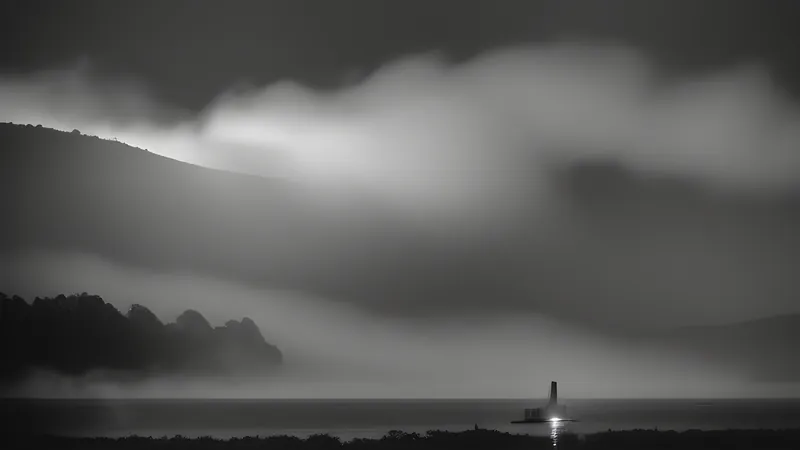
The most famous thing about Vampyr is its look: a soft, silvery haze that lies over every image, as though the whole film were shot through breath on cold glass. The origin story that has hardened around it is that Dreyer’s cinematographer, Rudolph Maté, discovered the effect partly by mistake — a stray reflection or a fault in the light bouncing back into the lens — and that Dreyer, recognising a gift, chose to reproduce it deliberately by shooting through a layer of gauze held a short distance from the camera. Whatever the exact mechanics, the result is a world with no hard edges, where light seems to come from nowhere and settle on things like dust.
This matters because the haze does something specific to your perception. Sharp focus tells the eye what to trust; Dreyer removes that reassurance and leaves you squinting into a grey middle distance where a shape might be a man, a shadow, or nothing. It is the same instinct that drove Val Lewton’s shadow-craft at RKO a decade later — the refusal to let you see cleanly, so your imagination does the frightening — but where Cat People hides its monster in hard black shadow, Dreyer hides everything in a soft grey light. The two films arrive at dread from opposite ends of the tonal scale and meet in the middle.
Shadows with their own agenda
Vampyr is technically a sound film, made in three language versions, but Dreyer treats dialogue as almost vestigial. Whole stretches play like silent cinema with a haunted soundtrack of wind and dripping water and a wandering musical score. Freed from making people talk, the camera drifts. It follows Allan Grey through an inn and a chateau and a mill as though it too were sleepwalking, and it keeps finding things that should not be.
The film’s greatest images are its independent shadows. A one-legged soldier’s shadow moves without him, detaching from its owner and going about its own business on a wall. Shadows of labourers dig a grave in reverse, the spadefuls of earth flying back into the hole. A shadow sits down at a table where no man is sitting. Dreyer never explains these; he simply lets them accumulate until the ordinary rules of light have quietly stopped applying and you have not noticed the exact moment they failed. This is dream logic filmed straight — the way in a nightmare the impossible arrives without announcing itself and you accept it because you have no choice.
The vampire, when the film finally gives you one, is not a caped count. She is an old woman, Marguerite Chopin, played by Henriette Gérard — frail, ordinary, malevolent — and the horror she spreads is a slow wasting sickness that falls on the daughters of the chateau. Sybille Schmitz plays Léone, the stricken sister, and there is a single close-up of her face on a sickbed, her expression sliding from suffering to a sudden predatory hunger as the infection takes hold, that is worth the whole film. It is the moment the illness reveals itself as appetite.
Why the dread never resolves
Most horror films build tension in order to release it — a shock, a kill, an explanation that lets you breathe. Vampyr withholds the release almost entirely. Its scares are diffuse, ambient, more like a rising sense that the ground is not solid than a series of frights. That structure defeated 1932 audiences who came for a monster movie and got a fever, and it is exactly why the film has aged so much better than the growling Draculas of its decade.
You can trace its bloodline forward with real precision. The floating, unmoored camera and the refusal to distinguish waking from dreaming run straight into the American unease of Let’s Scare Jessica to Death and the lost, sun-bleached delirium of Messiah of Evil, two of the finest dream-horror films of the 1970s, both of which behave the way Vampyr does. Its ambiguity — the steadfast refusal to tell you whether the supernatural is real or a symptom of the protagonist’s unravelling mind — is the same trick The Innocents would perfect thirty years on. And as an early, oblique adaptation of Le Fanu, it belongs in conversation with the more literal Carmilla of The Vampire Lovers, which shows you exactly what Dreyer chose to leave out.
The film’s most celebrated sequence is one I will hold below the line, because it is a formal invention so audacious it deserves to ambush you. It is enough to say that Dreyer found a way to put the camera somewhere no horror film had thought to put it, and that the shot has been quoted and stolen ever since.
Where to see it: seek out the restoration that reconstructs the fullest surviving cut with the original German intertitles — the film exists in compromised versions with wildly variable image quality, and the haze that is the whole point turns to mud in a bad transfer. Vampyr is a difficult film in the honest sense: slow, elliptical, occasionally incoherent by design. It is also one of the very few horror pictures that drops you bodily inside a nightmare and closes the lid. That is the verdict. It closes the lid, and the lid is the point.
Spoilers below
The shot everyone remembers is the burial from inside the coffin. Allan Grey has a vision — or a premonition, or an out-of-body slippage the film never clarifies — in which he sees his own dead body laid in a coffin, and Dreyer mounts the camera inside the box, looking up through a small glass window in the lid at the faces of the vampire and her servant peering down. The coffin is then carried out and through the village, and we travel with it, the sky and the treetops and the church spire sliding past overhead through that little pane of glass. It is one of the most genuinely disorienting point-of-view shots in cinema, made in 1932, and every filmmaker who has since put a camera in a grave or a coffin is standing on Dreyer’s shoulders.
The film’s climax delivers its clearest catharsis, and it is aimed at the human accomplice as much as the vampire. Marguerite Chopin, the old woman, is dealt with in the traditional way — an iron stake driven through her as she lies in her grave, at which the wasting curse on Léone lifts and the years catch up with the vampire’s corpse. But the more memorable death belongs to the doctor who has served her, the film’s most tangible villain. He flees to a flour mill, and the machinery entombs him: a great chute opens and pours white flour down over him until he is buried alive in it, thrashing and then still, the pale powder rising to cover his terrified face while the wheels turn on indifferently.
That image — a man drowned in whiteness while machines grind — is the film’s thesis in a single tableau. Vampyr fears a world that has quietly stopped obeying the rules, where death arrives as suffocation by something soft and ordinary and unstoppable; a fanged aristocrat would almost be a relief. Allan Grey and the surviving sister escape across a river into a bright, fog-lifting morning, and the sudden clarity of that final light is the only moment the gauze relents. You leave the nightmare the way you leave sleep: abruptly, gratefully, and unsure how much of it you are allowed to believe.
Related Content