Valhalla Rising: Refn's Silent Viking Descent
The film Nicolas Winding Refn made before Drive, and the one that explains it
Contents
There is a version of film history where Valhalla Rising (2009) is the most interesting thing Nicolas Winding Refn ever made, and the fact that almost nobody agrees is part of what makes the argument fun. It sits in his filmography between Bronson (2008) and Drive (2011) like a stone dropped in a stream. Bronson was a music-hall performance about a man who liked hitting people. Drive was the neon fairy tale that turned Refn into a brand. Between them he went to Scotland with Mads Mikkelsen, took away his voice, took away his plot, and shot ninety-odd minutes of men walking through weather.
I came to it late, on a rental disc, expecting a Viking film. What I got, and what no marketing department could have sold me, is a film about the moment a belief system stops working and the people inside it keep walking anyway.
What you are actually watching
Mikkelsen plays a man the other characters call One-Eye. He is a captive, kept chained on a Norse hillside by a chieftain who makes money from him in bare-handed pit fights. He has one eye. He does not speak — never, not once, in the entire film. A boy named Are (Maarten Stevenson) tends him and, in effect, becomes his voice, though the boy speaks about as often as a cat.
The picture is cut into six titled chapters, and the titles do most of the film’s signposting: Wrath, Silent Warrior, Men of God, The Holy Land, Hell, The Sacrifice. That structure is the closest thing the film gives you to a plot summary, and Refn means it as one. Somewhere in the middle of that list, One-Eye and Are fall in with a band of Christians heading for Jerusalem by sea, and the sea does what fog-bound seas do in this kind of story.
Everything above this paragraph is on the box. Everything the film actually does with it lives below the spoiler line at the bottom, because Valhalla Rising is one of the rare pictures where knowing what happens genuinely deflates it. The whole design is a slow withdrawal of certainty, and if you know in advance which certainty goes when, you are watching a diagram.
Why it works: the mechanics of a film with no dialogue to hide behind
Take the talking out of a film and every other department has to carry more. Refn knows this, and Valhalla Rising is a good place to watch the compensation happen in real time.
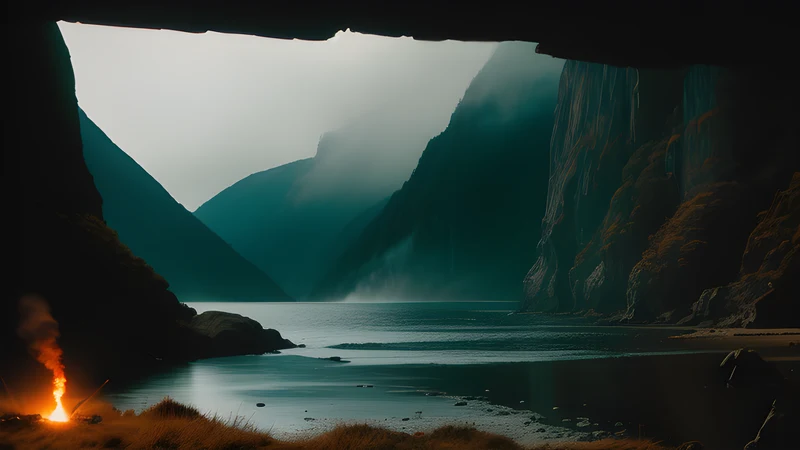
The camera stays still and the frame stays wide. Morten Søborg shot it in the Scottish Highlands, and the compositions place figures small against ridgelines and water. When you cannot cut to a close-up for information — because a close-up of Mikkelsen’s face yields nothing, deliberately — the eye starts reading landscape as character. The hills are doing the exposition. That is a real technique, and it is the same one Herzog used to get Aguirre, the Wrath of God to mean something without anybody explaining the theme.
The violence is arrhythmic. Refn’s fight staging here is deliberately bad cinema by conventional standards: no build, no choreography you could follow, no beat where you know the hit is coming. A man is standing and then a man is opened. The effect is that violence stops being a payoff and becomes weather — it arrives, it passes, the survivors keep walking. Compare the fights in Drive, which are shaped to land like punctuation. Same director, opposite intent, four years apart.
The colour is doing argument. Refn is red-green colourblind and has said so repeatedly; he cannot see mid-tones, which is why his films tend to push saturation to extremes. Valhalla Rising is mostly a wet grey-green film that periodically floods to a hallucinated blood red. Those red passages are the only interior life One-Eye is given. They function as the character’s dialogue. If you want the long version of how a colourist can carry meaning that the script never states, we wrote about exactly that in colour timing as horror, from Bava to Refn — this film is the purest test case in his filmography.
The score refuses to help. Peter Peter and Peter Kyed’s music is drones, low hums, occasional metallic pressure. It never tells you how to feel about a scene. Most historical epics use score as an emotional subtitle track. Strip that out and the audience is left alone with the image, which is precisely the discomfort Refn is selling.
Mikkelsen’s performance deserves its own line. He is doing almost nothing — a stillness, a set of the shoulders, an eye that tracks slightly late. It is the most economical work of his career, and it lands because he never once mimes what a lesser actor would mime. He acts like a man who has no reason to explain himself to anyone.
The real ancestor
Every review at the time reached for Aguirre, and they were right, but they usually stopped there. The Herzog debt is obvious: a small party moving through hostile country toward a destination that does not exist, led by a will that has detached from reason. Refn has never pretended otherwise.
The more interesting ancestor is Jodorowsky. Watch the chapter structure again — six titled movements, each a stage in a spiritual descent, culminating in a sacrifice — and you are looking at the shape of El Topo with the surrealism sanded off and the mud left in. The acid-western template is a wandering figure moving through symbolic stations toward an ending that reads as either enlightenment or annihilation depending on your mood. Refn transposed the whole thing from the desert to the North Atlantic and swapped the mysticism for silence. Zachariah and Greaser’s Palace belong on the same shelf; so, at a diagonal, does Dead Man, which is the same journey with a talkative guide.
There is a third ancestor worth naming, and it is the one that unlocks the film’s mood: Herzog’s Heart of Glass, in which the cast performs in an actual hypnotic trance. Valhalla Rising is not hypnotised, though it is shot as if it wants to be. The blank, delayed quality of everyone’s reactions is a stylistic decision borrowed straight from that film’s texture. Once you see it you cannot unsee it.
For the wider family, this belongs squarely in the tradition we mapped out in the slow cinema of dread — pictures that generate fear from duration rather than incident. And if you want the modern Nordic-pagan cousin with a friendlier surface, The Ritual is doing a domesticated version of the same fear.
The case against, made properly
The film is boring. I do not want to weasel out of that. There are stretches — the sea chapter especially — where the picture is asking you to watch fog for minutes at a time with no dramatic contract in place, and a great many intelligent people have found this an insult rather than a technique. The distinction between hypnotic and inert is one the film cannot make on your behalf, and Refn declines to help.
It also has a genuine problem with its Christians. The crusader band is written thinly — they are zealots, they are afraid, they are venal, and that is roughly the whole spectrum. A film this committed to withholding interiority from its lead can afford to grant a little more to the supporting cast, and this one does not. The result is that when the group starts to come apart, it feels like a design decision rather than a tragedy.
And the mysticism will not survive a direct question. Ask what the film thinks it is saying about faith and you get fog. Refn’s defenders — I am one — argue that fog is the statement. His detractors point out, fairly, that this is an unfalsifiable position.
The verdict
Valhalla Rising is a film I would not press on a friend without a warning, and one I have rewatched more often than Drive. It commits to an idea most directors would flinch from: that a man can be the centre of a film for ninety minutes while telling you nothing, and that his silence will fill with whatever you brought into the room. That is a real achievement, achieved on a small budget with weather and a face.
It also explains everything Refn did afterwards. The neon of Drive and Only God Forgives is the same instinct — image as scripture, dialogue as decoration — with a commercial gloss applied. If you liked Drive and wondered where the weirdness in it came from, it came from Scotland, in the rain, in 2009.
It turns up on streaming rentals regularly and has had good physical releases; the picture rewards the biggest screen and the darkest room you can arrange, because the whole film lives in the low end of the image.
Spoilers below
One-Eye kills his captor, takes the boy, and joins the Christians because they are heading somewhere and he is not. The sea chapter is the hinge: the boat becalms in fog for days, the water runs out, the men drift, and when land finally appears they are convinced it is the Holy Land. It is not. The trees are wrong, the light is wrong, and the Native people who eventually appear at the edge of the frame make it plain that the party has crossed the Atlantic. The Christians have sailed away from Jerusalem and landed in North America around the year 1000, which is the film’s one enormous joke: a crusade that arrives at the exact geographic opposite of its destination and never understands what happened.
The band disintegrates. One-Eye’s red visions, which have been running throughout, turn out to have been showing him this place all along — the film’s only supernatural claim, and it is made without a single line of explanation. In the final chapter he simply stops. He puts down whatever he is carrying, stands, and lets the men who have surrounded him beat him to death, while Are watches. Then the boy walks away alone and the film ends.
That is The Sacrifice, and it is why the chapter titles matter. One-Eye has spent the film as an instrument of other men’s wrath. The last thing he does with his body is refuse to use it. Read it as Christ imagery if you like — Refn has flirted with that reading and never confirmed it. Read it as a man who has finally arrived somewhere his violence cannot follow him. Either way, the boy survives, alone, in a world with no name, and the film has the nerve to leave him there.
Related Content