Under the Shadow: The Djinn in Wartime Tehran
Babak Anvari builds a haunting where the escape route is also a threat
Contents
In 2017 the United Kingdom submitted a Persian-language horror film to the Academy Awards. That fact tells you almost everything about Under the Shadow’s peculiar position: a British production, shot in Jordan, set in Tehran, spoken in Farsi, financed out of London, directed by an Iranian who left the country as a teenager and made his debut about the city he grew up in and cannot film in.
Babak Anvari’s 2016 film is set in 1988, during the phase of the Iran-Iraq war that Tehranis called the War of the Cities, when Iraqi missiles fell on residential districts and the sirens ran nightly. It is a haunted-house film. The house is an apartment block. The ghost is a djinn. And the reason the film is far better than that summary suggests is a single structural decision that I think is the smartest thing in horror this century.
The woman who cannot leave
Narges Rashidi plays Shideh, and the film opens with her being refused. She was a medical student before the revolution; her political activity during the Cultural Revolution has permanently disqualified her from resuming her studies. The scene is played flat, in an office, by an administrator being reasonable. There’s no cruelty in it. There’s just a door closing that will never open again, and Rashidi takes the news with a stillness that tells you she has been rehearsing for it.
Her husband Iraj is a doctor, conscripted and sent to the front. That leaves Shideh alone in the flat with their daughter Dorsa, played by Avin Manshadi, in a building emptying out as the shelling gets worse and the neighbours with somewhere to go go there.
Anvari builds the domestic texture with a documentarian’s patience before he touches the supernatural. Shideh does aerobics to a Jane Fonda tape on a hidden VCR — the videotape is contraband, the leotard is contraband, and the neighbours could report her. Her medical textbooks sit on the shelf as a rebuke. Mrs Ebrahimi upstairs mutters about djinn. A superstitious old woman and an orphaned mute boy arrive in the building, and Shideh, a rationalist and an educated woman, has nothing but contempt for the folklore starting to circulate around her.
The move that makes the film
Here is the design, and it is worth spelling out slowly.
An Iraqi missile hits the block and fails to detonate. It lodges in the upper floor and cracks the ceiling of Shideh’s flat. In djinn lore — which the film takes seriously and explains economically — the creatures travel on the wind, arrive where anxiety and fear are thick, and take a beloved object from the person they attach to. The crack is a way in.
So the haunting starts. And Shideh’s rational response is to leave. Take the child, go, get out of the building.
At which point the film springs the trap it has been setting since the first scene. Shideh runs into the street in the middle of the night, terrified, holding her daughter — and she is stopped, because she is a woman outside without a chador, and that is an offence. The threat behind her is a djinn. The threat in front of her is the state. Anvari has constructed a haunted house whose exit leads to a second haunted house with better paperwork, and the woman in the middle can be arrested for fleeing.
I’ve never seen the horror premise of “why don’t they just leave the house?” answered with such total, unanswerable authority. The film doesn’t have to invent a curse or a locked door. It just points at the actual conditions of the actual place in the actual year.
The chador, and why the image works
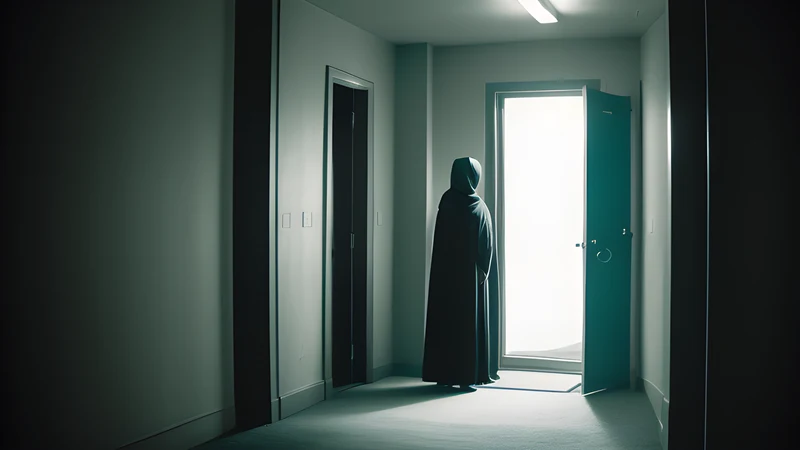
The craft payoff is the djinn’s form. It manifests as cloth — a chador, floating, filling with wind, hovering in a doorway with nothing inside it. Anvari shoots it mostly in the periphery and mostly in draughts, and it is one of the great horror images of the decade for a reason that has nothing to do with the effects budget: the garment that the state compels Shideh to wear in public is the same shape as the thing hunting her in private. She cannot go outside without it. She cannot stay inside with it.
That’s the whole argument in one costume, and Anvari never says it aloud. He doesn’t need to. He puts the cloth in the frame and lets it move.
The production history is folded into that image, too. Anvari could not shoot in Tehran and was never going to be able to; the film was made in Jordan, with Amman standing in for a city the director had to reconstruct from childhood memory and reference photographs. That distance shows in a way that helps. The Tehran of the film has the slightly heightened, over-remembered quality of a place recalled by someone who left — every detail correct, the whole thing a degree too vivid. For a film about a haunting, having the location itself be a reconstruction from memory is an accident that behaves like a decision.
The rest of the technique is equally frugal. The film’s palette is dust and beige and the specific brown of eighties Iranian domestic life. Sound does the shelling — the siren, the whistle, the long wait, the impact somewhere else — and Anvari cuts away from the explosions to Shideh’s face, which is a choice about resources and also a choice about meaning, because the war in this film is a pressure rather than a spectacle. And he uses the building vertically: as neighbours evacuate, floors go dark, and the block becomes a stack of empty rooms with two people in it. The geography does the isolation. Nobody has to say the word “alone”.
The real ancestor
The lazy comparison is The Babadook, and it’s a fair one — mother and child, a monster that arrives through an object, a woman whose competence is being eroded by a thing nobody else can see. Both films were sold as “the monster is really grief/stress”, and both are better than that reading, because both keep the creature literal enough to bite.
The true ancestor is The Devil’s Backbone, and the correspondence is almost eerie. Del Toro’s 2001 film stands an unexploded bomb in the courtyard of an orphanage during the Spanish Civil War and hangs its entire haunting on it: the ordnance that failed to go off is the ghost’s anchor, the war’s presence in the building, the thing everyone walks past. Anvari does the identical trick thirteen years later with an Iraqi missile in a Tehran roof. Two directors, two wars, one image — a weapon that did not detonate, sitting in a home, going off in a different register.
If you want the other Iranian corner of this, A Girl Walks Home Alone at Night arrived two years earlier and pulls the opposite trick: a chador as a vampire’s cape, agency instead of terror, the same cloth read as power. The two films together make an argument no single film could.
The case against
The film is ninety minutes and the last twenty are a chase. That chase is well made and it is the least interesting stretch, because Under the Shadow is superb at pressure and merely competent at pursuit. Once the djinn is confirmed and mobile, the picture loses the ambiguity that made its first hour so unpleasant to sit through, and becomes a more ordinary thing with running in it.
The second objection is that the political reading is available to the point of being handed over. Some viewers find the chador-as-monster equation too neat, a thesis rather than an image. My view is that it survives because Anvari refuses to explain it, and I accept that a film whose meaning can be stated in one sentence is carrying a risk.
There’s also Manshadi’s Dorsa, who is asked to do a great deal of frightened-child acting and does about eighty per cent of it. Rashidi carries her.
And the film asks a lot of an audience’s patience up front. The first half hour is an administrative drama about a woman being told no, shot in offices and kitchens, with the horror entirely withheld. It premiered at Sundance in 2016 and reached most viewers through Netflix, which is a delivery system with roughly a four-minute tolerance for slow. Plenty of people bailed before the ceiling cracked. Those thirty minutes are load-bearing — the trap only shuts because the film spent that long showing you the walls — and it remains the most likely reason someone tells you they didn’t get on with it.
What is beyond argument is that Anvari made a debut in which the supernatural and the political are the same pressure, applied to one woman, in one flat, in a real year. Under the Shadow streams widely and needs no restoration; its grain and beige are the point. Follow it with The Devil’s Backbone and watch two bombs fail to explode.
Spoilers below
The djinn’s method is the lore’s method, and Anvari plays it straight. It takes what you love. Dorsa’s doll Kimia goes first, and the child’s insistence that the doll has been taken reads, to Shideh and to us, as a distressed girl inventing a story — until Shideh’s own medical textbook goes, which is the film’s cruellest joke. The djinn takes the beloved object. For the mother, the beloved object is the career she was refused in the first scene.
Dorsa sickens. Shideh’s rationalism starts costing her: she disbelieves her daughter, then disbelieves the neighbours, then slaps the child, and the film is honest enough to let her be wrong and frightening. Mrs Ebrahimi’s warnings, dismissed as peasant superstition by an educated woman, turn out to be a technically accurate briefing.
The flight into the street is the hinge I described above. Shideh is stopped, uncovered, and delivered a lecture — no violence, a warning, a form — and then sent home. Back to the building. Back up the stairs. The state returns her to the haunted flat with a caution about her clothing.
The last act runs them through the block as the chador-thing pursues, and Anvari keeps the shape half-glimpsed to the end, which is the correct call and takes real discipline at the point where every producer wants a face. They get out. The film lets them get out.
And then the final movement gives you the objects. The djinn keeps what it takes; the doll stays gone; and the film closes on the strong implication that the attachment travelled with them and that escaping the building settled nothing at all. Shideh saved her daughter and left her textbook behind, which is the bargain the first scene already told you she had made.
Related Content