Un Chien Andalou: The Razor and the Eye
Sixteen minutes, two dreams, and a rule that has never been bettered
Contents
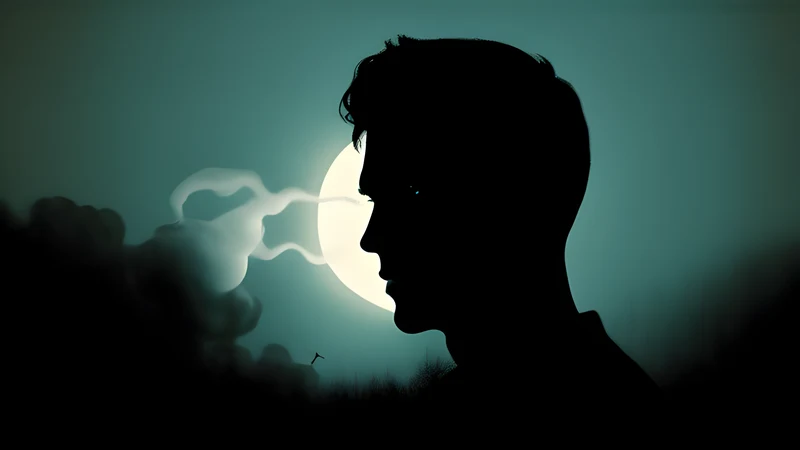
The most famous sixteen minutes in avant-garde cinema were written in about a week, in Figueres, by two young Spaniards trading dreams over breakfast. Salvador Dalí described a hand crawling with ants. Luis Buñuel described a thin cloud slicing across the moon and, in the same motion, a razor slicing an eye. They put both in, agreed a rule, and had a script in days. Buñuel’s mother paid for it. He was twenty-nine and had never directed a film.
Un Chien Andalou has survived a century of being taught, and being taught is usually fatal. Every film student meets the eyeball in a lecture hall with the lights up and a slide behind it, which is roughly the worst way to encounter anything. What gets lost in the seminar is that this is a funny film, a fast one, and an unusually cruel one — and that its central formal decision, made before a frame was shot, is still the most rigorous rule anyone has ever imposed on a screenplay.
The rule
Buñuel and Dalí agreed that no image or idea would be admitted if it permitted a rational explanation. Nothing psychological, nothing symbolic, nothing that could be traced to a cultural reference either man could name. If either of them could say why something belonged, it was out.
That is a much harder constraint than it sounds, and it is the opposite of what most people assume surrealism was doing. The popular idea of the movement is that it was about free association, throwing things at the wall, letting the unconscious speak. The rule here is a filter, and a punishing one. Free association produces symbols almost immediately, because a mind left to itself reaches for meaning within seconds. Excluding every explicable image means rejecting most of what occurs to you, which is why the finished film is sixteen minutes and why every one of them holds.
The result is a picture that cannot be interpreted, and — this is the part the seminars never quite admit — has been interpreted continuously for ninety-odd years anyway. Buñuel spent his life being told what the ants meant. He found the readings hilarious and, on the record, insisted that a work built specifically to defeat explanation had generated a small industry of explainers, which he took as proof that the human need for sense is a reflex on the order of a knee-jerk.
The premise, kept above the line
There is no plot and no attempt at one. A prologue: a man sharpens a razor, steps onto a balcony, watches a cloud cross the moon, and the cut that follows is the reason the film is famous. Buñuel plays the man himself, which is a detail worth carrying into the viewing — the director of the most notorious moment in avant-garde cinema is also its perpetrator, on screen, holding the blade.
Then a series of episodes involving a man (Pierre Batcheff) and a woman (Simone Mareuil) in a Paris flat and the street below it, connected by intertitles that announce intervals of time — eight years later, around three in the morning, sixteen years before — and which are pointedly useless. The intervals do not correspond to anything. The same actors continue. The film is mocking the one convention it retains, and the joke is that a title card promising chronology is enough to make an audience assume chronology, even when the screen immediately contradicts it. Ninety years on, this remains a better demonstration of how narrative grammar works than most textbooks.
Among the episodes: ants pouring from a hole in a palm; an androgynous figure in the street poking at a severed hand with a stick while a crowd watches; a man dragging an extraordinary assemblage across a room, which I will not itemise because arriving at it cold is one of the pleasures. Dalí appears briefly in that sequence, as does a quantity of dead livestock, and the whole business took the production most of its budget.
Why it works: the cut
The eye sequence deserves its reputation, and the reason is editing rather than gore. Buñuel builds it in three movements: the razor being stripped on a leather, the man on the balcony, the thin cloud drawing across the face of the full moon. Then the woman’s face, the blade, and the slit. The cloud and the moon have already shown you the shape of the action a beat before the blade arrives, so by the time the cut lands your eye has been trained to complete it.
The effect is achieved by rhyme. You are not shocked by an image; you are shocked by a resemblance you noticed yourself, a second early, and could not un-notice. That is why the sequence survives an audience that knows the eye was a dead calf’s, obtained from an abattoir and shot in close-up. The technical trick is trivially exposed and the sequence still works, because the mechanism was never concealment. It was the moon.
Everything in the film runs on the same principle. Buñuel cuts on graphic matches — a shape becomes another shape, a texture becomes another texture — so the film feels like it is being reasoned, moment to moment, even as it refuses every reason. He borrowed the vocabulary of continuity editing and pointed it at nothing. That is a young man’s joke, and it is the foundation of everything he did later; the flat, unastonished camera of L’Age d’Or and Simon of the Desert starts here.
The premiere, and the disappointment
Buñuel screened it at the Studio des Ursulines in Paris in June 1929, in front of the Paris avant-garde, and by his own account filled his pockets with stones in case the audience rushed the projection. They applauded instead. It ran for months. It made him famous and got him admitted to André Breton’s surrealist group, and he claimed for the rest of his life to have been depressed by the reception, on the grounds that a film designed as an act of aggression had been received as a triumph by exactly the people he wanted to insult.
That is worth taking seriously rather than as a good anecdote. The failure Buñuel diagnosed in 1929 is the one that swallowed the movement: the avant-garde is unusually good at being delighted by its own attackers. He would spend the next year making L’Age d’Or with a bigger budget and an explicit aim of getting a rise out of somebody, and it worked — a mob wrecked the cinema and the film was banned in France for fifty-one years. Whether he was happier is another question.
The soundtrack was Buñuel on a gramophone at the back of the room, alternating Wagner’s Tristan und Isolde with Argentine tangos, played live at each screening. When he made a sound print in 1960 he simply fixed those choices to the picture, which is the version everyone now sees. It is worth knowing that the pairing was improvised at a party in 1929 and only became canonical thirty years later.
The collector’s note
The film’s real descendant is Meshes of the Afternoon, Maya Deren’s 1943 short, which takes the same dream logic and does something Buñuel refused to do — gives it a structure. Watch them back to back and you can see the fork in the road for the entire experimental tradition: one branch insists on meaninglessness, the other builds architecture out of the same materials. Deren’s film is the more influential of the two, and she got there by breaking Buñuel’s rule.
The other essential line runs to Eraserhead, where David Lynch arrives at a comparable register from an entirely different direction, with sound doing what Buñuel gave to cutting. And for the deep root, A Trip to the Moon is where cinema first discovered that a cut can make the impossible look documented; Méliès used it to delight and Buñuel used it to injure, with the same tool.
The honest case against
The film has been so thoroughly absorbed that its power is now partly a matter of reputation management. Sixteen minutes cannot be padded, so it does not sag, but a good deal of what follows the prologue is inert on a first viewing — the middle stretch is a young man’s inventory, and some of the inventory is just objects. The rule about rational explanation is also, quietly, cheated: Buñuel and Dalí had read their Freud, and a picture containing severed hands, ants and impotence is not as innocent of psychology as its authors maintained.
I would also resist the standard claim that this is the greatest short film ever made. It is the most consequential, which is a different award. Deren did more with fourteen minutes.
The verdict, above the line
A century on, this remains the purest demonstration of what cinema can do that no other medium can: assert a connection between two images so forcefully that the audience supplies a logic which does not exist. Everything Buñuel made afterwards is a refinement of that discovery. It is sixteen minutes, it is in every archive and on every experimental-cinema collection, and there is no excuse. Everything above this line is safe. The final image goes below.
Spoilers below
The film ends with an intertitle — In spring — and then a wide shot of a beach, where the man and the woman stand buried to their chests in sand, immobile, apparently blind, eaten away, entirely still. And that is the end.
It is a genuinely bleak closing image and one that Buñuel, in keeping with his rule, refused to gloss. The obvious reading is that the couple have been fixed, planted, finished with — that the film’s whole nervous, mobile catalogue of desire and violence terminates in two figures who can no longer move at all. The obvious reading is also, by the film’s own logic, forbidden, and that is the last and best joke: the picture ends on an image so plainly meaningful that you cannot help but read it, in defiance of every rule its authors imposed on themselves.
There is a real horror underneath. The season card says spring, the time of germination, and what is planted is two people. The film has spent sixteen minutes refusing to let anything resolve, and it finishes by resolving into stillness — the one thing the whole picture has been running from. Buñuel understood the effect precisely, whatever he said afterwards about meaninglessness, because he closes on it and holds.
A postscript that Buñuel himself noted with some grimness in later years: both of his leads came to appalling ends. Pierre Batcheff took his own life in 1932, three years after the premiere. Simone Mareuil died in 1954, by fire, in her home town in the Dordogne. Nothing in the film caused it, and it means nothing, and the rule would exclude it. It is also impossible to watch the last shot now without the knowledge sitting in the frame — two figures buried in sand, in spring, and neither of them would get old. My verdict: the founding text, and its final thirty seconds are better than its famous first ninety. Watch it, then go straight to Meshes of the Afternoon and see what the next generation built on top of it.
Related Content