Ugetsu: Mizoguchi's Ghost Story as War Elegy
A sixteenth-century ghost tale that is really about what war does to the people who survive it
Contents
Some films are shelved under horror because they contain a ghost, and the label undersells them. Ugetsu is a ghost story the way Hamlet is a ghost story — the phantom is real, and it is the least of what the film is about. Kenji Mizoguchi made it in 1953, eight years after Japan’s defeat, and beneath its sixteenth-century tale of a bewitched potter runs a low, steady grief for what war does to ordinary people, especially the women left in its path. It is one of the most beautiful films ever made, and one of the saddest, and its ghost is a door into both.
Two men and their ambitions
The story is set during the civil wars of the late sixteenth century, a Japan of roaming armies, burned villages and no safety anywhere. Two peasant men in a lakeside village catch the fever of ambition just as the fighting reaches them. Genjuro is a potter who sees, in the chaos, a chance to sell his wares at a premium and grow rich. Tobei, his brother-in-law, dreams idiotically of becoming a samurai, of armour and glory and a name. Each has a wife — Genjuro’s Miyagi, Tobei’s Ohama — who can see exactly where these ambitions lead and cannot stop them.
Mizoguchi adapted the film from two tales by the eighteenth-century writer Ueda Akinari, folded together with a story by Guy de Maupassant, and the seams do not show. What he built is a single tragic machine in which two kinds of male greed — for money, for status — pull two families apart while war grinds in the background. The men chase phantoms of success into the ruined countryside; the women pay for it. That structure, worked out with terrible patience, is the film’s real subject, and the supernatural episode sits inside it like a jewel in a wound.
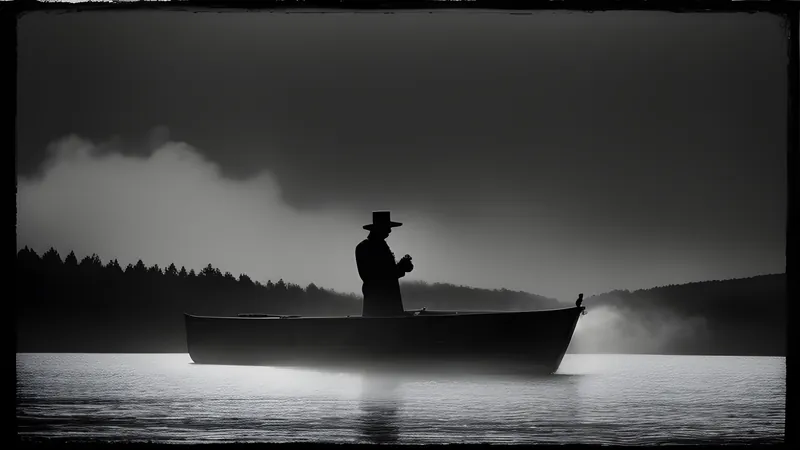
The most famous image in Ugetsu comes early, and it announces the film’s register. The two couples cross a great misted lake by boat to reach the town where Genjuro means to sell his pots, and Mizoguchi shoots the crossing as a passage into another world — the water flat and silver, the fog swallowing the shore, a drifting boat emerging out of the murk with a dying boatman aboard. It is one of the supreme sequences in cinema, and it works as a threshold. Everything after it happens on the far side of something.
The phantom bride
In the town, Genjuro sells his pottery and is approached by a noblewoman of striking elegance, the Lady Wakasa, who admires his work and invites him to her mansion. What follows is a seduction of eerie, formal beauty. Wakasa and her ancient attendant draw Genjuro into a household of exquisite manners, refined pleasure and a strange, chilly stillness. He is dressed in fine robes, feasted, adored, and given everything the money he came for was meant to buy. He forgets, for a time, that he has a wife and child waiting at home.
The revelation of what Wakasa is arrives with great restraint, and it reframes the seduction as the film’s central horror. The mansion is a snare, and the pleasure inside it is a way of dying. Machiko Kyo — unforgettable two years earlier at the heart of Kurosawa’s Rashomon — plays Wakasa with a serene, painted stillness, her white face and slow movements borrowed from the ghost figures of Noh theatre. She is not a rattling spectre. She is a beautiful, sorrowful thing that wants what it can never have, and her longing is genuinely moving even as it consumes the man she has chosen.
This is the film’s cruellest insight, and its most humane. Wakasa is a victim too, a life cut short by the very wars that surround the story, reaching out of death for the ordinary happiness she was denied. The horror is not that she is evil. The horror is that everyone in Ugetsu — the living and the dead, the men and the women — is grasping at something the war has already destroyed. Greed and grief turn out to be the same hunger seen from different sides.
Why it looks the way it feels
The reason Ugetsu casts the spell it does is its cinematographer, Kazuo Miyagawa, one of the great artists ever to hold a camera, who also shot Rashomon and much of the best Japanese cinema of the era. Working with Mizoguchi’s beloved long takes, Miyagawa moves the camera in unbroken, floating passages that glide through space as if the film itself were a spirit drifting through the world. Scenes unfold in single shots that reframe and rebalance without a cut, so that time seems continuous and dreamlike, and the boundary between the living world and the ghost world grows soft.
The lake crossing, the approach to Wakasa’s mansion, a late scene of a man returning to a home that is not quite as he left it — these are staged as continuous movements, the camera easing through the frame, and the technique is inseparable from the meaning. Mizoguchi refuses the hard cut that would tell you where reality stops and the supernatural begins, so the film keeps you in a permanent, gentle uncertainty. You feel the ghost world lapping at the edges of the real one, because the camera never draws a line between them.
Fumio Hayasaka’s score, laced with traditional Japanese percussion and voice, works the same seam, drifting between the eerie and the elegiac. The whole film is pitched at the threshold, and its craft exists to keep you standing on it. This is where Ugetsu earns its place in any conversation about horror as an art form: it frightens you by dissolving your certainty about what is solid, and it does so with technique so refined it looks like weather.
A ghost tradition worth following
Placed in the collector’s map, Ugetsu is a cornerstone of the Japanese ghost tradition — the kaidan — that gave world cinema some of its most haunting images. It shares its era and its sensibility with Masaki Kobayashi’s Kwaidan, which stages its ghost tales as painted theatre, and with the pair of astonishing films Kaneto Shindo set in the reed fields of a war-torn Japan, Onibaba and Kuroneko, both of which share Mizoguchi’s core idea that war breeds ghosts and that the vengeful dead are usually wronged women. For the same period’s descent into a filmed underworld, Jigoku takes the moral logic to its literal, hellish conclusion. Watch these together and a whole national horror grammar comes into view, one where the ghost is a moral verdict on the living.
Its influence reaches west, too. The soft, floating dread of long-take horror, the ghost who is pitiable rather than monstrous, the idea that a haunting is history refusing to stay buried — these all pass down through decades of serious ghost cinema, and directors from Scorsese to Kurosawa’s own admirers have named Ugetsu as a touchstone.
The verdict needs no hedging. Ugetsu is a masterpiece, one of the films that proves horror and high art were never separate countries. It uses a ghost to say something almost unbearable about greed, war and the people who are left holding the wreckage, and it says it in images of such beauty that the sadness sneaks up and floors you. If you think of the ghost story as a minor form, this is the film that will change your mind. Seek out a good print — the Criterion restoration is luminous — and give it your full attention. It rewards every ounce of it.
Spoilers below
Genjuro finally breaks Wakasa’s spell — warned by a priest, protected by holy characters painted on his skin — and flees the mansion, which is revealed in daylight as a burned-out ruin. Wakasa and her whole household were ghosts, a noblewoman and her line extinguished by the wars, and the paradise Genjuro lived in was a charred shell all along. He has been feasting among the dead while his real life fell to pieces.
He returns to his home village to find his wife Miyagi waiting, the house warm, a fire lit, their child asleep. She feeds him, comforts him, listens to his remorse, and he sleeps at peace for the first time in the film. In the morning he wakes and the house is empty. Miyagi is not there and, we learn, has not been for some time: she was killed by marauding soldiers while he chased his fortune, and the tender homecoming was itself a ghost’s gift, a phantom of his wife granting him one last night of the ordinary happiness he threw away. Mizoguchi stages the reveal with a single, quietly devastating camera move, the same floating technique that never once told us where the living ended and the dead began.
The film’s cruellest irony lands here. Genjuro chased a beautiful ghost across the water and mistook her for his fortune; the real ghost, the one that loved him, was the wife he abandoned at home. The parallel story of Tobei and Ohama closes just as bitterly — his samurai dream bought at the price of her ruin — and the film ends with the survivors chastened, returned to the potter’s wheel and the poor village, the ambitions burned away. War took the women; the men are left to grieve and to work. It is a ghost story whose final horror is not the phantom at all. It is the plain, unspectral fact of everything the living cannot get back.
Related Content