Touchez Pas au Grisbi: Gabin's Ageing-Gangster Elegy
Jacques Becker films two tired men, a fortune in gold bars and a set of pyjamas, and invents the modern French crime picture
Contents
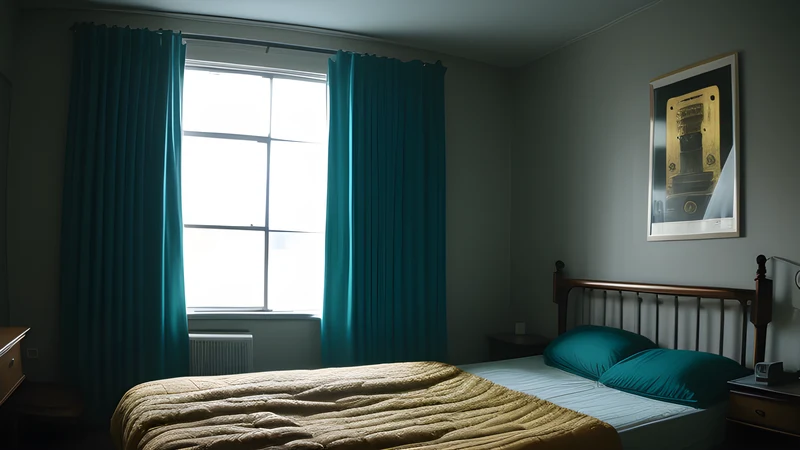
Halfway through Touchez Pas au Grisbi (1954), two middle-aged criminals sitting on fifty million francs in stolen gold go to bed. That is the scene. Max le Menteur takes his friend Riton back to a flat nobody knows about, lays out pâté and biscottes, pours the wine, hands over a spare toothbrush, produces a spare pair of pyjamas, and the two of them eat, brush their teeth and turn in. Jacques Becker gives this domestic housekeeping more screen time, and considerably more care, than he gives the robbery that generated the money in the first place — which happened before the film started and which we never see at all.
That decision is the whole picture. Becker had spent years as Jean Renoir’s assistant, and what he brought to the French crime film was Renoir’s interest in how people actually behave in rooms. The gangsters here are not mythic. They are ageing professionals with sore feet, fixed habits and a very clear sense of how much energy they have left. The gold is the plot. The tiredness is the subject.
The flat, the pyjamas, the toothbrush
Every crime film has a lull before the storm. Becker turns his into the emotional centre of the movie, and it works because of what the objects tell you. Max has a bolthole with two of everything in it. Two toothbrushes, two sets of pyjamas, food in the cupboard, a record player. He has kept this place ready for years against exactly this night. Nobody says so. You simply watch him move through the flat, and you understand that this man has been quietly planning for disaster for a very long time, and that the person he planned to save was Riton.
Then there is the record. Jean Wiener’s score gives the film a harmonica theme so plaintive it became a genuine hit in France, and Becker plants it inside the story: Max puts it on in the flat, and it plays while two exhausted men chew. The music is not commenting from outside on their weariness — it is a thing Max chose to listen to, because he likes it, in the room where he has decided to hide. That single move converts a score cue into character. It also makes the tune unbearable later, once you know what it is scoring.
The performances complete it. Jean Gabin plays Max with a stillness that has nothing to do with cool. He is careful because he is old, and because he has calculated that carefulness is now his only remaining advantage. René Dary’s Riton is the reason the calculation keeps failing: an old friend who talks too much to the wrong woman, who wants to still be the man he was at thirty, and whose vanity Max has decided to underwrite for the rest of his life. The film is honest enough to make Riton faintly irritating. Loyalty to a person who has earned it is easy drama; Becker is interested in loyalty to someone who has not.
What Becker refuses to show
The heist at Orly is backstory. The film opens after it, with the money already sitting in bars and the problem being what happens to men who have finally won. This is a startling structural choice for 1954, and it is why the picture still feels modern seventy years on. There is no clock counting down to a job, no assembly of a crew, no blueprint on a table. There is only aftermath — the slow, grinding discovery that a fortune is a liability, that everyone will find out, and that the young men coming up behind you are not going to be sentimental about your seniority.
Those young men are led by Angelo, played by Lino Ventura in his first film role. Ventura had been a professional wrestler, and Becker uses the body he came with: a physical presence with no technique in it and no need for any. Angelo does not have Max’s craft or Max’s patience. He has time and appetite, and the film understands with total clarity that those beat craft eventually. Ventura went on to a long career as one of French cinema’s great slabs of implacable weight, and the entire persona is visible here, fully formed, on his first day.
Becker’s other refusal is dialogue in the American register. The screenplay came from Albert Simonin’s 1953 novel, with Simonin himself working on the adaptation, and Simonin’s fame rested on argot so dense that his books were published with a glossary at the back. Becker keeps the slang and lets it do the work of exposition, so that the criminal world announces itself as a closed system with its own language. Subtitles flatten some of it. Enough survives that you can hear a professional class talking shop.
Gold is not money
The film is unusually clear-eyed about a problem most heist pictures wave away: stolen bullion is not wealth, it is a logistics problem. Fifty million francs in bars cannot be spent, banked or carried. It has to be moved, hidden, and eventually converted by someone who will take a large cut and who will also, by definition, know that you have it. Becker builds his second act out of this arithmetic. Max’s every move is dictated by the physical inconvenience of the thing he has won, and the people circling him are circling because the conversion has to happen through them.
This is why the flat matters so much. It is the only place in the film where the gold is simply there, inert, stacked, doing nothing, and where its owner can stop managing it for a few hours. Every other location — the club, the street, the garage — is a place where the gold generates work. Becker shoots the bars themselves with no romance whatsoever: no gleam, no lingering, no music swell. They are luggage. A director who wanted us to lust after the money would have lit it. Becker lights the pâté.
The face that came back
Gabin arrived at this film in trouble. He had been the defining face of French cinema in the 1930s — the doomed working-class hero of the poetic-realist pictures — and the post-war years had not known what to do with him. Grisbi solved it by refusing to pretend. Becker cast the age. He cast the white hair, the thickening, the man who is visibly not going to outrun anyone, and built a character whose authority comes entirely from having survived long enough to know how things end.
It rebuilt Gabin’s career and fixed his late persona for the next two decades: the patriarch, the man of the world, the one who has already done the arithmetic. But the version here is sadder and better than most of what followed, because Becker never lets Max be right. Max’s judgement is superb, and the film is interested in exactly what that buys him. Wisdom, in this film, is just a clearer view of the drop.
The film’s influence ran immediately. Jules Dassin’s Rififi followed in 1955 and gave the French polar its wordless procedural set piece; Jean-Pierre Melville’s Bob le Flambeur arrived in 1956 with the gentleman-criminal elegy already in place. Melville would spend the next fifteen years abstracting this material into ritual, until Le Samouraï reduced the criminal to a man in a coat performing rites. Becker got there first by going the other way — toward the mundane, the domestic, the toothbrush.
Watch it against Classe Tous Risques, which pairs Ventura with an ageing outlaw’s exhaustion and plays like a direct descendant, or against Hollywood’s own great ensemble of tired professionals in The Asphalt Jungle. And the line runs forward as much as back. Every crime film about a man too old for this — the retired villain dragged back in, the professional whose body has stopped cooperating — is working ground that Becker turned over first, in a flat, in pyjamas, at one in the morning.
The case against
It is slow, and the slowness is not always doing something. The nightclub material sags, the film’s interest in its women is thin even by the standards of 1954, and Jeanne Moreau, three years from becoming the most interesting actress in Europe, is handed a part that mostly requires her to be a liability. Becker’s realism has a blind spot: he grants his ageing men full interiority and gives everyone else a function. You can admire the picture enormously and still notice that half its cast exists to be a plot mechanism.
Where to find it
It is a repertory and boutique-label staple, well served on disc and a regular on the arthouse streaming platforms. Watch it before Rififi if you want to see the French crime film’s foundations being poured, and watch it after Le Samouraï if you want to see how much Melville had to strip away to get to his cathedral.
Spoilers below
The plot moves when Angelo takes Riton, and the demand is exactly what you expect: the gold for the man. Max pays it without visible hesitation, and Becker has spent an hour making sure we understand that this is not a hard decision for him. He has been prepared to lose the money since he first stocked that flat with two toothbrushes. The gold was always the smaller thing.
What follows is the film’s one burst of real violence, and Becker shoots it like a traffic accident — fast, graceless, over before anyone has arranged themselves into a pose. The exchange collapses. Riton does not survive it. The fortune ends up doing nobody any good at all, which is the only possible ending for a film that has spent its whole running time insisting that the money was never the point.
And then Becker delivers the closing beat that makes the picture. Max is back at a restaurant table, in public, with company, and word reaches him. He has to receive it there — with a napkin, with people watching, with a face he cannot let move. Gabin plays the entire loss in the small adjustments of a man deciding not to react, and it is devastating precisely because he has nowhere to put it. He asks for something. He carries on.
That is the elegy. Not the death — the etiquette. A man of Max’s generation and Max’s trade does not get to grieve, so he sits in a nice room and orders, and the harmonica comes back, and you remember it playing in a flat while two friends ate pâté and went to bed thinking they had got away with it.
Related Content